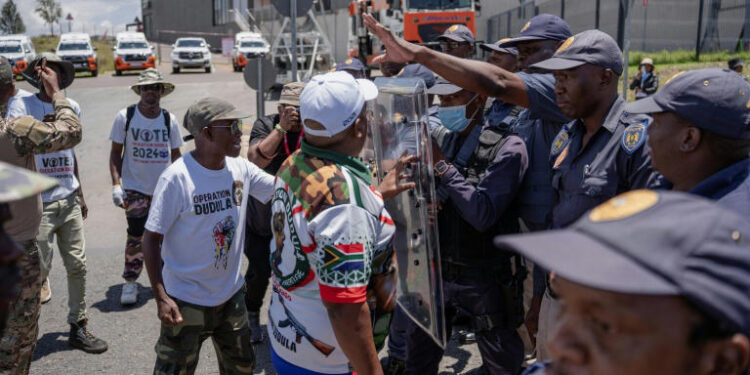
South Africa’s High Court has condemned the authorities for failing to stop anti-immigrant protests that blocked undocumented foreigners from entering public clinics.
The court ruled that national and local officials must take stronger action against the vigilante group Operation Dudula, which has staged protests outside healthcare facilities in Gauteng and KwaZulu-Natal. For months, activists have confronted patients, demanded identity documents and attempted to block non-South Africans from receiving treatment.


The ruling instructs officials to ‘take all reasonable measures to ensure safe and unhindered physical access… for all persons seeking health services’. It names municipalities, the police and health departments as those responsible for preventing future intimidation at public health facilities.
Judge Stuart Wilson criticised the state’s inaction, saying it was ‘a great pity that litigation was required to address what has happened at the clinics’. He described the weak response to an organised attempt to restrict access to essential services as ‘of grave concern’.
Rights groups took state to court
The case was brought by Doctors Without Borders (MSF), the Treatment Action Campaign and other civil society groups, who argued that authorities had not acted despite repeated incidents recorded at dozens of clinics. MSF said thousands of patients, including heavily pregnant women, children and people living with chronic illnesses such as diabetes and HIV, had been affected.
The organisation reported cases where hospital guards and staff appeared to collaborate with protesters to divert patients. A previous High Court order in November instructed Operation Dudula to stop blocking clinics, yet sporadic pickets have continued.
Vigilante group targets migrants
Operation Dudula, meaning ‘push back’ in Zulu, formed in 2020 and has grown rapidly by tapping into frustration over South Africa’s economic situation, unemployment and violent crime. The movement presents itself as a civic initiative but has carried out military-style actions that include closing foreign-owned shops and trying to stop migrant children from enrolling in public schools.
Judge Wilson warned that xenophobia was now ‘one of the greatest threats to democracy and human rights we presently face’, calling it ‘merely another kind of racism’. Activists welcomed the court’s stance, saying it sends a clear message that access to healthcare cannot be restricted by vigilante groups.
Tensions rise amid economic pressure
South Africa, the continent’s most industrialised economy, attracts people from across the region looking for work and safety, even as its own unemployment rate stands at around thirty-two percent. According to official figures from 2022, about 2.4 million immigrants live in the country, representing nearly four percent of the population.
The influx, combined with a dim economic outlook, has driven periodic waves of anti-immigrant violence in recent years. Human rights organisations warn that unless authorities enforce the court’s order, protests targeting public services could escalate.
The ruling requires officials to demonstrate the measures they will take to ensure every patient can enter healthcare facilities safely, a move campaigners say will test the government’s commitment to protecting vulnerable communities.