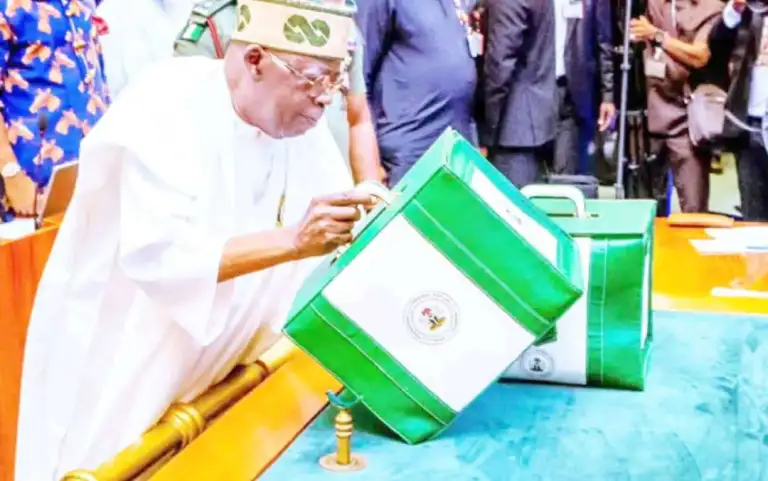
President Bola Tinubu is expected to present the N54.43 trillion 2026 budget to the joint sitting of the National Assembly on Thursday, the last day of their sitting for the year, ahead of the lawmakers’ vacation for Christmas.
In early December, the Federal Executive Council (FEC) put budget worries to rest by approving the 2026–2028 Medium-Term Expenditure Framework (MTEF). The plan outlines a N54.43 trillion fiscal target, with projected total revenue of N50.74 trillion and an economic growth forecast of 4.68 per cent for 2026. The presidency also submitted the MTEF, complete with its spending details, to the National Assembly last week.


The delayed presentation of the budget has pushed its approval by lawmakers and eventual assent by President Tinubu into the new year, echoing the difficult days under former President Goodluck Jonathan, when budgets were often signed by the end of the first quarter.
The process was streamlined by the late former President Muhammadu Buhari, who restored the January-to-December budget cycle.
Unless there are last-minute changes, the 2026 budget sets an ambitious crude oil production target of 2.06 million barrels per day, with a worst-case projection of 1.8 million barrels per day, and a benchmark price of $64.85 per barrel.
Under the approved 2026-2028 MTEF, the spending plan stands at N54.43 trillion ($37.71 billion), with projected federal revenue of N34.33 trillion. This leaves a deficit of N20.10 trillion, about 36.9 per cent of the proposed budget, meaning the government will borrow over a third of its total expenditure for the year. Debt servicing is estimated at N15.9 trillion, while nonrecurrent debt spending is set at N15.27 trillion, underscoring the financial strain on Africa’s most populous nation. The naira is expected to trade at ₦1,512 to $1 against the US dollar during the year.
Total capital spending is set to fall from N26.19 trillion this year to N22.37 trillion in 2026. Funding for MDAs will drop from N12.39 trillion to N8.67 trillion, and project-linked loans will decrease from N3.36 trillion to N2.05 trillion. Meanwhile, the fiscal deficit is expected to grow sharply to N20.12 trillion, up from N14.10 trillion in 2025.
Of the ₦50.74 trillion projected Federation revenue, ₦22.60 trillion will accrue to the Federal Government, ₦16.30 trillion to the states and ₦11.85 trillion to local governments
The Federal Government’s share from all sources totals ₦34.33 trillion, including ₦4.98 trillion from government-owned enterprises — about 16 per cent lower than the 2025 revenue estimate.
The spending mix includes the ₦3 trillion statutory transfers, ₦15.27 trillion non-debt recurrent expenditure, and ₦15.91 trillion debt service, indicating that debt service will consume 29.2 per cent of the entire 2026 budget, meaning nearly three out of every ten naira will be used to repay loans.
The debt service burden started to balloon from ₦3.98 trillion in 2022, reflecting a staggering 299 per cent increase in four years.
Recurrent expenditure has also expanded significantly, rising from ₦7.11 trillion in 2022 to ₦15.27 trillion proposed for 2026, increasing by 115 per cent, while capital spending has grown far more slowly.
The proposed ₦20.10 trillion deficit is more than double the 2025 deficit of ₦9.22 trillion, highlighting worsening fiscal pressures that have created worries in analysts who warned that persistent overspending, rising debt and late budget cycles could destabilise Nigeria’s macroeconomic recovery, fuel inflation and weaken the naira.
The 2026 budget, as outlined in the Abridged Budget Call Circular from the Federal Ministry of Budget and Economic Planning and shared with ministers, service chiefs, and agency heads, is expected to roll over 70 percent of the 2025 capital allocations for ministries, departments, and agencies (MDAs). This approach aims to focus on ongoing projects, ease new spending demands, and handle limited revenues.
The document bars MDAs from adding new capital projects in the 2026 budget cycle and requires them to stick with the previously approved 2025 allocations.
The circular notes that MDAs are required to upload 70 percent of their 2025 capital votes to carry forward into 2026, stressing that this must align with national priorities like security, economic stability, education, health, agriculture, power, infrastructure, and social protection.
It noted that just 30 per cent of the 2025 capital budget will be released this year, with the remaining 70 per cent serving as the base for the 2026 capital program — replacing past rollover practices with a more structured continuation plan.
According to government officials familiar with the circular, the plan aims to cut down on duplication, improve oversight to ensure value for money, and focus resources on existing commitments, especially given rising inflation and tighter fiscal conditions. [Inside Business]