By Prosper Okoye


Nigeria’s revised Migration Policy is currently before the Federal Executive Council (FEC) for adoption, following months of consultations involving government agencies, civil society groups and international partners. Supporters say it reflects an attempt to rethink how migration is managed in a country where movement — both within and across borders — has become more complex.
The existing policy was introduced in 2015 under former President Goodluck Jonathan. A decade on, critics argue it no longer reflects today’s realities.
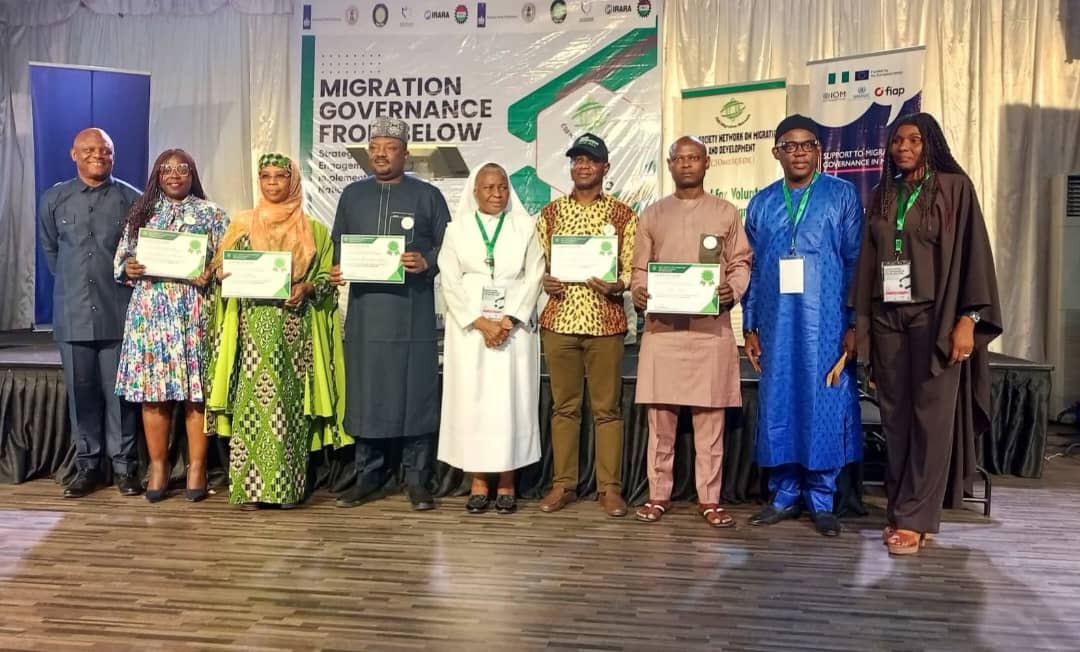
“The policy is long overdue for review, given the migration issues and trends that have emerged over the years,” says Osita Osemene, Executive Director of Patriotic Citizen Initiatives (PCI), speaking at the 2025 Civil Society Forum on Migration in Abuja.
One of the most persistent criticisms of the 2015 framework was its limited attention to local communities. Migration decisions, Mr Osemene argues, begins in the communities.
“Migration starts at the grassroots,” he says. “If governance is not structured from the bottom up, you won’t get ownership, sustainability or real impact.”
A key change in the revised policy is the introduction of a fourth layer in the migration governance structure — state-level coordination. Previously, the framework consisted of a national consultative committee, a technical working group and thematic groups, with little formal role for states.
This shift reflects changing migration patterns. Nigeria, long viewed mainly as a country of emigration, is increasingly also a destination.
“At our shelter, which was originally set up for Nigerians returning from abroad, we now host non-Nigerians,” Mr Osemene explains. “We have families from Sierra Leone, Côte d’Ivoire and Congo Brazzaville. That tells you the dynamics are changing.”
Without stronger involvement from communities and state governments, he warns that migrants, particularly those who are stranded or undocumented, could be left without support.
Abdulganiyu Abubakar, President of the Network Against Child Trafficking, Abuse and Labour (NACTAL), believes the revised policy could push state governments to take migration management more seriously.
“Nigeria’s insecurity today is partly fuelled by poorly managed migration,” he says. “Many states neglect their borders and shift responsibility entirely to the federal government.”
He argues that the new framework should build on existing community structures, while mirroring key federal institutions at state level. One of the policy’s priorities is strengthening integrated border management, linking national security concerns with safer migration pathways.
Despite the optimism, concerns about implementation remain. Funding gaps, weak data coordination, rivalry among agencies and uneven adoption across states are all cited as potential obstacles.
“In the first policy, some regions focused almost entirely on trafficking,” says Charles Nwanelo, a Fellow of CSOnetMade. “There needs to be broader grassroots sensitisation, and the problems that undermined the earlier framework must be addressed if this one is to succeed.”
Government officials say lessons have been learnt. Ambassador Catherine Udida, Director of Migration Affairs at the National Commission for Refugees, Migrants and Internally Displaced Persons (NCFRMI), says coordination has improved.
According to her, more than 12,000 Nigerian migrants have been safely returned so far in 2025, with reintegration support and skills training provided. She adds that reported cases of abuse linked to irregular migration have declined.
“Nigeria is chairing the Rabat Process this year, and that has helped project the country positively,” she says.
Ambassador Udida describes the revised policy as clearer and more accessible, with better-defined roles. She says consultations with state governors and zonal stakeholders are ongoing, ahead of a final decision by the Federal Executive Council, expected on Thursday the 18th.
Civil society groups say they have been closely involved in shaping the framework. Rukayya Abdulrahman, chair of the 2025 Civil Society Forum on Migration, says the platform — now in its fifth year — has helped deepen public understanding of migration governance.
“We must strengthen engagement among civil society, government institutions, academia, the private sector and communities,” she says. “Most importantly, we must co-create practical and sustainable approaches for the future.”
The revised policy also places greater emphasis on evidence-based planning, while addressing cross-cutting issues such as gender and disability. Coordination will be led by NCFRMI, supported by technical working groups responsible for implementation and periodic review.
The International Organization for Migration (IOM) has pledged continued support. Its representative, Ukamaka Anayaechi, says the framework aligns with Nigeria’s regional and international migration commitments.
Whether the revised policy delivers on its promises, observers say, will depend less on its wording — and more on how well it is carried out beyond Abuja.