

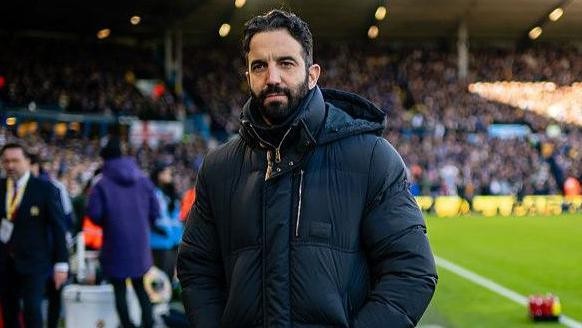
Manchester United’s decision to part ways with Ruben Amorim was the culmination of mounting internal concerns over leadership, communication and tactical rigidity rather than a single poor result or disagreement in the transfer market.
themomentng reports that Manchester United confirmed Ruben Amorim’s exit less than 24 hours after Sunday’s 1-1 Premier League draw with Leeds, drawing the curtain on 14 months.


According to Sky Sports News, the club’s hierarchy had grown increasingly uneasy with the head coach’s emotional behaviour and what they saw as an unwillingness to adapt.
When Amorim was appointed, United wanted stability and a clear structure. Early signs were encouraging, but confidence began to drain as the season progressed.
Senior figures felt the Portuguese coach became too fixed on his ideas, resisting tactical evolution even as circumstances and personnel changed.
A key moment came during a scheduled meeting last Friday with director of football Jason Wilcox. The discussion focused heavily on tactics and the direction of the team.
United sources say Amorim’s response was viewed as overly emotional and negative, deepening doubts about his suitability to lead the next phase of the project.
Importantly, the split was not about his preference for a 3-4-3 system. Club insiders stress it was his refusal to adjust that system to different situations which proved decisive. United felt flexibility was essential, particularly for a squad they still believe is capable of pushing for a European place.
Transfer policy was another area of visible strain, though the club insist it was not the trigger for the dismissal.
United have spent around £250 million on new players since Amorim arrived and made it clear from the outset that central midfield reinforcements were planned for the summer.
The January pursuit of Bournemouth attacker Antoine Semenyo was described internally as opportunistic rather than urgent and never intended to compromise longer-term plans.
What troubled United’s leadership more was Amorim’s public tone. Repeatedly downbeat media comments suggested a head coach who no longer shared the club’s belief in the squad.
After the Leeds draw, Amorim openly hinted at tensions with officials, saying he wanted to work as a manager “not the coach” and indicating he was prepared to leave when his contract expires in 18 months.
Those remarks followed earlier cryptic exchanges over the transfer budget. “I have the feeling that if we have to play a perfect 3-4-3, we need to spend a lot of money, and we need time,” Amorim said on Christmas Eve. “I’m starting to understand that is not going to happen. So, maybe I have to adapt.”
Yet his actions suggested uncertainty rather than clarity. United briefly switched to a back four in the win over Newcastle, then reverted to five at the back in a draw with Wolves.
There were also disagreements over targets, including the late signing of Belgian goalkeeper Senne Lammens instead of Amorim’s preferred option, Aston Villa’s Emiliano Martinez.
Amorim leaves Old Trafford having managed 63 matches, winning 25, drawing 15 and losing 23, a win rate of 39.6 per cent, the lowest of any permanent United coach since Sir Alex Ferguson.
He did, however, guide the club to last season’s UEFA Europa League final and was named Premier League Coach of the Month in October 2025.
Former midfielder Darren Fletcher will take charge on an interim basis, starting with Wednesday’s league fixture against Burnley.
![BREAKING: Tinubu appoints new NUPRC, NMDPRA Board chairmen, 19 others [Full List]](https://themomentng.com/wp-content/uploads/2026/01/20250626_165418.jpg-75x75.webp)



