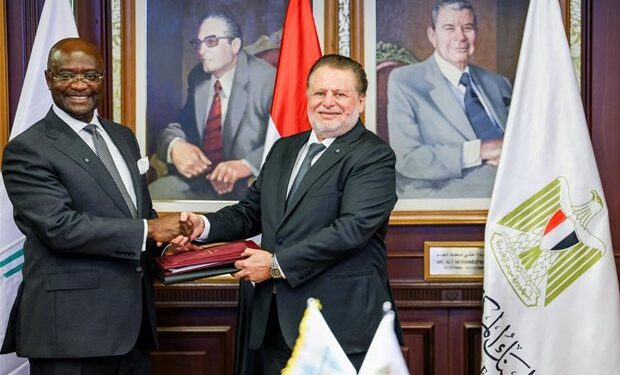
Africa has taken a decisive step towards reclaiming control of its gold wealth, as the Central Bank of Egypt and Afreximbank formally launched plans to establish the continent’s first pan-African Gold Bank.
The initiative was formalised through a Memorandum of Understanding by CBE Governor Hassan Abdalla and Afreximbank President and Board Chairman George Elombi, according to information supplied by the institutions.


The proposed Gold Bank is designed to strengthen Africa’s gold value chains, support central banks in building strategic reserves, and reduce the continent’s heavy reliance on foreign refining, trading and storage hubs that have long captured much of the value generated from African gold.
Egypt positioned as continental hub
The programme aligns with Egypt’s strategy to deepen economic partnerships across Africa, as well as Afreximbank’s mandate to accelerate value addition and strategic mineral processing on the continent.
Under the MoU, the two institutions will jointly commission a detailed feasibility study to assess the technical, commercial and regulatory requirements for developing an integrated Gold Bank ecosystem within a designated free zone in Egypt, with participation from other African countries.
The proposed ecosystem would include an internationally accredited gold refinery, secure vaulting facilities, and a range of financial, trading and settlement services linked to gold.
If approved, Egypt’s selection as host would leverage its strategic position at the crossroads of Africa, the Middle East and Europe, strengthening its role as a regional hub for precious metals trade and financial innovation.
Driving African integration
Commenting on the agreement, Abdalla said the initiative could serve as a foundation for a broader pan-African framework that progressively engages African governments, central banks and market participants.
He reaffirmed Egypt’s commitment to advancing African economic integration, noting that the project reflects confidence among African institutions in the country’s capacity to support large-scale continental initiatives, subject to the outcome of the feasibility study and subsequent approvals.
Beyond Egypt, the initiative is expected to expand across the continent, encouraging closer collaboration among governments, mining companies and regulators, while promoting harmonised standards and more sustainable gold trade practices.
‘Africa’s gold must serve Africans’
Speaking at the signing ceremony, Elombi described the Gold Bank as a strategic turning point for Africa’s management of its mineral wealth.
‘Today’s ceremony may appear simple, yet it has tremendous economic consequences for our continent,’ he said. ‘We make a bold declaration that Africa’s gold must serve African people.’
He added that the initiative would fundamentally change how gold is extracted, refined, valued, stored and traded, with the primary aim of retaining value within Africa rather than exporting it through external hubs.
By building up gold stocks, Elombi argued, African economies could enhance resilience to external shocks, improve currency stability and convertibility, and create long-term wealth on the continent.
Strategic minerals, strategic finance
The Gold Bank initiative reflects a wider push across Africa to link mineral resources more directly to financial stability, industrial growth and development financing.
For Afreximbank, the project complements its broader efforts to support domestic manufacturing, deepen regional trade integration and reposition Africa within global commodity markets.
While timelines will depend on the feasibility study, the launch signals a clear intent to anchor Africa’s gold economy at home — a move that could reshape both mineral governance and financial architecture in the years ahead.