

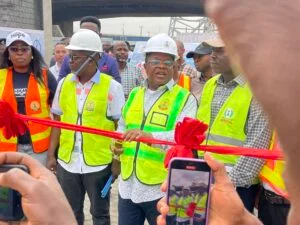
The Minister of Works, Sen. Dave Umahi, on Monday inspected Section-3 of the Sokoto–Badagry Superhighway, reaffirming the Federal Government’s commitment to national connectivity.
Umahi described the road as a strategic corridor to boost trade, transport and economic integration between northern and southern Nigeria.


“This highway will unlock economic opportunities and strengthen movement of people and goods across states,” the minister said.
He noted that Section-3 spans about 162.35 kilometres, starting from Agbara in Ogun State and terminating at the Ogun–Oyo border.
Umahi said the project formed part of the larger Sokoto–Badagry Superhighway linking Sokoto, Kebbi, Niger, Kwara, Oyo and Lagos.
“We are determined to deliver this project to world-class standards,” he assured Nigerians.
The minister added that the Federal Government would continue supporting contractors to ensure timely and quality delivery.
Engineer Representative, Mr Aliu Oyewande, said key challenges included security concerns along greenfield alignments and compensation for affected communities.
“Engagements with stakeholders and affected persons are ongoing to resolve right-of-way and compensation issues,” Oyewande said.
He disclosed that the project duration was 36 months, with construction beginning in November 2025.
“Within two months, about 18 kilometres of earthworks and 47 kilometres of site clearance have been achieved,” he said.
Director of Highways, Mr Musa Saidu, said the road was being built with rigid pavement technology similar to the Lagos–Calabar Coastal Highway.
“The 200mm reinforced concrete pavement is designed to last up to 100 years,” Saidu said.
Hitech Managing Director, Mr Danny Aboud, said the Section-3 contract was awarded in November 2025, with construction starting immediately.
“We are working across multiple sections nationwide and are committed to completing this project ahead of schedule,” Aboud said.
Senior Special Assistant to the President on Community Engagement, Southwest, Mrs Moremi Ojodu, stressed that effective community engagement was vital for sustainable infrastructure delivery.




