America’s biggest technology companies are no longer just building platforms for African users — they are racing to become the continent’s internet providers.
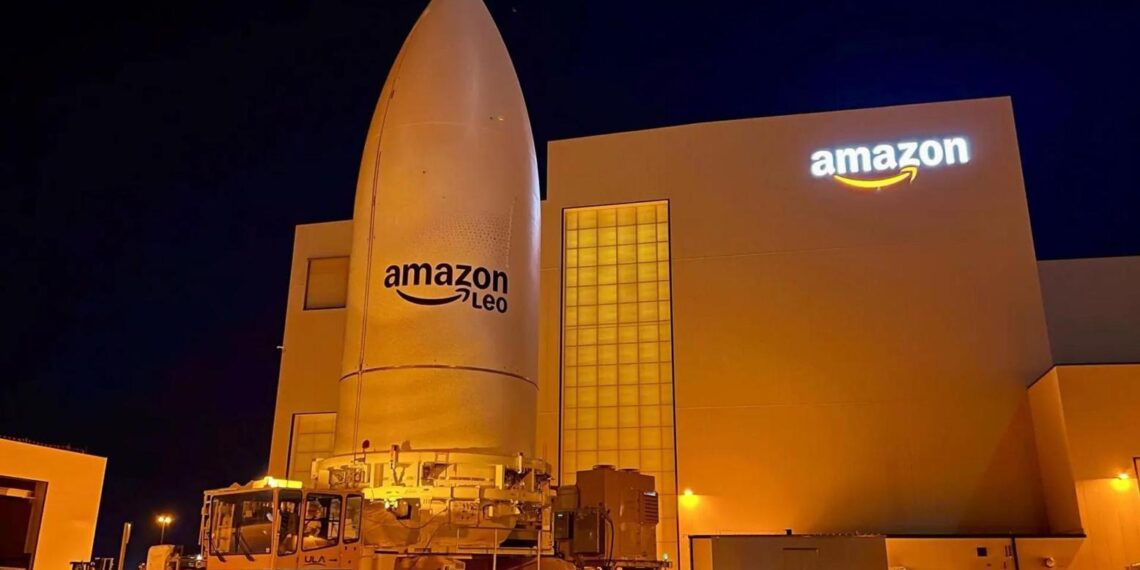
Earlier this month, Amazon received regulatory approval to operate its low-Earth orbit satellite broadband service, Amazon Leo — formerly known as Project Kuiper — in Nigeria. The licence allows the company to begin rolling out satellite connectivity in Africa’s largest economy, placing it in direct competition with Elon Musk’s Starlink.


The move also deepens rivalry with Meta and Google, whose infrastructure ambitions stretch beneath the ocean through vast subsea cable systems now encircling the continent.
The decision signals a fundamental shift in how global technology firms approach Africa. Rather than competing mainly through consumer apps and platforms, big tech is now focused on controlling the physical infrastructure that delivers the internet itself — satellites, cables and spectrum.
Starlink already operates at scale in Nigeria, where thousands of households and businesses rely on satellite internet due to unreliable fibre networks and patchy mobile coverage. Across Africa, the service is active in more than a dozen markets, often serving rural and remote communities long overlooked by traditional telecom operators.
According to Temidayo Oniosun, founder and managing director of consulting firm Space in Africa, the continent’s connectivity gap is precisely what makes it so attractive.
‘Africa remains the least-connected region in the world, yet this is exactly why global connectivity providers see it as a strategic growth market,’ Oniosun said.
Only about 38 percent of Africans were online in 2024, according to the International Telecommunication Union. That leaves more than 400 million people without internet access. Even where networks exist, usage is limited by high costs, unstable service and congested infrastructure.
Mobile broadband penetration across sub-Saharan Africa remains below 50 percent, while fixed broadband access is largely restricted to major cities.
Nigeria’s demographic scale magnifies its importance.
‘As the most populous country on the continent, Nigeria carries enormous symbolic and commercial weight,’ Oniosun said.
In Europe and North America, internet connectivity is largely universal, leaving little room for expansion. Africa, by contrast, still offers hundreds of millions of potential first-time users.
That reality has reshaped investment priorities.
‘Infrastructure — not consumer apps — has become the strategic battleground,’ Oniosun said.
Satellite networks allow companies to bypass weak terrestrial systems entirely, offering immediate continental reach without relying on national fibre rollouts.
Competition is also unfolding underwater.
Meta’s 2Africa cable, the world’s longest subsea system at roughly 45,000 kilometres, is circling the continent with landing points across West, East and Southern Africa. Once fully operational, it is expected to significantly increase bandwidth and lower wholesale data prices in markets such as Nigeria, Ghana and Senegal.
Google’s Equiano cable has strengthened high-capacity links between Africa and Europe, particularly along the Atlantic coast, improving network resilience and reducing latency.
Microsoft has adopted a partnership model, working with governments and telecom operators to connect more than 117 million Africans through its Airband programme, powered by satellite company Viasat.
The arrival of multiple satellite providers is likely to intensify competition — particularly on pricing.
‘The entry of Starlink triggered noticeable shifts in user behaviour,’ Oniosun said. ‘With Amazon’s Leo constellation entering the market, competition is expected to deepen further.’
For consumers, the impact could be positive in the short to medium term, with falling prices and wider coverage as companies compete for subscribers.
Yet the rapid expansion of foreign-owned infrastructure raises complex questions.
Most of the connectivity systems now shaping Africa’s digital future are controlled by companies headquartered outside the continent. In many cases, internet traffic is routed through overseas infrastructure, heightening concerns over data sovereignty, national security and regulatory oversight.
As Africa moves closer to universal connectivity, the central question may no longer be whether the continent gets online — but who ultimately owns and governs the networks powering its digital economy.