

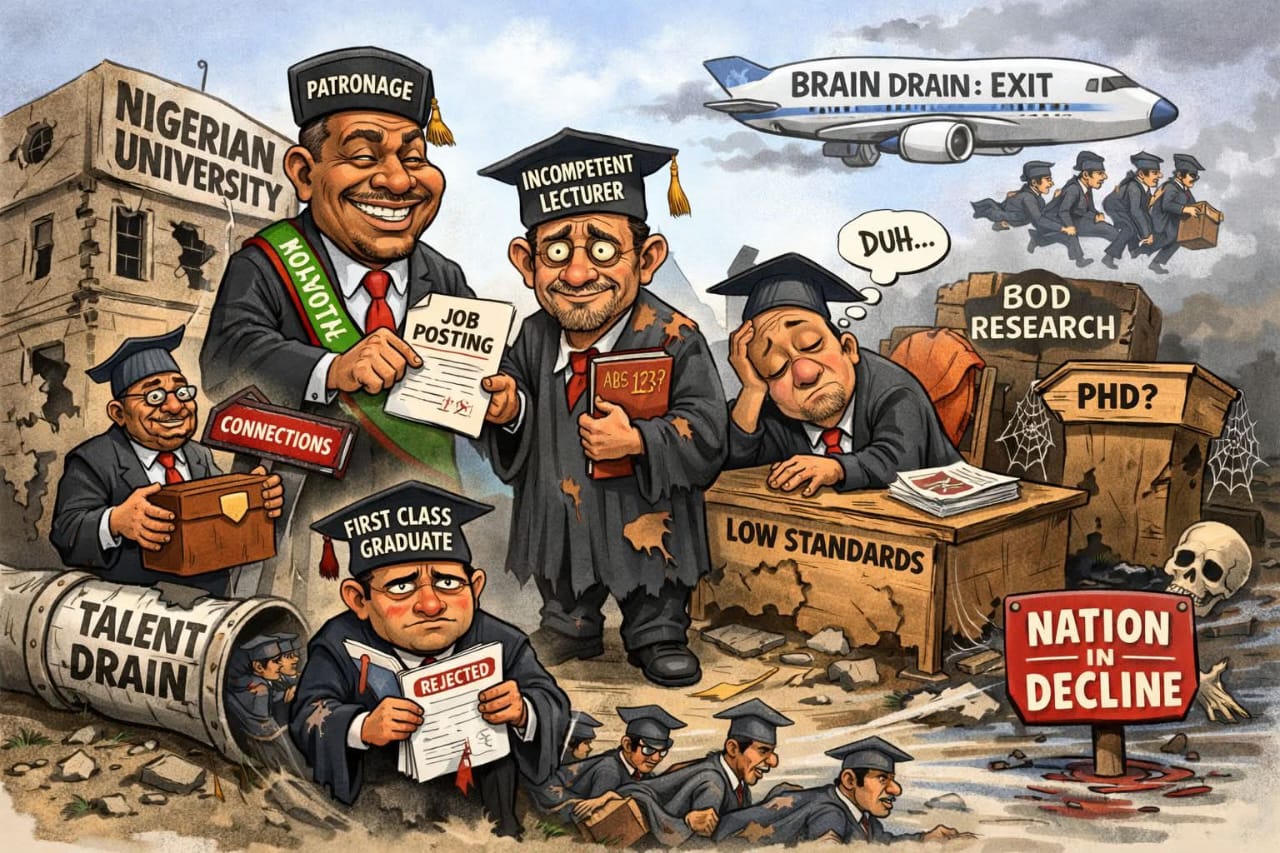
A deliberate blueprint for the collapse of academic excellence in Nigeria
If anyone ever set out to deliberately destroy university education in Nigeria, the fastest and most effective way would be this: disconnect academic recruitment from merit, sever departments from decision-making, and replace scholarly excellence with patronage, bureaucracy, and political loyalty. Sadly, that is no longer a hypothetical scenario. It is unfolding before our eyes.
What is happening today in the recruitment of academic staff in many Nigerian universities is not merely an administrative anomaly. It is not a “teething problem.” It is not reform gone wrong. It is an existential threat to the very idea of a university. If left unchecked, it will hollow out Nigeria’s higher education system from the inside, producing graduates without depth, lecturers without scholarship, and institutions without credibility.


This article is a warning, a lament, and a call to conscience.
1. What a University Is Supposed to Be
A university is not a ministry.
It is not a parastatal.
It is not a dumping ground for the unemployed.
It is not a reward system for political loyalty.
A university is a community of scholars.
Historically and globally, universities exist for three core purposes:
The creation of knowledge (research)
The transmission of knowledge (teaching)
The preservation of intellectual standards (academic culture)
These purposes demand excellence, rigour, and intellectual integrity. That is why, across the world, universities are fiercely protective of who becomes an academic.
You do not recruit lecturers the way you recruit clerks.
2. How It Used to Be: Merit as the Gatekeeper
For decades, imperfectly but recognisably, Nigeria understood this truth.
Academic staff were drawn from:
The top 5–10% of graduating students
Individuals with exceptional CGPAs
Students who had demonstrated intellectual curiosity, research ability, and discipline
Departments played a central role:
They identified promising students
They mentored them
They recommended them for postgraduate training
They groomed them into academics
Even when corruption crept in, academic competence still mattered. A weak student could not simply stroll into academia without being exposed by postgraduate rigour, seminars, peer review, and departmental scrutiny.
The system had flaws, but it had standards.
3. What Is Happening Now: Academia as Civil Service Posting
Today, in many Nigerian universities, a quiet but devastating shift has taken place.
Academic staff are now being:
Recruited centrally
Posted to universities like civil servants
Assigned to departments without departmental input
Handed appointment letters without academic vetting
This is not reform.
This is vandalism.
In some cases:
Departments only discover a new “lecturer” after the appointment letter has been issued
Heads of Department are informed, not consulted
Professors are expected to “manage” staff they never recommended and would never have selected
This process violates every known principle of university governance.
A university without departmental control over recruitment is no longer a university.
It is a bureaucracy with classrooms.
4. The CGPA Scandal: When the Unqualified Become Lecturers
Perhaps the most alarming dimension of this new order is this:
Individuals whose CGPAs would not qualify them for postgraduate admission elsewhere are being appointed as academic staff.
Let that sink in.
People who:
Could not gain admission for a master’s degree in a reputable university
Could not survive competitive postgraduate screening
Could not defend a rigorous research proposal
…are now expected to teach, supervise, and examine others.
Meanwhile:
First-class graduates
Brilliant scholars
Research-oriented minds
…are excluded—not because they lack ability, but because they lack external support, connections, or political backing.
This is not injustice alone.
It is academic suicide.
5. When Patronage Replaces Scholarship
Universities thrive on intellectual hierarchy:
Juniors learn from seniors
Excellence commands respect
Knowledge earns authority
Patronage destroys this hierarchy.
When recruitment is based on:
Political influence
Ethnic balancing
Godfatherism
Quotas without competence
…the message is clear:
Scholarship no longer matters. Loyalty does.
Once that message settles in, the consequences are irreversible:
Students stop striving for excellence
Lecturers stop improving themselves
Research becomes ritualistic
Teaching becomes mechanical
The university becomes a certificate factory.
6. Departments Reduced to Spectators
In serious universities worldwide:
Departments are the custodians of standards
No one teaches a subject without departmental endorsement
Recruitment is peer-driven, not bureaucrat-driven
In Nigeria today, many departments have been reduced to:
Spectators
Damage controllers
Firefighters
They are told:
“This is who has been posted to you. Manage.”
But you cannot manage incompetence into excellence.
You cannot mentor someone who lacks the intellectual foundation for scholarship. You cannot force curiosity into a mind that never cultivated it. You cannot manufacture academic passion through memos.
7. The Collapse of Postgraduate Training
The effects are already visible at postgraduate level.
Poorly recruited academics:
Struggle to teach advanced courses
Supervise theses they barely understand
Recycle outdated lecture notes
Avoid research because they fear exposure
As a result:
Master’s theses become glorified undergraduate projects
PhD dissertations lack originality
External examiners lower standards out of pity or fatigue
Nigeria’s postgraduate degrees are quietly losing international credibility.
This is how academic reputations die—not with scandal, but with silence.
8. The Tragedy of the First-Class Graduate
Perhaps the cruelest casualty of this system is the first-class graduate without connections.
These are individuals who:
Did everything right
Studied hard
Excelled academically
Dreamed of scholarship
Yet they are told—implicitly or explicitly:
“You are brilliant, but you are not connected.”
What lesson does this teach? That excellence is irrelevant. That hard work is optional. That mediocrity is safer than brilliance.
A society that teaches this lesson is already in decline.
9. Teaching Without Mastery: A Dangerous Experiment
Teaching is not the recitation of slides. It is interpretation, contextualisation, critique, and inspiration.
When lecturers lack mastery:
They discourage questions
They punish curiosity
They fear intelligent students
They reduce learning to memorisation
This produces graduates who:
Cannot think independently
Cannot analyse problems
Cannot compete globally
Nigeria then complains about “unemployable graduates,” forgetting that lecturers produce graduates.
10. Research Without Researchers
Universities are judged globally by:
Research output
Citations
Innovation
Knowledge contribution
But research requires:
Intellectual depth
Methodological training
Discipline
Curiosity
When recruitment ignores these attributes:
Research becomes a box-ticking exercise
Journals become dumping grounds
Conferences become social gatherings
Nigeria cannot build a knowledge economy on weak scholarship.
11. International Isolation and Academic Irrelevance
Already:
Nigerian degrees face suspicion abroad
Foreign universities demand extra verification
International collaborations bypass local scholars
As recruitment standards fall:
Nigerian universities drop in rankings
Grants become harder to secure
Talented scholars emigrate
The brain drain accelerates, leaving behind mediocrity to train mediocrity.
12. Universities Are Not Job Creation Schemes
One of the most dangerous misconceptions driving this crisis is the idea that:
“Universities should absorb unemployed graduates.”
No.
Universities exist to produce knowledge, not to solve unemployment through patronage.
When job creation becomes the priority:
Standards are sacrificed
Excellence is negotiable
Scholarship is optional
If government wants job creation, let it build industries. Let it fund innovation hubs. Let it expand technical education.
But do not cannibalise universities.
13. The Long-Term National Cost
This destruction will not announce itself immediately. Its costs will appear gradually:
Weak professionals
Poor doctors
Incompetent engineers
Shallow economists
Uninspiring teachers
Eventually:
Policy fails
Institutions weaken
Governance collapses further
A nation cannot rise above the quality of its universities.
14. Who Benefits from This System?
Certainly not:
Students
Scholars
The nation
The beneficiaries are:
Political brokers
Administrative opportunists
Patronage networks
Mediocre minds seeking protection
This is not accidental. It is systemic.
15. What Must Be Done
If Nigeria is serious about saving its universities, the following are non-negotiable:
a. Restore Departmental Authority
No academic staff should be recruited without departmental recommendation.
b. Enforce Minimum Academic Standards
Clear CGPA thresholds must be mandatory and transparent.
c. Separate Academia from Civil Service
Lecturers are scholars, not bureaucrats.
d. Transparent, Competitive Recruitment
Vacancies must be advertised, screened, and defended academically.
e. Protect the Best Graduates
Create structured academic pipelines for top students.
16. A Final Warning
History is unforgiving to nations that destroy their universities.
Once academic standards collapse:
Recovery takes generations
Reputation is hard to rebuild
Damage becomes irreversible
Nigeria is standing at that edge.
This recruitment model is not reform. It is not inclusion. It is not equity.
It is how to destroy university education: quietly, efficiently, and catastrophically.
If we love this country,
If we value knowledge,
If we care about the future,
This madness must stop.
Because when universities fall,
the nation follows.




