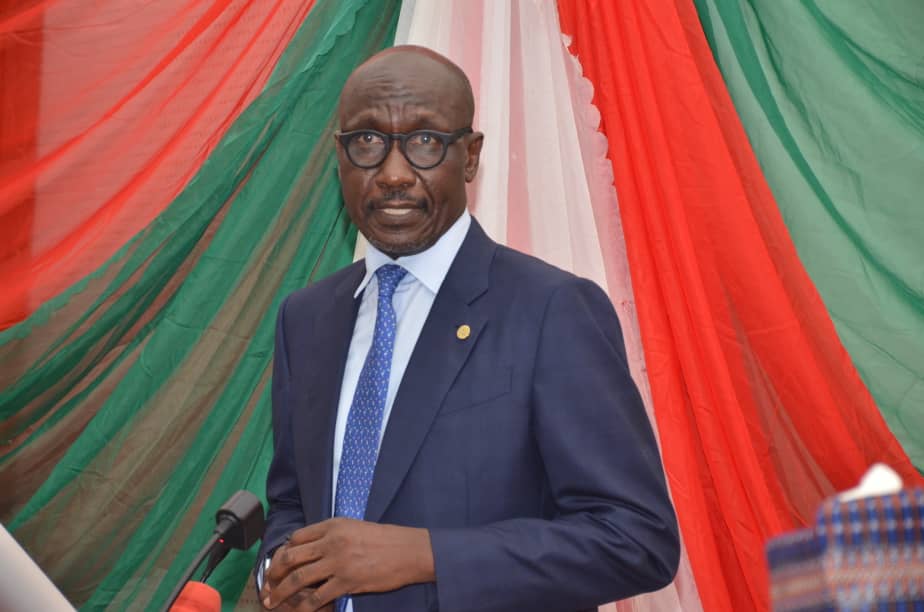
The senate committee on public accounts has summoned the immediate past management of the Nigerian National Petroleum Company (NNPC) Limited, including Mele Kyari, its former group chief executive officer, over alleged financial discrepancies totalling N210 trillion in the company’s audited financial statements from 2017 to 2023.
Aliyu Wadada, chairman of the committee and senator representing Nasarawa west, spoke to journalists about the invitation during a press briefing at the national assembly complex on Thursday.
Wadada said the committee launched the legislative inquiry in the exercise of its constitutional mandate to ensure accountability, transparency, and value for money in the management of public funds.


He said the investigation is backed by sections 85, 88, and 89 of the 1999 constitution and the senate standing orders.
“The senate public accounts committee, in the exercise of its constitutional mandate to ensure accountability, transparency, and value for money in the management of public accounts of the federation, embarked on a status inquiry into the income and expenditure of the Nigerian National Petroleum Company Limited,” he said.
BACKGROUND TO THE PROBE
Wadada said the inquiry commenced in May 2025 after the committee observed financial management lapses while reviewing the reports of the auditor-general for the federation for the years ending 2019 and 2020.
“The legislative inquiry exercise originated from the committee’s observed financial management lapses during the consideration of the auditor-general for the federation’s annual reports,” he said.
He said the committee subsequently requested relevant information from NNPC and reviewed the company’s audited financial statements covering 2017 to 2023.
The lawmaker said the panel also examined the financial records of the former National Petroleum Investment Management Services (NAPIMS), now known as NNPCL Upstream Investment Limited.
He said the committee raised 19 queries seeking clarification on inconsistencies in the financial statements.
“Although responses were provided, they were not satisfactory to the committee,” he said.
Wadada said the committee observed an accrued expenses figure of N103 trillion recorded in the company’s 2022 audited financial statements.
“These accrued expenses, according to the books, consisted of retention fees, legal fees, and audit fees,” he said.
“However, no specific figures were assigned to these items in the audited financial statements.
“I repeat that the retention fees, legal fees, and audit fees that were said to make up N103 trillion had no individual figures attached to them.”
Wadada said the oil firm later explained that the N103 trillion represented cumulative expenditure by joint venture partners under the joint venture cash call arrangement.
“This position contradicts the disclosures in the audited financial accounts,” he said.
“It is worthy of note that the cash call regime was abolished in 2016 and took effect from January 2017. For that reason, the committee finds this explanation unacceptable.”
The politician said the committee also discovered that the NNPC recorded N107 trillion as sundry receivables as of December 2023.
“As of December 2023, NNPCL recorded N107 trillion as sundry receivables, which it claimed were owed by some defunct banks and other entities,” he said.
“However, the company was unable to provide a clear breakdown identifying the banks or other entities responsible for these amounts. This is also unacceptable to the committee.”
Wadada said the committee also observed an alleged duplication of subsidy deductions amounting to N3.8 trillion.
‘NNPC SPENT N5.9 BILLION TO TRANSITION INTO A COMMERCIAL ENTITY’
“Subsidy costs were deducted from crude oil proceeds in the books of NAPIMS and also from petroleum product proceeds in the books of NNPC,” he said.
“This amounts to an apparent duplication of subsidy deductions against revenue due to the federation.”
Wadada said the committee also queried N5 trillion charged as direct production costs between 2017 and 2021.
“NNPCL and NAPIMS admitted charging N5 trillion as direct production costs between 2017 and 2021,” he said.
“However, NNPC and NAPIMS do not produce crude oil. Charging such costs against crude oil revenue is unacceptable.”
Wadada said the committee also raised concerns over N5.9 billion spent as incorporation expenses during the transition from the NNPC to NNPC Limited.
“NNPC paid N2.9 billion as incorporation expenses from petroleum product proceeds,” he said.
“NAPIMS also charged N2.9 billion against crude oil revenue for the same purpose.
“This resulted in a combined total of N5.9 billion being spent simply to change the name from NNPC to NNPCL. This is unacceptable.”
SENATE RESOLUTIONS
Wadada said the committee resolved that the NNPC must account for the combined N210 trillion arising from unexplained accrued expenses and sundry receivables.
“NNPCL should refund the sum of N210 trillion, being the combined figures of N103 trillion and N107 trillion, which were not properly explained to the committee,” he said.
“These figures cannot be netted off under standard accounting principles.”
The lawmaker said the committee directed the company to refund all production costs charged against crude oil revenue during the period under review.
He said the panel has invited the immediate past management of NNPC and NAPIMS to appear before the committee.
“The immediate past management, including Mele Kyari as group managing director, Umar Ajiya as chief financial officer, and Bala Wunti as group general manager of NAPIMS, must appear before the committee,” he said.
“They are expected to appear alongside the current management of NNPCL and the external auditors responsible for the audited financial statements.”
He said the committee also recommended that the auditor-general for the federation conduct a forensic audit of NNPC’s financial statements from 2017 to 2023.
“This should be done in line with section 85 of the constitution of the Federal Republic of Nigeria,” he said.
Wadada said the committee will continue to engage with relevant institutions to strengthen accountability in the management of public funds.