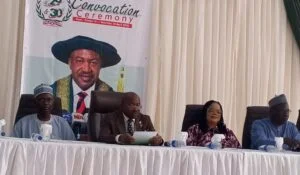
The University of Abuja says a total of 77 graduating students will be conferred with First Class degrees at its 29th and 30th Convocation, slated for April 17th and, April 18th 2026.
The Vice-Chancellor (VC) of the University, (now Yakubu Gowon University), prof. Hakeem Fawehinmi, said this during the pre-convocation press briefing on Monday in Abuja.
Fawehinmi said that a total of 12,624 undergraduate students would be graduating in the joint convocation involving the 2022/2023 and 2023/2024 academic sessions.

He further gave the breakdown to include 48 First Class, 2,048 Second Class Upper, 4,418 Second Class Lower and 644 Third class, totalling 7,158 students for the 29th convocation which involves the 2022/2023 set.
Also, for the 30th convocation which involves the 2023/2024 set, he gave the breakdown as 29 First class, 1,395 Second Class Upper, 3,091 Second Class Lower and 951 Third Class, totalling 5,466 students.
“We are indeed very proud of our graduands who we have trained not only in knowledge and skills but also in character.
“As part of our commitment to the development and advancement of our graduates, the overall best graduating students of both sets will be given automatic employment in the university to further their career.
“We remain committed to the developing the university in ways that will enable it to realise its aspiration of becoming a 21st century world-class institution,” he said.
He said that with the massive population expected, the convocation ceremonies would be held on April 17 for first degrees and April 18 for higher degrees and the conferment of honorary doctorate degrees.
Fawehinmi said that during the convocation the university would confer Honorary Doctorate Degrees (Honoris Causa) on some distinguished Nigerians.
He said they included Prof. Yusuff Ali, a Senior Advocate of Nigeria (SAN), Mr Paul Odili and Emmanuel Iza in recognition, of their contributions to their various fields of endeavours and humanity.
The VC said that the university, which was established in 1988, was envisioned as a comprehensive institution that combines conventional and distance learning models.
He said that it had nearly 40,000 students currently enrolled and a projected enrollment of 50,000 by 2030.
“With this increase, the institution needs massive expansion of infrastructure to become a modern university of first choice,” he said.
Fawehinmi said that the university has continued to make steady progress in its academic and research activities, leading to the university securing a research grants from TETFund and other national and international partners.
He said the fund included a major intervention of four billion Naira from TETFUND for the college of Health Science through the Provost of the College, Prof. Titus Ibekwe and his team.
“The university also hosts the Centre for Sickle Cell Disease (SCD) Research and Training, let by Prof. Obiageli Nnodu.
“Through this centre the university has sustained significant research and intervention programmes focused on SCD in Nigeria and Sub-Saharan Africa,” he said.
He said to improve accommodation and welfare for students, the university was embarking on a major project for the construction of 1,500 student bed space through a Public Private Partnership with Royal Dynasty Homes Ltd.
He said that the institution had formalised a partnership with PLAN International Nigeria through the signing of MoU aimed at advancing education, gender inclusion and Institutional development.
Fawehinmi said that the students of the university were invited by the British Council to participate in a Great Talk Initiative workshop on the use of Artificial Intelligence (AI) in weather prediction and climate change.
“The programme includes a student empowerment component with a 20,000 Pounds grant opportunity for selected trained participants.
“About 400 students and interested staff from chemistry, Mathematics, Statistics, Geography and Meteorology are expected to take part with resource persons from the University of Reading and Birmingham.
“All of these partnerships, among many others are part of our strategic steps towards strengthening research and Institutional development,” he said.
He called on investors to explore areas of collaboration with the university to upgrade facilities for innovation to meet national and global competitiveness.
Speaking on staff and student welfare, the VC said that several academic and non-teaching staff had been promoted, while recruitment and professional development initiatives continued.
“Only recently, the university recorded its highest ever promotion of academic staff with over 100 scholars elevated to professorial ranks. This development strengthens our academic and research base.
“The university is engaging with the Nigeria Social Insurance Trust Fund (NSITF) on the Employee Compensation Scheme, which provides support for workers in case of injury, disability or death.
“Students welfare has also been enhanced through improvements in accommodation, healthcare services and campus security,” he said.
He said that the university had ensured that students were well trained, adding that anyone who violates rules will be appropriately sanctioned.
“In February, the Senate of the university approved the expulsion of 28 students over offences ranging from examination malpractice to drug possession and other serious misconduct.
“Our campus is designed for those who are disciplined enough to advance the course of learning,” he said
Fawehinmi said that all the programmes in the university had full accreditation, adding that efforts are ongoing to prepare additional programmes for accreditation, while teaching and research continue without disruption.
He said that in spite of all the achievements, there were some other challenges that the university must continue to address.
According to him, with the growing students population, the need to expand infrastructure is becoming more pressing.
“Funding remains a challenge, even though we cannot rely on the government entirely as we continue to strengthen our internally generated revenue and block leakages.
“Encroachment on university land from all fronts is also a serious challenge. The university of Abuja deserves more than its 11,000 hectares.
“With a determined and committed administration like ours, the freedom to utilise our land without harassment and intimidation will enable us to create additional research institutes, centres and other platforms for innovative knowledge protection,” he said.