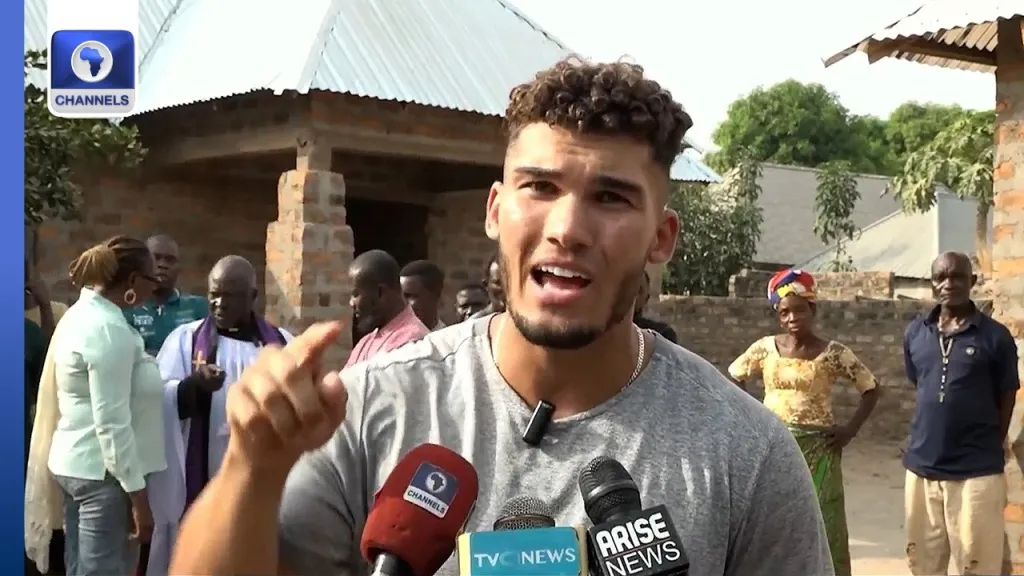
A United States–based Christian missionary has accused Benue State authorities of deliberately obstructing a low-cost humanitarian project for survivors of the 2025 Yelewata massacre, alleging that officials rejected his ₦50–60 million market reconstruction plan and instead promoted a ₦300 million alternative that has triggered fresh concerns over transparency and aid diversion.
Alex Barbir, founder of the American humanitarian group Building Zion, made the allegations public this week, igniting widespread debate over corruption, governance, and the handling of relief funds in Nigeria’s conflict-ravaged Middle Belt.

Yelewata, a farming community in Guma Local Government Area of Benue State, was the scene of one of Nigeria’s deadliest rural attacks in recent history on June 13–14, 2025, when gunmen killed between 100 and 200 residents in a single night. The massacre drew national outrage, presidential visits, and international condemnation.
Since the attack, Barbir—who is in his mid-20s and a former U.S. college athlete—has worked directly in the community, rebuilding at least 35 homes, drilling boreholes, constructing a clinic, and supporting the resettlement of more than 100 displaced families from IDP camps.
According to Barbir, his next priority was rebuilding Yelewata’s central market, a critical economic lifeline for local farmers and traders. He said the project could be completed for ₦50–60 million using donor funds and transparent procurement, in partnership with organizations such as Equipping the Persecuted.
However, after approaching Benue State’s Ministry of Humanitarian Affairs and the Benue State Emergency Management Agency (BSEMA), Barbir claims his proposal was rejected outright. He alleges that officials later presented their own counterproposal, placing the cost of the same market infrastructure at ₦300 million.
“The same market can be rebuilt for ₦50–60 million,” Barbir said in interviews circulated by Nigerian media platforms. “They later presented a proposal for ₦300 million. It simply didn’t add up.”
Citing deep concerns about transparency, Barbir said he suspended the project rather than risk donor funds passing through what he described as compromised channels. He further alleged that more than ₦4 billion in donations raised for Yelewata victims after the massacre has failed to reach survivors, raising questions about relief fund accountability.
Despite halting the market project, Barbir says he has continued delivering direct aid on the ground, bypassing bureaucratic structures to support affected families. He has also warned that any renewed attacks on Yelewata would be met with increased international scrutiny, noting that U.S. officials are monitoring the situation closely.
Benue State has continued to experience deadly violence in recent weeks, with at least 13 people reportedly killed in fresh attacks linked to ongoing farmer-herder and militia conflicts.
As of Saturday, February 7, neither the office of Governor Hyacinth Alia, BSEMA, nor the Federal Ministry of Humanitarian Affairs has issued a public response to the allegations.
Online reactions have been sharply divided. Many Nigerians have praised Barbir’s hands-on approach and transparency, while others argue that foreign-led reconstruction efforts raise questions about sovereignty and long-term sustainability.
For survivors in Yelewata, however, the debate remains secondary to survival. As insecurity persists and trust in aid distribution continues to erode, the controversy has once again spotlighted a familiar question in Nigeria’s conflict zones: where does the money really go?