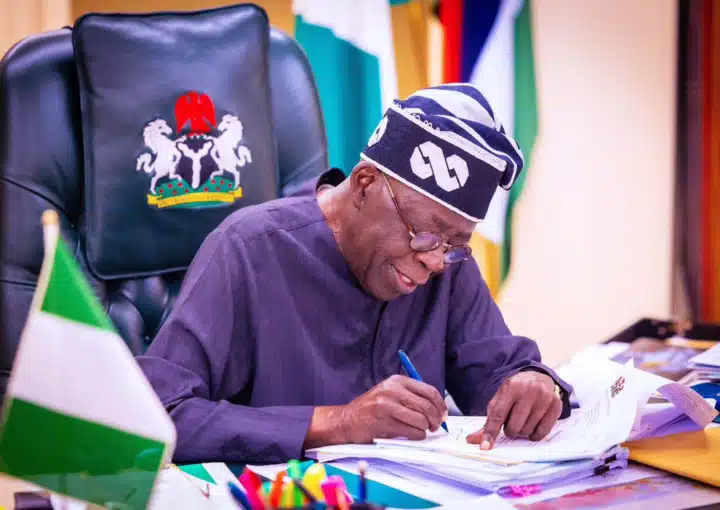
President Bola Tinubu on Tuesday officially unveiled and launched the Nigeria Industrial Policy 2025, signalling a renewed push to reposition the country’s industrial base.
The unveiling took place at the Bola Tinubu International Conference Centre in Abuja, where Vice President Kashim Shettima represented the President.
The formal launch comes weeks after a soft introduction of the policy in Lagos and underscores the administration’s commitment to deepen value addition, address structural bottlenecks, and accelerate industrial growth.


The development also comes amid renewed calls from leading industrialists, including Aliko Dangote, for urgent reforms in the power sector, which they describe as critical to the success of any industrial strategy.
President Tinubu described the Nigeria Industrial Policy 2025 as a strategic roadmap aimed at re-engineering Nigeria’s industrial ecosystem and unlocking value across key sectors of the economy.
He emphasised that the administration has put in place a clear implementation structure, noting that policies often fail at the execution stage rather than at conception.
“We have realised that industrialisation is not a wish you think about; it is an action you perform. More than that, we must remind ourselves that this task demands coherence across energy, trade, infrastructure, finance, skills, and innovation. It requires partnership between the government and the private sector.”
“We will measure success by the number of factories that open their gates at dawn, the jobs created for young men and women, the exports that leave our ports bearing the mark of Nigerian excellence, and the value retained within our domestic economy.”
“It advances value chain development so that Nigeria moves steadily from exporting raw materials to producing finished goods. It integrates our micro, small, and medium enterprises into the heart of industrial growth, because prosperity must not be exclusive.”
“It aligns infrastructure and energy with industrial ambition, for factories cannot run on policy alone. It strengthens skills, technology, and innovation to prepare our people for the industries of today and tomorrow,” he said.
Vice President Kashim Shettima also called for stronger private sector collaboration to deepen local value chains and accelerate job creation.
Speaking at the event, Aliko Dangote stressed the urgency of resolving Nigeria’s electricity challenges as a prerequisite for industrial growth.
“Mr Vice President, I advise that you call a national forum where we resolve the issue of power.”
“If there is no protection, there is no way any industry will thrive here.”
“No power, no growth,” he said.
Dangote commended the government for stabilising the foreign exchange market but maintained that reliable electricity supply remains the single most critical requirement for sustainable industrial expansion.
The President of the Manufacturers Association of Nigeria, Otunba Francis Meshioye, added that manufacturers are focused on ensuring the effective implementation of the new policy framework.