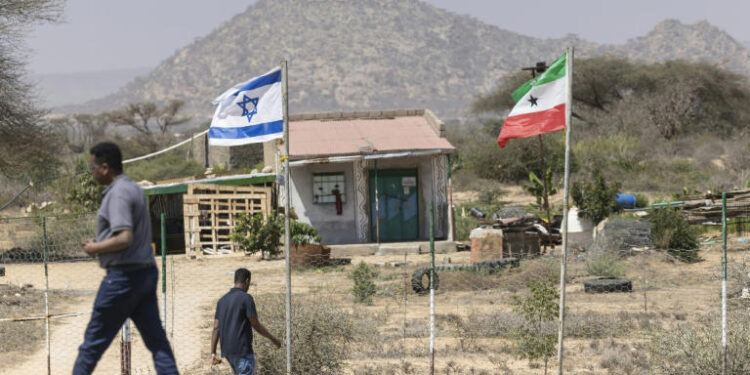
‘I LOVE Israel’ is not a phrase commonly associated with Muslim-majority societies. Yet in Somaliland, the self-declared republic that broke away from Somalia more than three decades ago, such expressions have become increasingly visible following Israel’s decision to recognise the territory’s independence.
Israel became the first country to formally acknowledge Somaliland as a sovereign state in December, marking a turning point for a region that has pursued international recognition since declaring independence in 1991. Reporting by AFP indicates the move has generated strong reactions among citizens, particularly as Ramadan begins in the deeply Muslim territory.
Across the capital, Hargeisa, residents describe recognition as long-awaited validation after decades of diplomatic isolation.
A decades-long search for legitimacy
In Hargeisa’s central square, a preserved Soviet-made MiG fighter jet stands atop a memorial commemorating the devastating bombing campaign carried out by forces loyal to former Somali president Siad Barre in the late 1980s. The attacks destroyed an estimated seventy percent of the city and remain a defining chapter in Somaliland’s collective memory.
Ahmed Abiib Ibrahim, a student interviewed by AFP near the memorial, said recognition symbolised the sacrifices made during the independence struggle.
‘We were waiting for recognition for 35 years,’ he said. ‘This is the product of our grandparents who fought in the war.’
Many Somalilanders argue that atrocities committed during that conflict received little condemnation from Muslim-majority nations, shaping how some residents now interpret international alliances.
Public displays of support emerge
During the opening days of Ramadan, several residents interviewed by AFP expressed gratitude toward Israel, with some displaying Israeli flags in homes and businesses. Images circulating locally on social media showed citizens holding the flag or incorporating it into clothing as a symbol of diplomatic recognition.
Muna Ali, who works at a travel agency in Hargeisa, described the moment as deeply symbolic.
‘It is the first Ramadan when the world knows us,’ she said.
Outside the city, lorry driver Abdilrashiid Adam Jamac told AFP he had placed an Israeli flag inside his home, saying recognition had changed how he viewed international partnerships.
Despite these sentiments, officials emphasise that sympathy for Palestinians remains widespread. A Somaliland government official, speaking anonymously to AFP, said residents raised around $2 million for Palestinians during the previous Ramadan, illustrating the complexity of public opinion.
Mogadishu condemns recognition decision
Somalia’s federal government swiftly rejected Israel’s move. President Hassan Sheikh Mohamud described the recognition as a violation of Somalia’s sovereignty and warned it could threaten regional stability.
Mogadishu continues to regard Somaliland as an integral part of Somalia, even though the territory has operated independently for more than three decades with its own currency, armed forces, passport system and governing institutions.
Strategic rivalry intensifies in key trade corridor
The Horn of Africa occupies a critical position along maritime routes linking the Indian Ocean and the Suez Canal, making it an increasingly competitive arena for regional and global powers.
Turkish President Recep Tayyip Erdogan criticised Israel’s recognition during a recent visit to Ethiopia, arguing the decision could destabilise the region. Analysts also point to the United Arab Emirates — which operates a major commercial port in Berbera — as an influential actor shaping evolving diplomatic alignments.
Few countries have followed Israel’s lead so far, partly due to fears that recognising Somaliland could encourage separatist movements elsewhere.
Nevertheless, Somaliland’s relative stability compared with southern Somalia — where Islamist insurgencies and clan conflicts persist — continues to strengthen its case for international legitimacy.
Whether Israel’s decision triggers broader recognition remains uncertain. For many Somalilanders, however, the symbolic breakthrough already marks a profound shift: after decades seeking acknowledgement, their cause has finally gained a powerful international supporter.