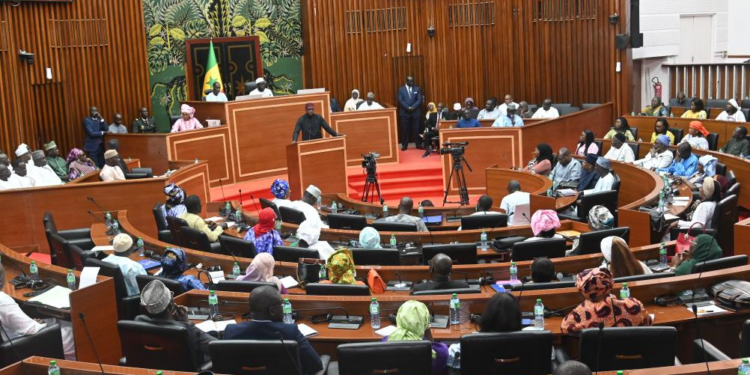
Senegal’s Prime Minister Ousmane Sonko has introduced legislation that could significantly increase penalties for same-sex relations, proposing prison sentences of up to 10 years under revised criminal laws.
The draft bill was submitted to parliament on Tuesday after receiving cabinet approval last week, following a surge in arrests linked to alleged same-sex relationships in the West African nation, where homosexuality is already prohibited under existing law.
Addressing lawmakers, Sonko said the proposed legislation would amend current provisions by expanding prison terms from the present one-to-five-year range to between five and 10 years for what the law defines as ‘acts against nature’.
‘If an act is committed with a minor, it will attract the maximum penalty,’ Sonko told parliament.
The proposed reforms mark a significant tightening of Senegal’s legal stance on LGBT issues and come amid rising political and social pressure from conservative and religious groups, highlighting growing tensions between domestic cultural politics and international human rights standards.
In addition to harsher prison terms, the bill introduces penalties for individuals accused of promoting or advocating same-sex relations. Those found guilty under these provisions could face sentences ranging from three to seven years in prison.
The legislation also proposes punishment for people who falsely accuse others of homosexuality without proof, a clause authorities say is intended to prevent misuse of the law.
Convictions under the draft framework could carry fines of up to CFA10 million ($18,000), according to government estimates.
Sonko emphasised that the revised legislation would maintain the offence’s current classification as a misdemeanour rather than elevating it to a more serious criminal category.
‘We can achieve the intended objectives without going so far as to elevate the acts to the level of more serious crimes,’ he said.
A date for parliamentary debate and voting has not yet been announced. However, the chamber is controlled by Sonko’s ruling Pastef party, suggesting the proposal may face limited legislative resistance.
The legislative push follows intensified enforcement actions earlier this month. Police detained 12 men, including public figures and a journalist, under existing anti-LGBT laws. Local media reports indicate that roughly 30 people have been arrested nationwide during the same period.
Debate over LGBT rights has long generated divisions in Senegal, a predominantly Muslim and socially conservative society. Religious organisations have staged demonstrations in recent years calling for stricter punishments and stronger enforcement.
Supporters of tougher laws often argue that LGBT activism represents foreign cultural influence, a narrative that has shaped public discourse and political positioning around the issue.
Sonko, a former opposition figure appointed prime minister in 2024, had previously pledged to reinforce restrictions on same-sex relations during his political campaign.
Human rights organisations have criticised both the proposed legislation and recent arrests. Human Rights Watch said the crackdown violates ‘multiple internationally protected rights’, including equality and protection against discrimination.
Advocates warn that harsher penalties could increase stigma and expose individuals to abuse, particularly where accusations are difficult to verify.
The developments mirror broader legislative trends across parts of Africa. Burkina Faso approved a ban on homosexual acts in September last year, following similar measures adopted by Mali in 2024.
Uganda drew widespread international attention in 2023 after passing one of the world’s strictest anti-homosexuality laws, allowing severe penalties — including the death sentence — for certain same-sex acts.
Analysts say Senegal’s proposed reforms could influence policy debates across West Africa, where governments increasingly balance domestic political pressures with international human rights expectations.
As parliament prepares to consider the bill, attention is likely to focus on how Senegal navigates competing demands between sovereignty, social values and global diplomatic relationships.