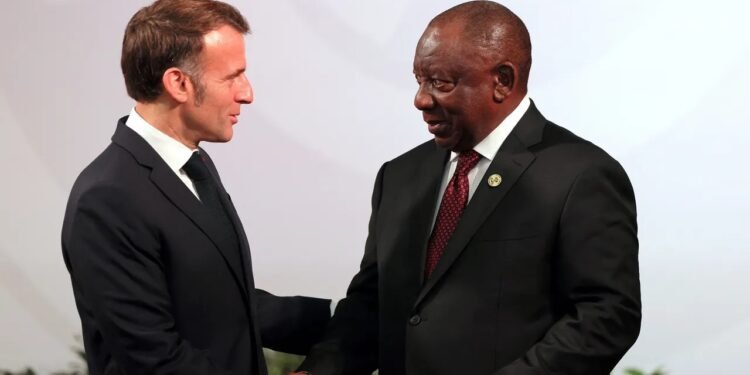
South African President Cyril Ramaphosa has been removed from the G7 summit scheduled for June in Evian, France, after sustained pressure from the United States, the South African presidency confirmed on Thursday, according to AFP. The decision marks a sharp escalation in tensions between Pretoria and Washington.
The withdrawal of South Africa’s invitation reflects more than a diplomatic snub. It signals tightening US influence over Western alliances, raises questions about Africa’s access to elite global forums, and highlights a deepening divide between the Global South and traditional G7 powers.
US pressure forces France to reverse course


Presidential spokesperson Vincent Magwenya said France had been compelled to rescind its invitation following direct pressure from Washington.
‘We’ve learnt that due to sustained pressure, France has had to withdraw its invitation to South Africa to attend the G7 meeting,’ he told AFP.
Magwenya added that the US had threatened to boycott the summit if South Africa participated, placing Paris in a difficult diplomatic position.
The G7, a bloc of leading industrialised nations, often invites non-member countries to broaden discussions on global economic and security issues. South Africa’s initial inclusion had been viewed as part of efforts to engage key Global South economies.
The decision follows months of deteriorating ties, with Pretoria already seeking dialogue after Washington scaled back engagement, as reported in South Africa seeks talks as US cuts aid support.
Mounting US–South Africa tensions
The disinvitation comes against a backdrop of widening disputes between the United States and South Africa under President Donald Trump. Tensions now span trade, domestic policy and foreign affairs, forming a pattern of sustained diplomatic friction.
Trump imposed tariffs of roughly 30 percent on most South African exports last year—the highest applied to any country in sub-Saharan Africa. Although the US Supreme Court later overturned the tariff policy, the move strained economic ties and signalled a tougher stance toward Pretoria.
The fallout also reflects broader strain in US–Africa relations, including resource-linked disputes such as Zambia halts $320m US mineral-linked aid.
Washington has also criticised South Africa’s racial justice policies, designed to address inequalities rooted in apartheid. Trump has described these measures as discriminatory against white citizens, a claim rejected by the South African government and widely discredited by analysts.
Relations have further deteriorated over South Africa’s decision to bring a case against Israel at the International Court of Justice, accusing the US ally of genocide in Gaza.
The move has positioned South Africa as a leading Global South voice on international justice issues while placing it in direct opposition to US foreign policy priorities in the Middle East. Analysts say this divergence has become a central fault line in bilateral relations.
The development mirrors wider tensions between African states and Western-led platforms, echoing disputes highlighted in Mozambique quits London summit over bias claims.
France’s balancing act exposed
The episode also underscores the constraints facing European diplomacy. French President Emmanuel Macron had personally invited Ramaphosa during the G20 summit in Johannesburg, signalling an effort to broaden engagement with African leaders.
However, the subsequent reversal suggests that US leverage within Western alliances remains decisive, even when European states seek more inclusive global dialogue.
The contrast is particularly stark as Africa continues to push for greater representation in global governance, even as access to elite forums like the G7 remains constrained by geopolitical alignment.
Despite the development, Pretoria moved quickly to contain any diplomatic fallout with Paris.
‘This will have no impact on the strength and close nature of our bilateral relationship with France,’ Magwenya said.
Africa’s place in global governance questioned
The decision raises broader concerns about Africa’s role in global decision-making. While the G20 has expanded to include the African Union, the G7 remains a more exclusive forum, with participation often shaped by geopolitical alignment.
For South Africa, the snub may reinforce its strategic pivot toward alternative blocs such as BRICS, where emerging economies seek greater influence in global governance. It also adds urgency to calls for reform of international institutions to better reflect shifting global realities.
Pretoria has maintained that it remains open to engagement with Washington despite the tensions.
‘Notwithstanding all of these developments, South Africa remains committed to engage constructively with the US,’ Magwenya said, noting that bilateral relations extend beyond any single administration.
However, the episode points to an increasingly fragmented diplomatic landscape, where ideological divides and strategic competition are reshaping alliances. For South Africa—and for Africa more broadly—the challenge will be navigating these shifts while securing a meaningful voice in global decision-making.