

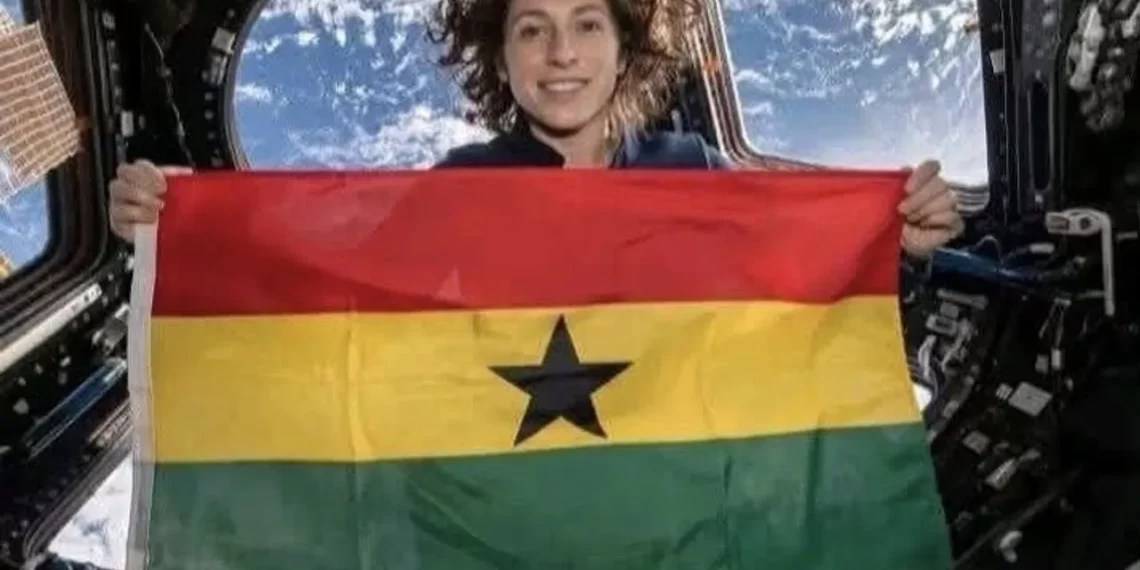
Ghana has joined global celebrations for NASA astronaut Christina Koch, who has become the first woman to travel beyond low Earth orbit as part of the landmark Artemis II mission.
The milestone marks a defining moment in modern space exploration, while spotlighting Ghana’s unique link to one of humanity’s most ambitious lunar missions in more than half a century.
Koch’s connection to Ghana dates back to the 1999/2000 academic year, when she studied astrophysics as an exchange student at the University of Ghana.


That period, widely regarded as formative, saw her immerse herself in Ghanaian culture while advancing her scientific training.
More than two decades later, she has carried that connection into orbit — hoisting the Ghanaian flag aboard the Artemis II spacecraft as a tribute to the country that helped shape her journey.
Mahama hails ‘deeply touching moment’
Ghana’s President John Mahama praised the gesture, calling it a moment of national pride.
In a statement issued on April 9, Mahama said the display of the Ghanaian flag in space was ‘a deeply touching moment for every Ghanaian’.
He added that Koch’s journey from the University of Ghana to the frontiers of space exploration should inspire young people across the country and the wider African continent.
‘Her story reminds us that our institutions continue to shape global leaders who break barriers and reach for the stars,’ the president said.
Born in Michigan in 1979, Koch built her career on a strong academic foundation in electrical engineering and physics, earning both Bachelor’s and Master’s degrees from North Carolina State University.
She rose to prominence during her 328-day mission aboard the International Space Station between 2019 and 2020, one of the longest single spaceflights by a woman.
During that mission, she also participated in the first all-female spacewalk, cementing her place in the history of human spaceflight.
Artemis II and the return to the moon
On Artemis II, Koch serves as a mission specialist alongside commander Reid Wiseman, pilot Victor Glover, and mission specialist Jeremy Hansen.
The mission, which launched on April 1, 2026, is a 10-day journey designed to test critical systems for future lunar landings.
The crew travelled approximately 6,400 miles beyond the far side of the moon — farther than any human mission since the Apollo programme of the 1970s.
It marks humanity’s long-awaited return to deep space exploration and is a crucial step towards future missions that aim to land astronauts on the lunar surface.
A moment of global and African significance
Koch’s role as the only woman on the Artemis II crew underscores the mission’s broader significance for representation and international collaboration in science.
For Ghana, her achievement carries added meaning — a reminder of the country’s role in shaping global talent through education and opportunity.
As the Artemis programme progresses, Koch’s journey is already being seen as a defining moment, not just for NASA, but for a new generation of Africans inspired to pursue careers in science, technology, and space exploration.




