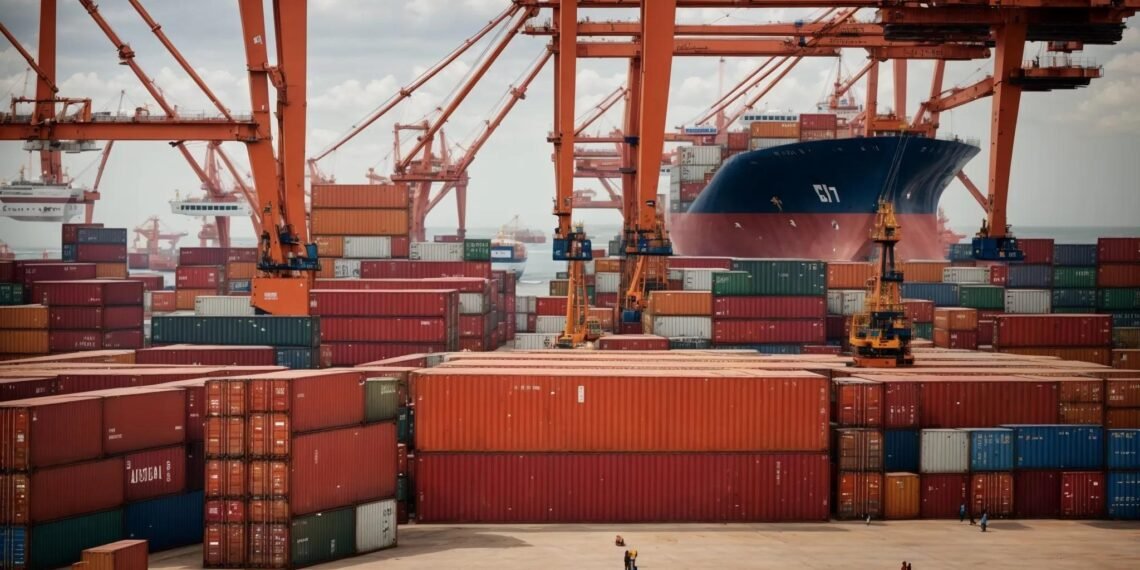
China has removed tariffs on exports from 53 African countries, opening one of the world’s largest markets to the continent—but the move risks deepening a long-standing trade imbalance that continues to favour Beijing.
The policy by China is being hailed as a breakthrough for African exporters. Yet analysts warn it could entrench a deeper structural problem: Africa supplies raw materials, while China captures the high-value manufacturing and profits.
China’s decision to extend zero-tariff access across almost the entire continent—excluding only Eswatini—builds on earlier moves outlined in Africa Briefing reporting on China’s tariff removal policy.


It is not just about trade.
It is about influence.
At a time when global trade tensions have intensified, particularly under policies linked to Donald Trump, Beijing is positioning itself as Africa’s most accessible economic partner.
The offer is simple: easier access, fewer restrictions, and a vast consumer base.
But behind that simplicity lies strategy.
China is strengthening its role in African economies while securing long-term access to resources and markets.
The numbers reveal the real challenge.
Africa’s trade deficit with China has reached about $102bn, reflecting a persistent imbalance where African exports remain dominated by commodities while manufactured imports surge.
More than 70 percent of African exports to China are raw materials—oil, copper, cobalt and other commodities.
Meanwhile, imports from China are dominated by manufactured goods, from machinery to electronics.
This imbalance is structural.
Tariffs were never the main barrier. Production capacity is.
Without the ability to manufacture and export higher-value goods, African countries risk exporting more—but earning proportionally less.
The real story lies in global supply chains.
Africa holds critical resources needed for the energy transition, including cobalt and lithium—materials that continue to flow largely as raw exports under expanded market access.
China, however, dominates the processing and manufacturing stages of these supply chains.
That creates a clear pattern:
- Africa extracts
- China processes
- Value is captured elsewhere
This is how dependency is built—quietly, but consistently.
At the same time, China is dealing with industrial overcapacity at home. Expanding access to African markets helps absorb excess production, further embedding Chinese goods across the continent.
Not all African countries will benefit equally.
Economies with stronger infrastructure and export capacity—such as South Africa, Morocco and Kenya—are better positioned to scale exports quickly, a trend also explored in Africa Briefing’s analysis of US-China-Africa trade shifts.
Others face constraints that limit their ability to take advantage of tariff-free access, including weak logistics systems and limited industrial bases.
Even where gains are possible, they are likely to be concentrated in agriculture.
Products such as coffee, nuts and avocados may see increased demand. But without processing and value addition, these exports generate limited economic transformation.
Ghana’s cocoa problem explains everything
The structural issue is already visible across Africa.
Ghana, one of the world’s largest cocoa producers, exports vast quantities of raw cocoa beans each year. Yet most of the value in the global chocolate industry is captured elsewhere—through processing, branding and distribution.
China’s tariff policy could increase cocoa exports.
But without domestic processing capacity, Ghana remains locked into the lowest-value segment of the supply chain.
More access does not automatically mean more value.
The Eswatini signal
The exclusion of Eswatini is not economic—it is political.
As one of the few countries maintaining diplomatic ties with Taiwan, Eswatini’s omission reflects China’s broader geopolitical strategy.
Market access, in this case, comes with expectations.
It is a reminder that trade policy is increasingly tied to political alignment—and that economic relationships are rarely neutral.
Africa still has leverage
Despite the risks, the outcome is not fixed.
African countries have an opportunity to use improved market access as leverage—if they act strategically.
The African Continental Free Trade Area offers a pathway to build regional value chains, strengthen intra-African trade, and reduce dependence on external markets.
At the national level, governments can:
- invest in processing industries
- support manufacturing
- improve logistics and infrastructure
Countries like Morocco have already demonstrated how targeted industrial policy can shift economies up the value chain.
The lesson is clear: access must be matched with strategy.
A global power play unfolding
China’s move comes as global powers compete for influence in Africa.
The United States and European Union are seeking to deepen engagement, but their approaches remain slower and less coordinated.
This creates space for African governments to negotiate better terms.
But it also raises the stakes.
Without a clear strategy, Africa risks becoming a battleground for competing interests rather than a driver of its own economic future.