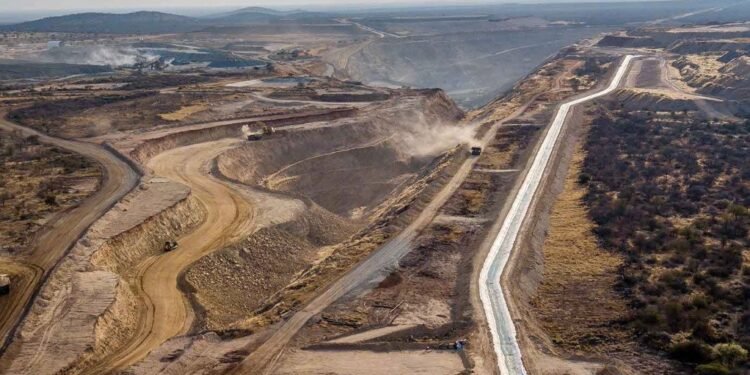
Namibia copper sector is set for a potential revival after investment firm Appian Capital Advisory unveiled plans to invest $400m in the Omitiomire copper project, amid rising global demand for critical minerals used in electrification and clean energy systems.
The company announced on Thursday, May 14, that it had acquired a 95 percent stake in the project and would move ahead with development work required to bring the mine into production. The investment adds momentum to Namibia’s growing mining investment pipeline as the country seeks to rebuild its once-active copper industry.
Omitiomire project targets long-term output


Appian said the Omitiomire project hosts an estimated 520,000 tonnes of recoverable copper and is expected to produce around 30,000 tonnes annually over a projected 15-year mine life.
The company said a feasibility study had confirmed the project’s commercial potential, although it did not disclose the key technical assumptions, financing structure or estimated construction timeline.
No date has yet been announced for first production.
Appian also confirmed that discussions had begun with potential commercial partners regarding future offtake agreements linked to copper production from the mine.
The company added that nearby exploration targets could provide opportunities to expand the project’s mineral resource base over time.
Namibia seeks copper sector recovery
Namibia’s copper industry has struggled since the closure of several major mines more than a decade ago.
Operations at the Matchless and Otjihase mines ended in 2015, contributing to a sharp decline in national copper production.
The launch of the Tschudi mine later provided a temporary boost to the sector before operations were suspended in 2020. The asset was subsequently taken over by Consolidated Copper, which resumed operations in 2024.
Tschudi remains Namibia’s only active industrial-scale copper mine, although recent production figures have not been publicly disclosed.
Meanwhile, the Kombat mine, currently under care and maintenance, is expected to restart operations before the end of the year under plans announced by its owner, Horizon Corporation.
According to the Chamber of Mines of Namibia, mining remains one of the country’s most important economic sectors, contributing significantly to export earnings and foreign direct investment despite weaker copper output over the past decade.
New projects attract investor interest
Several mining companies are now advancing additional copper developments across Namibia.
Koryx Copper is progressing the Haib copper project, which targets annual production capacity of around 88,000 tonnes over an estimated 23-year mine life.
Elsewhere, Bezant Resources continues work on the Hope & Gorob project, while junior exploration firms Kaoko Metals and Midas Minerals are also advancing early-stage copper assets.
Despite the renewed activity, most projects remain in the study and financing stages before full-scale mining can begin.
Koryx Copper is still assessing the economic and technical parameters of the Haib development, with a pre-feasibility study expected during the fourth quarter of 2026.
Industry analysts say investors are increasingly looking at African copper assets as supply risks grow in traditional mining regions and governments accelerate investment in renewable energy infrastructure.
Global copper shortages support expansion
The renewed push into Namibia’s copper industry comes as analysts warn of growing global supply shortages.
Benchmark copper prices have remained elevated in recent years as demand from electric vehicles, battery manufacturing and power grid expansion continues to increase globally.
The International Energy Agency estimates that the global copper market could face a supply deficit of up to 30 percent by 2035 as existing mines struggle to keep pace with rising demand from electric vehicles, renewable energy infrastructure and grid expansion.
The renewed focus on copper also reflects Africa’s expanding role in critical minerals supply chains linked to the global energy transition.
Although Namibia’s expected production volumes remain smaller than those of leading African producers such as the Democratic Republic of the Congo and Zambia, developers increasingly see the country as part of Africa’s emerging critical minerals hotspots capable of supplying future copper demand.
Appian said rising long-term demand and tightening global supply conditions could create favourable market conditions for projects able to enter production within the coming decade.
However, analysts note that financing, permitting and infrastructure development will remain critical hurdles before Namibia’s latest copper ambitions can translate into sustained industrial output.