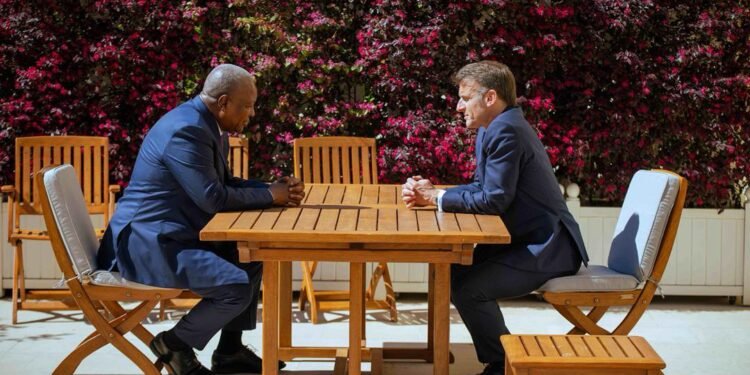
Ghana has welcomed fresh commitments by French President Emmanuel Macron on slavery reparations and historical justice ahead of a major summit in Accra next month, describing the developments as an important step towards accountability and deeper Africa-Europe dialogue.
Central to the announcement is a planned Ghana-French Scientific Commission on slavery in Ghana, which officials say will investigate France’s historical links to slavery in the country and help shape future discussions on reparatory justice, restitution and historical memory.
In a statement posted on X on May 23, Ghana’s Foreign Affairs Minister Samuel Okudzeto Ablakwa said President John Dramani Mahama had commended Macron for agreeing to work with Ghana on establishing the commission.


The commission is expected to bring together historians, researchers and policy experts from both countries to examine archival records, slavery-era connections and the broader impact of the transatlantic slave trade on Ghana and West Africa. Analysts say the initiative could become one of the most significant bilateral historical justice projects between an African country and a former European colonial power.
The commission also reflects Ghana’s growing diplomatic pressure on France and other former colonial powers following the passage of a Ghana-backed UN resolution on slavery reparations, an issue explored in Africa Briefing’s report on Ghana’s challenge to France after the UN slavery vote.
The announcement follows growing international debate over Europe’s colonial legacy and renewed African demands for reparatory measures, a conversation explored in Africa Briefing’s analysis of Ghana’s UN-led reparations push.
Macron praised over slavery commitments
According to Ablakwa, the Ghanaian government also applauded Macron for pledging to abolish historical slavery laws known as the ‘Code Noir’, which regulated slavery in French colonies for centuries and became one of the most controversial legal instruments associated with the transatlantic slave trade.
Macron was further praised for advancing a new French policy on the return of looted African artefacts and for what Ghana described as an ‘impressive commitment to an open and honest dialogue on Reparatory Justice’.
Ablakwa wrote that it was ‘great to see the concrete results’ of Ghana’s UN-led reparations campaign and the growing international recognition of the transatlantic slave trade as a crime against humanity.
The remarks come days after France signalled support for repealing colonial-era slavery legislation, a move detailed in Africa Briefing’s earlier report on France’s policy shift.
The developments come amid growing international pressure on former colonial powers to acknowledge and address the lasting social and economic consequences of slavery and colonial exploitation across Africa and the Caribbean.
Accra summit expected to shape reparations debate
Ablakwa also confirmed that Macron has accepted an invitation from Mahama to speak at the Next Steps Summit on Reparatory Justice scheduled to take place in Accra from June 17-19, 2026.
The summit is expected to bring together African leaders, historians, policy experts and civil society organisations to discuss reparatory frameworks, restitution of cultural artefacts and mechanisms for international cooperation on historical justice.
Ghana has increasingly positioned itself at the centre of global conversations on reparations, particularly through initiatives linked to the African Union and the United Nations.
Officials in Accra argue that reparatory justice should move beyond symbolic acknowledgements to include practical measures such as economic partnerships, educational investment, cultural restitution and institutional reforms. Analysts say the debate is increasingly shifting from moral recognition towards financial accountability and economic redress, themes examined in Africa Briefing’s feature on whether Africa can transform reparations into tangible payouts.
Source: Africa Briefing