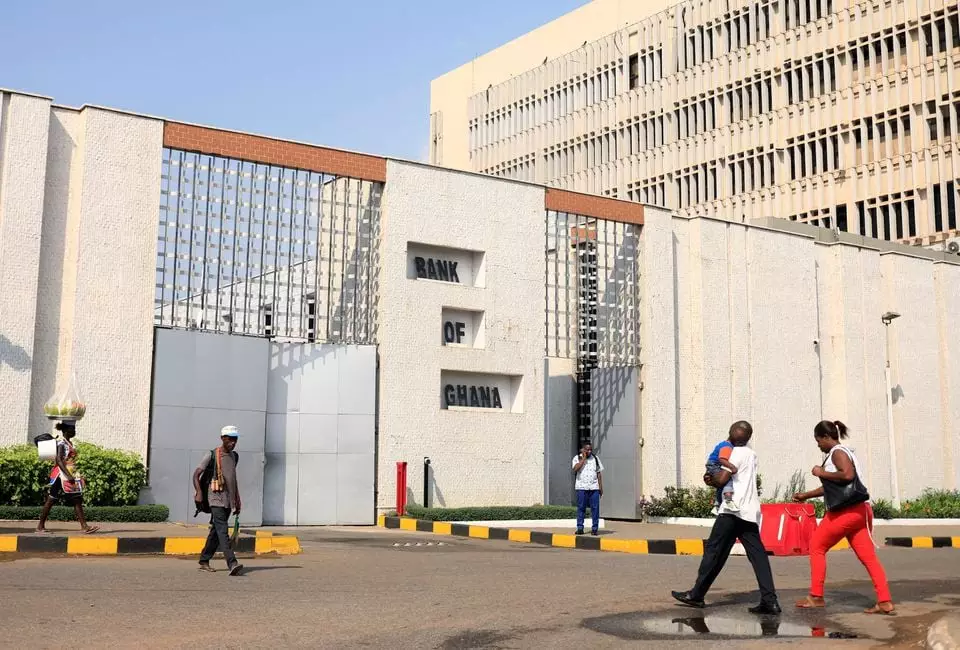
Ghana central bank has ordered the suspension of a planned fee on mobile money transfers into bank accounts after mounting public criticism and political tensions over the proposed charge.
The Bank of Ghana said Tuesday that Mobile Money Fintech Limited (MMFL) must halt implementation of the proposed 0.75 percent fee pending further consultations with banks, telecom operators, fintech firms and other financial sector stakeholders.
‘The suspension will allow for further stakeholder engagement and consultations on the proposed fee structure,’ the central bank said in its statement.


The decision temporarily shields millions of users from higher digital transaction costs in one of Africa’s largest mobile money markets, where mobile wallets have become central to daily commerce, salary payments and small business operations.
The fee had been due to take effect on June 1 after MTN Ghana informed customers about revised pricing arrangements affecting direct wallet-to-bank transfers.
Parliamentary tensions erupt
The controversy spilled into Parliament on Tuesday, triggering heated exchanges between lawmakers over what opposition figures described as the return of the controversial Electronic Transfer Levy (E-Levy) through another mechanism.
Minority Leader Alexander Afenyo-Markin accused the government of attempting to reintroduce digital transaction charges ‘through the back door’ despite previously scrapping the unpopular E-Levy.
Afenyo-Markin sought to raise the issue before parliamentary proceedings formally began, arguing that the proposed fee contradicted earlier promises to reduce the burden on mobile money users.
The political sensitivity surrounding digital transaction charges has remained high since the divisive E-Levy debate. Earlier analysis by Africa Briefing examined growing public scepticism surrounding Ghana’s E-Levy policy and concerns about its impact on financial inclusion and mobile money adoption.
However, Majority Leader Mahama Ayariga objected, insisting the matter was being introduced outside established parliamentary procedures and describing the attempt as ‘lawlessness’.
The confrontation escalated before the Speaker intervened and ordered all remarks linked to the exchange to be expunged from the official parliamentary record.
The parliamentary clash came only hours after the Bank of Ghana announced suspension of the proposed charges following widespread public backlash.
Central bank pauses fee rollout
Under the proposed pricing structure, transfers from mobile money wallets into bank accounts would have attracted a 0.75 percent fee capped at five cedis per transaction.
A transfer of 100 cedis ($6.50–$6.70), for example, would have incurred a 75-pesewa fee, while transactions above roughly 667 cedis would have reached the maximum charge threshold.
Industry observers said the proposal triggered strong reactions because many consumers viewed it as a reversal of efforts to reduce costs associated with digital financial services.
‘Any additional charge on wallet transfers immediately affects traders, transport operators and small businesses that depend on mobile money every day,’ Accra-based fintech analyst Kojo Amenyah told local media. ‘People are extremely sensitive to transaction costs after the E-Levy experience.’
The regulator did not indicate when a final decision on the proposed fee structure would be announced.
Mobile money dominates Ghana’s economy
Ghana has emerged as one of Africa’s leading mobile money economies, with telecom-based financial services deeply integrated into retail payments and banking access.
According to Bank of Ghana data, mobile money transaction values exceeded 3 trillion cedis in 2025 as adoption accelerated across both formal and informal sectors.
The country has consistently ranked among the world’s strongest mobile money markets. Earlier reporting by Africa Briefing highlighted Ghana’s continued dominance in global mobile money adoption rankings, driven by strong interoperability systems and rising smartphone penetration.
Analysts warned that introducing new wallet-to-bank transfer charges risked slowing digital financial inclusion and increasing costs for small traders and low-income users who depend heavily on mobile wallets.
Interoperability and fintech growth
Ghana’s interoperability platform, launched in 2018, allows transfers between bank accounts, mobile wallets and telecom networks, significantly expanding digital transaction volumes.
The system has strengthened integration between telecom operators and traditional banking institutions while supporting broader cashless payment adoption.
Recent reforms have also expanded identity-linked digital payments. Africa Briefing previously reported on Ghana’s rollout of payment functionality linked to national ID cards as part of wider efforts to modernise financial infrastructure.
Across the region, mobile money continues to grow rapidly. A recent GSMA-focused Africa Briefing analysis on West Africa’s mobile money expansion showed telecom-led financial services becoming increasingly connected to e-commerce systems and cross-border payments.
Sub-Saharan Africa remains the world’s largest mobile money market by active accounts, according to the GSMA.
Source: Africa Briefing