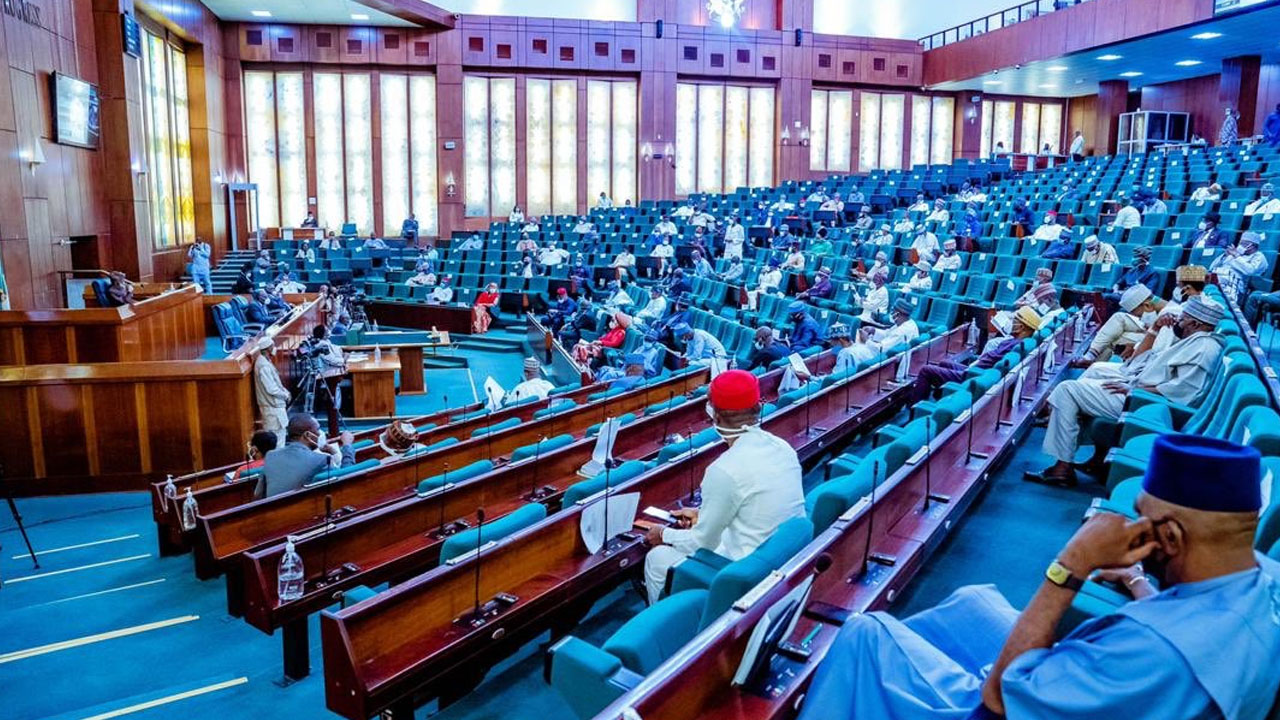
The House of Representatives on Thursday passed a constitutional amendment bill seeking the establishment of state police across the federation, advancing one of the country’s most debated governance and security reforms.
The bill, titled “A Bill for an Act to Alter the Constitution of the Federal Republic of Nigeria, 1999 to Provide for the Establishment of State Police and for Related Matters (Sixth Alteration) Bill, 2026,” received overwhelming support from lawmakers during consideration at the Committee of the Whole.
The proposal, sponsored by the Deputy Speaker of the House and Chairman of the Constitution Review Committee, Benjamin Kalu, scaled the legislative hurdle after a voice vote and subsequent manual voting process demonstrated near-unanimous support among members.


Voting records showed that 289 lawmakers voted in favour of the bill, one member abstained, while no legislator voted against the proposal, underscoring the growing consensus within the National Assembly on the need to decentralise policing in response to the nation’s persistent security challenges.
The proposed constitutional amendment seeks to establish a dual policing system that would allow both the Federal Police and State Police to operate concurrently across the country. Proponents of the reform argue that decentralised policing would improve intelligence gathering, community engagement, rapid response to security threats, and overall effectiveness in combating crime.
Under the amendment, Section 214 of the 1999 Constitution would be altered to formally recognise and provide constitutional backing for both federal and state police formations.
The National Assembly would be empowered to legislate on the structure, administration, operations, standards, and oversight mechanisms governing the two-tier policing arrangement.
The bill provides that state police forces would not automatically commence operations upon constitutional approval.
Instead, each state intending to establish its own police service must first enact enabling legislation through its House of Assembly and satisfy national operational standards prescribed by federal law.
Until such conditions are met, the Federal Police will continue to exercise full policing powers within affected states.
The proposed framework also contains safeguards aimed at preventing potential abuse of state-controlled police forces, a concern often raised by critics of the reform.
Under the provisions, federal authorities would only intervene in state policing matters under clearly defined circumstances, including situations where there is a breakdown of public order, where a state governor formally requests assistance, or where a state police structure is deemed incapable of effectively responding to security threats.
The bill further introduces significant changes to leadership appointments within the policing system.
According to the proposal, the Inspector-General of Police would continue to be appointed by the President based on the advice of the Nigeria Police Council and subject to confirmation by the Senate.
The appointee must be selected from serving officers within the Federal Police structure.
Similarly, State Commissioners of Police would be appointed by state governors upon the recommendation of the Nigeria Police Council and subject to confirmation by their respective State Houses of Assembly. Such appointments would be drawn from officers serving within the state police system.
To ensure accountability and maintain professional standards, governors would be empowered to issue lawful directives to State Commissioners of Police on matters relating to public safety and security.
However, where disputes arise regarding the legality or appropriateness of such directives, the Nigeria Police Council would serve as the arbiter and dispute-resolution authority.
The legislation also seeks to update several constitutional references by replacing the existing National Police Council and Federal Police Service Commission with the Nigeria Police Council and Police Service Commission in relevant sections of the Constitution.
The House’s approval of the bill represents one of the most consequential developments in the ongoing constitutional review process and is expected to reignite national discussions on restructuring, federalism and internal security management.
For years, advocates of state police have argued that Nigeria’s centralised policing structure has struggled to adequately address the country’s complex and evolving security threats, including banditry, kidnapping, terrorism, communal conflicts and organised crime.
Supporters believe state-controlled police forces would enhance local intelligence gathering and provide quicker responses to security incidents due to their closer connection to local communities.
However, opponents have consistently expressed concerns that state police could be misused by political office holders to harass opponents, suppress dissent and interfere with democratic processes.
Despite the House’s approval, the proposal still faces several constitutional hurdles before becoming law.
The bill must secure concurrence from the Senate, receive endorsement from at least two-thirds of the 36 State Houses of Assembly, and obtain presidential assent before the constitutional amendment can take effect.
If eventually adopted, the reform would mark one of the most significant changes to Nigeria’s security governance structure since the return to democratic rule in 1999, potentially ushering in a new era of decentralised law enforcement aimed at improving security coordination and strengthening public safety across the federation.