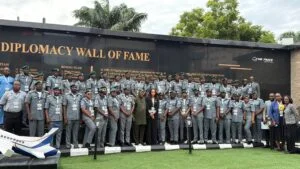
The Nigerian Institute of International Affairs (NIIA) has emphasised the importance of strategic foresight and trade intelligence for the Nigeria Customs Service (NCS).
Prof. Eghosa Osaghae, Director-General of NIIA, said the foresight and intelligence were critical to navigating the complexities of the global trade environment and advancing Nigeria’s economic interests.
Osaghae made this known on Monday in Lagos at the opening of an Advanced Senior Executive Course on Strategic Foresight and Trade Intelligence for senior officers of NCS.
The programme was organised by the Bashir Adeniyi Centre for International Trade and Investment (BACITI) of the NIIA.
The two-week programme for officers in the ranks of Assistant Comptroller and Chief Superintendent includes intensive classroom engagement, which would be followed by a one-week study tour.
The programme is expected to provide participants with practical exposure to relevant institutions and best practices in trade facilitation.
According to Osaghae, rapid technological advancements, evolving geopolitical dynamics, emerging security threats, digital commerce, climate-related disruptions, and shifting supply chains are redefining the context within which customs administrations operate.
The director-general noted that NCS occupied a strategic position at the intersection of national security, trade facilitation, revenue generation and economic development.
“As Nigeria deepens its engagement with regional and global markets through initiatives such as the African Continental Free Trade Area, Customs leadership must be equipped with the knowledge, tools and strategic mindset required to navigate future challenges and opportunities.
“This executive programme has been carefully designed to strengthen the capacity of senior customs officers in the areas of strategic foresight, trade intelligence, risk management, customs modernisation, technological innovation, and institutional transformation.”
Osaghae commended NCS under its Comptroller-General, Bashir Adeniyi, for commitment to continuous learning, professional excellence and institutional modernisation.
He described the programme as an investment in leadership development and organisational capacity, stressing that the future readiness of any institution would depend on the ability of its personnel to anticipate change, adapt to emerging realities and drive innovation.
“Through BACITI, we are particularly committed to advancing knowledge and strengthening competencies in international trade, investment, customs administration, and economic diplomacy,” he said.
Dr Adesuwa Erediauwa, Head of BACITI, said that the centre was established to promote capacity building, policy research, and advisory services on issues relating to trade, investment and international economic relations.
She said the course would strengthen participants’ capacities to anticipate future developments, apply strategic foresight methodologies, utilise intelligence-led decision-making and drive organisational transformation.
“We remain committed to supporting national development through professional training, evidence-based research, policy advocacy and stakeholder engagement,” she said.
Associate Prof. Godwin Ichimi, Acting Director, International Cooperation and Public Affairs at NIIA, said that trade remained an instrument of power and diplomacy.
Delivering a lecture entitled, “Global Geopolitical Trade Competiton and Supply Chain Disruptions”, Ichimi listed tools of trade power to include tariffs and quotas, export controls, sanctions and preferential trade agreements.
“Global trade is no longer just about economics, it is shaped by power, security and influence,” he said.
He highlighted the implications of power competition, security concerns and other geopolitical realities on customs.
According to him, trade policies are becoming more complex and strategically driven with risk management and intelligence being essential for border security.
“Trade is now a reflection of national strategy, not just market forces. Countries are using trade policy to advance security, resilience and strategic advantage,” he said.
Assistant Comptroller Goke Badmus expressed appreciation to NIIA and BACITI for organising the programme, describing it as comprehensive and well-structured.
“The course will enhance participants’ professional capacities and strategic leadership capabilities.
“It will also equip us with the tools required to navigate the evolving complexities of international trade and customs administration,” he said.
Chief Superintendent Patience Zagi from the Strategic Research and Policy Department of NCS described the programme as an opportunity to learn new ways of facilitating trade and generating revenue for government.
She said she would be open-minded to learn new strategies on trade intelligence and foresight.
One of the highpoints of the programme will be a strategic foresight war game expected to expose participants to simulated future trade and border management scenarios.
This exercise is designed to enable participants to identify emerging trends, assess potential risks, evaluate alternative policy options, and formulate strategic responses to complex future challenges.