By Richard Peters
For twenty-five years, the Ibom Deep Seaport has been Akwa Ibom’s biggest “Almost”. And as they say, nearly or almost cannot kill a bird.


Ibom Deep Seaport has been a priority across four different administrations in the State, in vision and in action. Conceived in 1999, carried through by four governors, approved by the Federal Executive Council, wooed by investors from China, France, South Korea and Singapore, yet not one container ship has berthed. Why?
The reason is not linked to lack of money alone, neither is it federal neglect alone. The single rope that has tied this project down at every turn is the fight over location and name. If some persons in Oro nation do not understand the technical facts and economic stakes now, they will chase the world away again, and spend another years telling stories instead of loading ships.
The history is long and every governor has carried the file. Governor Obong Victor Attah from 1999 to 2007 was the first to dream it. As an architect, he envisioned an “Akwa Ibom of our dreams” and placed a deep seaport at Ibaka in Mbo Local Government Area as the anchor. That choice was both political and emotional. It was meant to bring world-class infrastructure to Oro land, which produces the bulk of Akwa Ibom’s oil wealth but has always felt sidelined in project allocation. Obong Attah put the idea on Nigeria’s map, but his tenure ended before construction began.
Governor Godswill Akpabio picked up the file from 2007 to 2015 and pushed it from vision to procurement. In May 2015, the Federal Executive Council FEC approved the Outline Business Case and procurement phase for the Ibom Deepsea Port. Akpabio’s government handed the Certificate of Occupancy for land at Ibaka to the Nigerian Ports Authority NPA and promised delivery before 2015. But investors began to withdraw, citing community disputes and what they called a hostile investment climate. The project returned to the shelf.
Governor Udom Emmanuel inherited it from 2015 to 2023 and tried to revalidate it. He set up a Technical Committee chaired by Mrs. Mfon Usoro, former Director-General of NIMASA, and secured Full Business Case approval from FEC. His administration partnered with Busan Port Authority in South Korea and brought in Global Maritime and Ports Services GMAPS from Singapore as transaction advisor. But this period also produced the sharpest conflict. Some Oro stakeholders led by voices like Engr. Edet Nkpubre accused the government of relocating the port from Ibaka. They referenced a 2013 Due Diligence Report that they claimed selected a site near Ibaka Bay and Tom Shot Island as the most preferred location. The government’s response was firm. Mrs. Usoro said the relocation claim was disinformation because no FEC document ever fixed the port at Ibaka. Governor Udom himself went public to say that Oro petitions had scared investors away. The project stalled again.
Governor Umo Eno has carried the file since 2023 and injected new energy. He funded a comprehensive feasibility study, ordered new geotechnical and geophysical surveys, and completed an access road that had been abandoned for years. In June 2026, he led a delegation to meet Africa Global Logistics AGL in Paris to demand clear timelines and actionable next steps. At the Government House Monthly Prayer Service, he pleaded directly with Oro elders: “I am appealing to our fathers from Oron axis, this is your chance. Don’t miss this moment. There is nothing to fight about.” His warning was clear: if community feuds persist, he will hands-off and let investors decide elsewhere.
Now to the technical heart of why the location shifted from Ibaka to the current seaside area around Unyenge and why it should be Ibom Deep Seaport and not Ibaka Deep Seaport. A deep seaport is not defined by politics. It is defined by hydrography, draft, siltation, channel design and vessel size. Draft is the depth of water a ship needs to float without touching bottom. Dredging is the expensive process of excavating seabed to create that depth. Siltation is the natural deposition of sand and mud that reduces depth over time. Morphodynamics describes how waves, currents and sediment interact to shape the coast. Deadweight Tonnage DWT measures how much weight a ship can carry. And the global shipping industry now runs on Post-Panamax and New Panamax vessels that require drafts of 15 to 16 meters and above. If your water cannot take them, no shipping line will call.
Ibaka Bay has natural strengths. Academic research presented at the Western Dredging Association in 2015 found that Ibaka Bay has an average non-dredged draft of 13.5 meters and that minor dredging could deepen it to 15 meters for vessels of up to 200,000 DWT. Tom Shot Island also shields the bay from South-South-West Atlantic swells, giving natural protection. But the weaknesses are serious. In 2014, the state government’s own technical report classified Ibaka as suitable for vessels requiring a maximum of seven meters draft, while the open seaside was ideal for vessels requiring a minimum of 13 meters draft. The deeper problem is siltation. Ibaka is an estuary, and government satellite imagery presented by the Technical Committee shows heavy siltation of rejected locations including Ibaka upriver, compared to blue open waters at the approved seaside location. Estuaries silt quickly, which means perpetual dredging and perpetual cost. Banks that finance more than $4.2 billion projects see dredging as a risk, and they walk away.
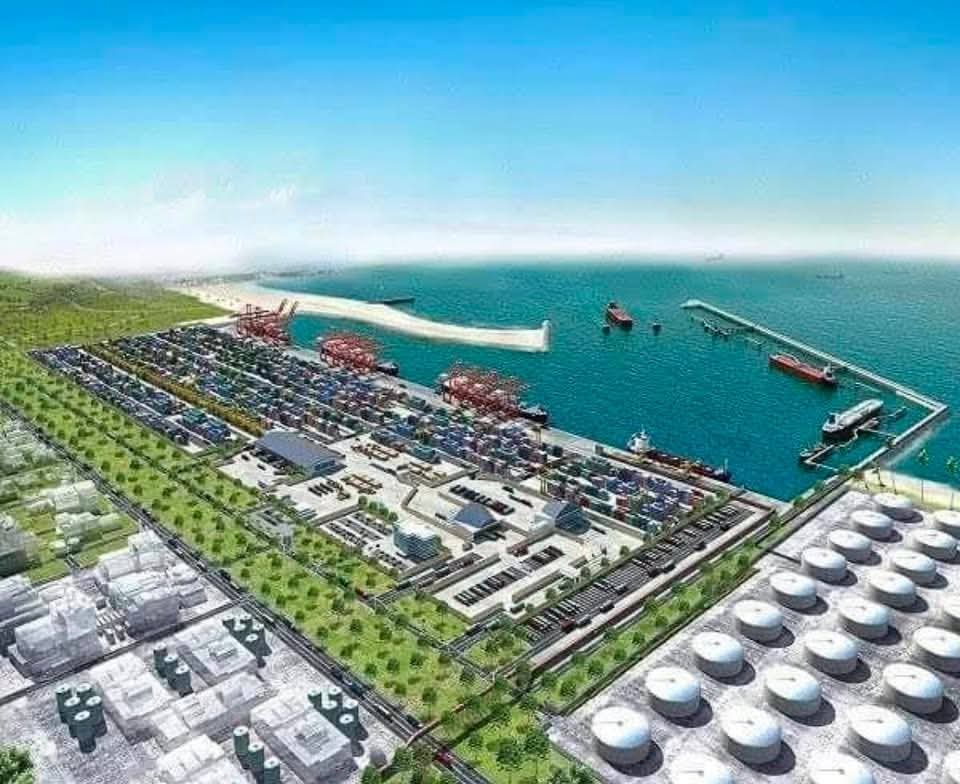
The current seaside site near Unyenge tells a different engineering story. According to the feasibility report presented to Governor Eno, the channel depth is 18.24 meters. The turning basin and berth pocket depth is 16.72 meters. The approach channel is over 18 meters deep, 20 kilometers long and 450 meters wide with two lanes. The government insists this depth is natural and requires no dredging, unlike Lagos Apapa which operates at 12 meters only after continuous dredging. The port is designed as a greenfield project spanning 2,565 hectares with another 1,565 hectares for future expansion. The quay length is 7.5 kilometers, meaning multiple ships can berth at once. It is directly integrated with the Ibom Industrial City and planned as a Free Trade Zone. When fully developed, the container terminals can berth up to 13 New Panamax Class container vessels and two very large feeder vessels simultaneously. The design vessel is minimum 80,000 DWT Post-Panamax, with New Panamax ships of up to 14,000 TEU containers. That is the scale needed for Nigeria to become a transshipment hub for West and Central Africa.
The engineering trade-offs are also clear. Tom Shot Island protects Ibaka Bay but the narrow estuary mouth restricts water exchange, causing more siltation and limiting channel width for 366-meter-long ships to maneuver. The seaside site faces open ocean, so engineers must build artificial breakwaters to manage wave energy. Government morphodynamic studies say the wave energy can be handled with breakwaters, and in return you get low siltation and direct access to deep ocean waters. The upfront cost of breakwaters is high, but the lifelong cost of dredging at Ibaka is higher. Rail and road connectivity is also easier to design from the seaside and Ibom Industrial City corridor than from the estuary at Ibaka, because cargo must move inland to Calabar, Port Harcourt and Cameroon.
So why was the location change necessary? The answer is engineering and economics. A 13.5-meter draft locks Nigeria into smaller feeder vessels of 3,000 to 5,000 TEU. An 18.24-meter natural depth allows us to compete with Lekki Deep Seaport and attract the biggest ships in the world without extra cost. Investors and banks demand natural depth because dredging cost kills profitability. The government’s position is that the FEC approval in 2015 was always for the seaside coordinates, not Ibaka Bay. From an engineering and investment perspective, the change was not betrayal. It was survival.
Investor history proves the point. During Akpabio’s years, Chinese company withdrew. During Udom’s years, French company withdrew after being named preferred investors. Both cited community disputes and uncertainty. Governor Udom said it openly: Oro petitions chased investors away. Governor Eno is saying it again: “This has happened before, and that led to the delay of the seaport project.” Africa Global Logistics and GMAPS are in the room now, but they will not commit about $4.2 billion where the host community is fighting the coordinates of the port.
Now to jobs, because that is what Oro should be negotiating for, not coordinates. A $4.2 billion port with 7.5 kilometers of quay and 2,565 hectares of reclamation typically creates over 50,000 to 80,000 direct jobs during the 5 to 7 year construction phase. These are civil engineers, welders, crane operators, divers, surveyors, dredgers and truck drivers. Once operational, a deep seaport of this size creates 15,000 to 300,000 direct jobs. Roles include dock workers, customs officers, NPA staff, terminal operators, logistics managers, ship agents, marine engineers, security personnel and ICT systems managers. The port plan includes specialized terminals for container, dry bulk, liquid cargo, crude oil and LNG, and each terminal creates thousands of jobs.
The multiplier effect is bigger. Ports create five to seven times indirect jobs in trucking, warehousing, clearing and forwarding, banking, hospitality, ship chandlery and food supply. The original Ibaka concept under previous administrations projected 100,000 employment opportunities including ancillary industries like refinery, independent power plant and factories inside Ibom Industrial City. The National Orientation Agency says the port can also cut $70 million yearly loss to illegal fishing by improving maritime security jobs. If Oro negotiates correctly, 20 to 40 percent of unskilled labor and 30 percent of skilled contracts can be reserved for the indigenes. That translates to potentially 20,000 to 40,000 Oro jobs across construction, operations and Ibom Industrial City.
Geography also tempers the pain. Both Ibaka and Unyenge are in Mbo Local Government Area. Both are Oro land. The distance between them is roughly some kilometers of coastline. The government’s message is that this is still Oro’s project, Oro’s jobs, Oro’s legacy.
The emotional hurt in Ibaka community is real because people feel like original owners losing their birthright. But development is not a zero-sum game. If Oro negotiates equity, job quotas and contracts now, the benefits will still flow to Oro sons and daughters, whether the quay is at Ibaka or at Unyenge.
Why It Must Be “Ibom Deep Seaport”
The name “Ibom Deep Seaport” is not sentiment, it is a legal and financial contract. Every federal approval, FEC memo, ICRC certificate, investor MOU and IMO registration has been signed under “Ibom Deep Seaport”. Changing it to “Ibaka” forces a legal amendment: new environmental approvals, new documents, new contracts with banks and insurers. Investors see that as project risk and will walk away, the same way others walked away before due to uncertainty. Oro cannot eat a name, but Oro can eat jobs, contracts and royalties and those are attached to the legal name already approved. “Ibom” is the name on the money.
Globally, ships and trade do not dock at villages, they dock at economic zones. No captain in Rotterdam or Shanghai books for “Ibaka”; they book for “Nigeria > Akwa Ibom > Gulf of Guinea”. “Ibom” is the state brand recognized by IMO, shipping lines and insurers, just like “Lekki” not “Ibeju-Lekki Village” and “Lagos Port” not “Apapa Village Port”. That brand brings instant recognition, higher traffic and better freight rates, which means more ships and more jobs for Oro youths at the quay. It also protects unity. The port footprint covers 2,565 hectares stretching beyond Ibaka into Idua, Unyenge and Esuk Aku. If we call it “Ibaka Port”, tomorrow Idua will demand a rename and we restart the same fight. “Ibom” is neutral and inclusive, covering all Oro clans and Akwa Ibom. The land stays Oro land, the jobs stay Oro jobs, the royalties stay Mbo LGA revenue, we just let the state carry the brand. Fight for coordinates and you may lose the port. Fight for the name and you will definitely delay the money. Accept “Ibom” on the signboard, then lock Oro into the contract, jobs and equity. That is logic, not concession.
We have been here before. Some Oro stakeholders once protested the Victor Attah International Airport, arguing that Calabar was close enough. We delayed it, fought over it, and today Oro nurses, lecturers, traders and students fly through it every week. We lost years arguing, then became the airport’s biggest users. The Deep Seaport must not follow that script. You can win the argument for Ibaka and lose the port entirely. Or you can win the port at Unyenge and still win jobs, contracts and prosperity for Oro.
The conclusion is hard but clear. The shift from Ibaka to the seaside site and was driven by hydrography, economics and investor reality, not ethnic politics. Thirteen point five meters of draft plus heavy siltation cannot compete with 18.24 meters of natural depth in 2026 shipping economics. Depth brings ships. Ships bring jobs. Jobs build generations. The world is offering over $4.2 billion to build the biggest maritime hub on the Gulf of Guinea. If Oro chases them away with petitions, name and location wars, the project will be stalled, and our children will ask why the money port is not in Oro land. The answer will be painful: because we chose coordinates over capacity.
Oro’s power today is not to chase the world away. Oro’s power is to sit at the table with facts and demand binding terms: job quotas for Mbo youths, contracts for Oro contractors, community equity in the Public-Private Partnership structure, and direct infrastructure linking the port to Ibaka town. Let us anchor prosperity instead of anchoring drama. This is our chance to flourish, and we cannot allow this golden opportunity flip through our fingers’ tips. Otherwise, posterity will never forgive us. This is a challenge for Oro across generations!
Venerable Richard Peters is a Public Relations Expert and writes from Uyo.