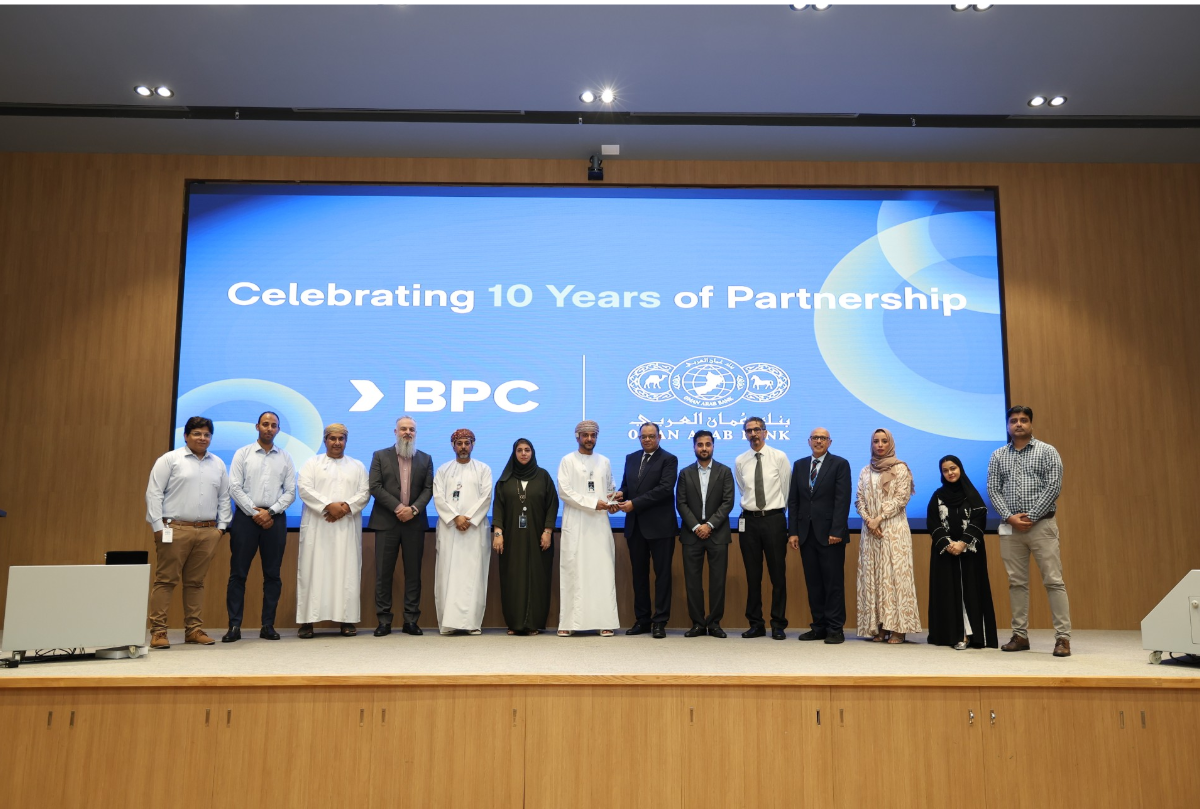
Oman Arab Bank (OAB) and BPC, a global leader in payment solutions, are marking 10 years of partnership, celebrating a decade of card and payments modernisation that has helped reshape the bank’s issuing and acquiring business in Oman.
Over that period, OAB has expanded from local card services into a broader modern card proposition, introduced contactless and enabled instant card issuance, and recently went live with Visa tokenization that positions the bank to introduce innovative and secure digital-first customer payment experiences.
Today, OAB is able to connect seamlessly to local and international schemes, support settlement and reconciliation, and launch innovative debit card propositions to market faster. The platform has strengthened and secured payment acceptance across the bank’s acquiring business, giving OAB more scalability for expansion.


For customers in Oman, the impact is visible in everyday banking. With Visa tokenization now in place, OAB cardholders benefit from more secure digital payment experiences, including safer card use in digital wallets and online environments where sensitive card details are protected through tokenized credentials. Customers can also access internationally enabled cards, use contactless payment options, and issue, renew or replace cards more quickly through self-service channels. The bank has further broadened its premium card offering for affluent segments while making modern payment tools more accessible to retail users, improving convenience, flexibility and payment choice across the customer base.
“Our partnership with BPC has played an important role in the evolution of our cards and payments business over the decade. What started as a need to support international card issuing has become a broader transformation that has strengthened how we serve customers across Oman. At OAB, innovation is always centred around making banking faster, smarter and more accessible. The introduction of tokenization and instant card issuance is another step in redefining convenience for customers, while reinforcing our vision of accessible banking.”
– Tariq AlZadjali, CTO, Oman Arab Bank
Across the partnership, OAB expanded its acquiring capabilities to support Visa, Mastercard and American Express international schemes. At the same time, the bank modernised card issuance and personalisation introducing contactless cards and VTS integration, and secured processing across its ATM and POS networks. Modernisation allowed the bank to offer instant issuance via its ATMs, allowing customers to issue, renew or replace cards and update PINs through self-service channels. The service covers multiple card types, including Classic, Advantage, Platinum, Elite, as well as the Maal card, Oman’s new local card scheme sponsored by the Central Bank of Oman. To comply with all international and local scheme mandates, OAB upgraded its ACS environment.
Through a decade of innovation, OAB focused on customer-centric features for its ATM and ITMs network, which now support a wide range of everyday services, including local and international fund transfers, utility bill payments, donations, cheque book requests, contact details updates, PIN management, daily spending limit changes, card payments and access to account statements.
Among the bank’s most visible recent milestones has been the introduction of Visa tokenization, which provides OAB with a stronger foundation for more secure digital payments, smoother wallet-based payment experiences and readiness for the next generation of innovations. Building on this progress, the bank is also advancing on Visa Click to Pay requirements linked to tokenization. While improving customer convenience, OAB is well set to expand further into e-commerce, digital-first checkout journeys and online payment experiences that shape how customers pay and shop in the region.
Looking ahead, the partnership continues to evolve. OAB is currently working with BPC on expanding security into digital banking, core banking, and corporate systems. This will allow the bank to unify fraud monitoring on one platform instead of relying on multiple distributed systems.