The Minister of Labour and Employment, Dr Muhammadu Dingyadi, has commended the Nigeria Social Insurance Trust Fund (NSITF) for implementing reforms aimed at transforming the administration of Nigeria’s Employees’ Compensation Scheme.
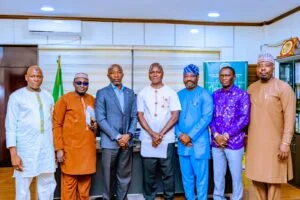
The minister gave the commendation while receiving a delegation from the Gambia’s Social Security and Housing Finance Corporation (SSHFC), led by its Industrial Injuries Compensation Fund Board, on Tuesday in Abuja.
The delegation was led by the Managing Director of NSITF, Mr Oluwaseun Faleye, during a courtesy visit aimed at strengthening cooperation on employees’ compensation administration and social security systems.


Dingyadi, who was represented by the Permanent Secretary, Dr Kamil Shoretire, praised the reforms introduced by Faleye, describing them as transformative for the administration of Nigeria’s Employees’ Compensation Scheme.
He said the visit would strengthen cooperation between both countries and provide opportunities to exchange ideas on improving social insurance systems for the benefit of workers.
The minister said Nigeria had improved its compensation mechanism through reforms and digitisation, ensuring faster processing of claims and better service delivery for beneficiaries nationwide.
“Our compensation mechanism has improved, and a lot of digitisation is happening now to ensure that claims are attended to as soon as possible.
“A lot of transformation has been going on in the Nigeria Social Insurance Trust Fund under the present leadership,” he said.
Dingyadi said both countries should continue sharing experiences and best practices to improve workers’ welfare and enhance the effectiveness of their respective social security institutions.
“It is very important that the two countries exchange ideas on how to improve the lives of their citizens, particularly the working population our institutions serve,” Dingyadi said.
He added that Nigeria remained committed to continuous improvement and was equally willing to learn from the Gambia’s experiences in strengthening social insurance administration and workers’ protection.
“Our own is an ongoing process. We have not reached where we want to be. We also want to learn from what Gambia has achieved,”he said.
Responding, Faleye commended the minister for receiving the delegation and reaffirmed NSITF’s commitment to regional cooperation in advancing employees’ compensation and occupational safety across West Africa.
He said Nigeria and Gambia shared similar demographic characteristics and labour market realities, making collaboration necessary in addressing common challenges facing workers and social security institutions.
“This exchange of ideas has been in the making for a long time. We readily accepted the request because our countries share similar challenges and opportunities,” he said.
Faleye recalled that the Gambian delegation participated in the International Social Security Association (ISSA) workshop hosted by NSITF earlier in the year alongside other West African countries.
He said the study visit would enable both institutions to deepen technical cooperation through practical engagements involving their operational departments and exchange of institutional experiences.
“We do not see this as learning from us alone. The interaction also enables us to understand their peculiar situations and learn from them,”he added.
He said NSITF remained committed to strengthening regional partnerships while promoting workplace safety, hazard prevention and effective compensation systems for workers across the sub-region
The Gambian delegation, led by Mr Pierre Gomez, expressed satisfaction with the reforms introduced by NSITF, describing Nigeria as a valuable partner in knowledge sharing.
“Nigeria is our big brother. We are here to share experiences, learn from your successes, and take that knowledge back home,” he said.
Gomez said he had observed remarkable changes compared to his previous visit to Nigeria a decade ago.
He added that the transformation demonstrated NSITF’s commitment to institutional development and service improvement.
“I have seen a lot of changes happen. It is imperative to come back, acquire this knowledge, and share it with our colleagues back home,” he said.