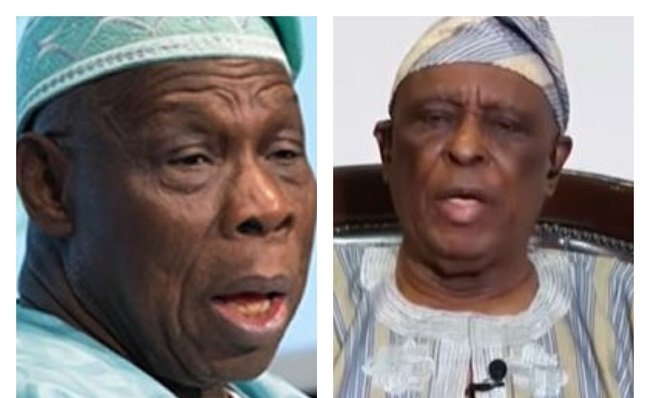
The mid-afternoon heat hung thick over the red dust of Ota, but inside Chief Olusegun Obasanjo’s farmhouse, the air was cold enough to bite.
On the table between the former President and his old associate lay a copy of The Legal Observer of July 20, 2026. Obasanjo’s broad fingers tapped rhythmically against the headline, a deep scowl settling onto his face as he looked across at the man sitting opposite him.
”Aremo,” Obasanjo’s voice rumbled, heavy with a mixture of disbelief and quiet fury. There are many things you got wrong, and many things you omitted—advertently or inadvertently—in your write-up. Your presentation was farfetched, to put it mildly.”
He leaned forward, placing his palms flat on the wooden table.
”Before I go any further, I take strong and serious objection to your calling me a deceit! I deceived nobody. I always presented my case and all issues as I had them, and as I understood them, no matter whose ox was gored.”
Obasanjo shook his head, holding up a finger to cut off any immediate protest.
”There were issues you did not know or understand because, as you pointed out yourself, they were above your head. They were handled by your elders in the Alliance for Democracy and Afenifere. And there were issues that you governors of the South-West kept away from me—things that normally should have been raised directly with me, but were discussed somewhere else.”
He paused, taking a breath, his tone shifting from sharp anger to a cold, measured candor.
”I would not say that you were diabolical or deceitful. You chose what you would do, and you did what you chose. Others could also choose differently.”
Obasanjo leaned back in his chair, his eyes reflecting memories from years past—the days immediately following his release from prison.
”When I came out,” he recalled softly, “many people came to congratulate me and started insinuating that I should have a role in government again. I paid no attention initially. I had serious family matters—my children’s schools to attend to. But soon, groups started to call on me directly to invite me, not just insinuate.”
He began counting the delegations on his weathered fingers. “The first group was led by Lawan Katsina right here to my Ota farm. I received them, thanked them, and promised to think about it. The second was led by Chief S.M. Afolabi. The third by Martins Kuye. Those last two were Yoruba-led, and I told them clearly: ‘The circle needs to be widened and enlarged.’ You didn’t know I had these contacts, did you?”
A brief, wry smile crossed his face as he recalled the early political chess moves. “With those approaches, I decided to consult across the South-West, East, and North. In Ibadan, I met Chief Akinloye, Chief Bola Ige, Chief Richard Akinjide, and Professor Oyeleye. In the North, my close friends Sunday Awoniyi and Adamu Ciroma. In the East, Professor Anezi Okoro and Arthur Mbanefo. It gave me a quick, good feel of the landscape. From there, I took an interest in party formations—especially the Peoples Democratic Party.”
Obasanjo tapped his chest. “For me, politics is for the welfare and well-being of the people. There should be no personal bitterness. If you don’t play politics my way, that shouldn’t lead to hatred or antagonism! It is a matter of ideas and choice.”
He chuckled, the memory bringing a sudden flash of warmth. “While competing with Alex Ekwueme for the PDP nomination, I was a guest in his own house in Anambra! We ate together. The following morning, I went out to campaign. I told him, ‘Alex, when I become President, I will repair the road to your settlement.’ He just retorted, ‘What I can do for myself, I will not give to someone else to do for me!’ We laughed it off.”
His expression sobered as he turned his mind back west. “On three occasions, I visited Chief Abraham Adesanya. On all three, he vowed that the Yoruba would not vote for me. But as a Yoruba boy, born and bred well, I gave respect where it was due. He asked me to join the AD, and I told him straight: ‘AD, as essentially a tribal party, is in a cul-de-sac.’ Yet, every time I called on Papa Adesanya at his Apapa residence, he made sure his daughter entertained us well. Otunba Fasawe accompanied me on every visit and heard my prayers. Aremo, I wonder how much of that you even knew?”
Obasanjo’s voice dropped, carrying the weight of historical grievances.
”Before the election, President Jimmy Carter visited to ensure a peaceful process. He met presidential hopefuls at the Sheraton in Ikeja. As I was going in, Bola Ige was coming out. I asked him, ‘Bola, how now? I met you in Ibadan and you said there would be fence-mending to do. Have you done the fence-mending for me?'”
Obasanjo mimicked Ige’s sharp response: “He said, ‘We will meet in the field.’ Well, we never met in the field. That, too, was above your head.”
He adjusted himself in his seat, resting his elbows on the table. “The elections came. PDP won 21 state governorships across the country, minus Yorubaland. At the presidential level, almost 63 percent of the votes were cast for me—though not many from our home soil. But my philosophy has always been to turn adversaries into neutrals, and neutrals into friends. Bringing PDP and AD together for a national government wasn’t out of weakness; it was out of strength and national unity.”
”As soon as we took office,” Obasanjo continued, “I called a meeting of all our defeated South-West PDP governorship candidates. They tried to make excuses. I stopped them immediately: ‘This is not the time for excuses, but action. The Yoruba did not vote for us today, but next time I want them to vote for us, and we begin now.’ I told Dr. Segun Agagu I would start in Ondo. The first AD stalwart I invited was Mrs. Mobolaji Osomo, a fellow poultry farmer. I told her, ‘The Yoruba have been on the periphery for too long. Come to the mainstream.’ She didn’t hesitate.”
Obasanjo leveled a hard look at his listener. “You talk of ‘stooping to conquer.’ When I visited your state while you were governor, I normally called on you at home. You called back on me. Eniti ko kini kuule, o padamu e kaabo. I don’t believe in presidential arrogance. It’s all part of stooping to conquer for good leadership.”
His brow furrowed deeply as he brought up a darker chapter. “And that brings me to Na’Abba’s impeachment attempt that you talked about so glowingly. The way you wrote about it—talking about remorse—suggests stack ignorance on your part, or being an accomplice! Both are possible.”
Obasanjo leaned in closer, his voice dropping to a harsh whisper. “Na’Abba’s impeachment began right inside the Presidency—by my own Vice-President. On a Friday when I was out of the office, he invited Na’Abba into his room. He convinced him that I should only have one term. This was the act of a man I brought up from governorship to the Vice-Presidency! From day one, he raised campaigners for his own presidency. On that Friday, he gave Na’Abba five million naira to begin the impeachment work. It was all recorded and reported to me by my Chief of Staff, a professional intelligence officer.”
Obasanjo scoffed dismissively. “I treated it with contempt. I had committed no impeachable offense. It was President Shagari who approached me on his own volition, asking to handle it, and I gave him the go-ahead. Tell me, Aremo: show me what I should be remorseful for if you were in my position?”
He shook his head at the absurdity of the past political calculations. “You created this idea of a monumental political upheaval that required six AD governors to extricate me from. Ridiculous! Six dictating to thirty? I had an Executive Council, a National Assembly, a virile party, 21 governors of my own, and 9 APP governors aligned with my government. To think AD and Afenifere could dictate to me was to grossly underrate me.”
”It was the same thing before my swearing-in,” Obasanjo added, his eyes flashing. “I was invited to Papa Onasanya’s house in Surulere. When I got there, five AD stalwarts were waiting. Papa took me into a room alone and asked, ‘What do we do with a Yoruba President?’ I screamed! I told him, ‘A Nigerian President must not be trivialized by tribalizing it!'”
He pointed an accusatory finger across the table. “You all got caught up in my Vice-President’s game. When his impeachment scheme failed, he fed you an anti-democratic plan: support Alex Ekwueme, or keep your six AD states unchallenged in 2003 so you could yield the field to him in 2007. You all fell for it! An idaro! None of you bothered to check with me. You thought dealing with the VP was a clever political move.”
Obasanjo chuckled coldly. “Let me remind you of what late Shehu Yar’Adua did to you in Abeokuta during the SDP days, and what Papa Ajasin told me about him. Shehu was my protégé. Whatever the protégé could do, the mentor could do as well—if not better. Your loss in 2003 was genuine across the board, except where figures were murderously altered in Lagos. You barely campaigned! At the end, you even went on TV apologizing for your arrogance, saying the starch in your agbada made you look stiff!”
He paused, letting the silence fill the room before his tone finally softened. The fierce political warrior seemed to yield, if only slightly, to the old elder from Abeokuta.
”I sympathized with some Afenifere leaders who died with regret—Chief Gani Daudu, Chief Abraham Adesanya, Chief Ayo Adebanjo. I was close to some of them before they passed. God answered my prayers that I was not too far from their deathbeds. I hold no bitterness.”
Obasanjo stood up, walking toward the window overlooking his farm, his back turned for a moment before he looked back over his shoulder.
”Aremo, in politics, no one should be ignored, and while politics may end, relationships live until life’s end. Party lines never stopped us when it mattered for our people. Remember Abuja? I wanted governors to buy land and build houses there to develop the capital. And when you developed Osoba Hilltop, you took me to show me the plot you allocated to me alongside Chief Shonekan.”
A genuine, warm smile broke across Obasanjo’s face, softening the harsh lines on his forehead.
”But the greatest service you ever rendered to me—and to Abeokuta—was the land you allocated for the Olusegun Obasanjo Presidential Library. It has become the most significant landmark in our city. The allocation was made for the good of the country and in the best interest of Ogun State, with no politics played and no games involved.”
Obasanjo walked back to the table, placing a heavy, warm hand on the man’s shoulder.
”All of us in Abeokuta thank God for that landmark, we thank you, and we thank God for your life. But remember, Aremo… it is never over until it is over, and there is no end to humility and thanksgiving.”