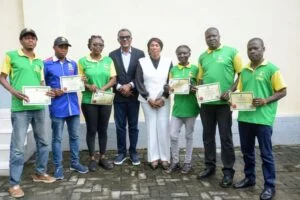
The Nigerian Railway Corporation (NRC) has graduated 31 newly trained locomotive pilots, who successfully completed over one year of intensive theoretical and practical training in locomotive operations.
The Managing Director, NRC, Dr Kayode Opeifa, at the ceremony on Tuesday, said the training reflected the corporation’s unwavering commitment to safety, professionalism and operational excellence.
Opeifa was represented by the Director of Administration and Human Resources, Dr Monsurat Omotayo.


He described locomotive pilots as the driving force behind the ongoing transformation and reforms in Nigeria’s railway sector.
The managing director said that the newly graduated pilots would play a critical role in the ongoing expansion of railway operations across the country.
The NRC boss said that the current administration remained committed to initiatives such as partnering with state governments on rail development.
According to him, it is a move that will enable more states to provide affordable and reliable rail transportation for their residents.
“Also close to the heart of this management are the track access policy and freight revolution.
“As locomotive pilots, you will be at the centre of these initiatives and the future of railway transportation in Nigeria,” Opeifa said.
He assured the new pilots, including two women, of the corporation’s commitment to continuous capacity building.
He said that sustained exposure to global best practices would further strengthen safety, efficiency and reliability in railway operations.
Asst. Director, Motive Power, Mr Abiodun Olokun, disclosed that 45 staff members drawn from various operational departments of the corporation were shortlisted for the training programme.
He said the programme was conducted at the NRC Training Schools in Lagos, Zaria, and Kaduna States.
“31 trainees successfully graduated, while 11 others have been directed to continue with further practical training to enhance their competence.
“Two trainees did not meet the required performance standard, while one trainee could not complete the programme following a road accident.
“The three have been returned to their respective departments,” he said.
He noted that all trainees were taught by experienced instructors and underwent simulator training at the Zaria Training Institute.
“We had three months of intensive classroom instruction followed by six months of practical training covering all operational departments,” he said.
Speaking on behalf of the graduating class, Amina Oden, expressed appreciation to the management of the corporation for investing in their training and restoring pride to the locomotive operations cadre.
Oden, who was the class governor, assured the management that the graduates would justify the confidence reposed in them through professionalism, discipline and dedication to duty.