

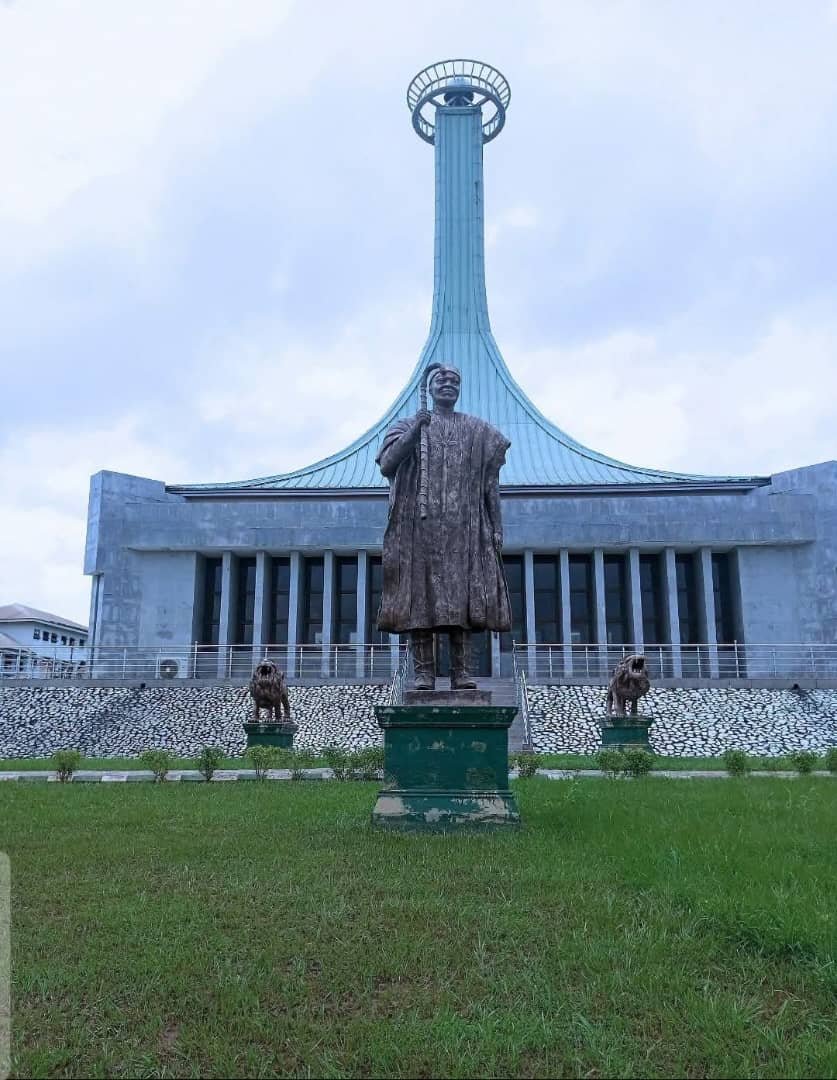
Standing in Onitsha, Anambra State, the Zik Mausoleum preserves the memory of Dr. Nnamdi Azikiwe, one of the foremost figures in Nigeria’s struggle for independence and the country’s first President.
The story of Nigeria’s history is filled with personalities whose contributions shaped the country long before and after independence. Among the most prominent was Dr. Nnamdi Benjamin Azikiwe, popularly known as “Zik of Africa.” Today, his memory is preserved at the Zik Mausoleum in Onitsha, Anambra State, a national monument built around his final resting place.


The mausoleum is located at Inosi-Onira, Azikiwe’s residence in Onitsha. It houses his tomb and forms part of a larger complex containing facilities intended for research, conferences, documentation, and the preservation of his legacy.
Who was Nnamdi Azikiwe?
Nnamdi Azikiwe was born on 16 November 1904 and became one of the leading Nigerian nationalists of the 20th century. He was a journalist, politician and statesman whose activities contributed significantly to the nationalist movement that eventually led Nigeria to independence in 1960.
Following independence, Azikiwe became Nigeria’s governor-general from 1960 to 1963. When Nigeria became a republic in 1963, he became the country’s first President, serving until the military coup of January 1966.
Although Azikiwe was born in Zungeru, present-day Niger State, he had strong connections with Onitsha, where he grew up and later maintained his residence. His association with the city explains why his final resting place became an important landmark in Onitsha. The architectural plans for the mausoleum also reflect a deliberate attempt to combine modern architecture with traditional Igbo influences.
From burial site to national monument
Azikiwe died on 11 May 1996, aged 91. Following his death, the Federal Government announced plans to develop his graveside into a major memorial complex in recognition of his contribution to Nigeria.
Construction of the mausoleum began in 1997, during the administration of the late General Sani Abacha. However, the project did not proceed smoothly. It passed through different administrations and was abandoned for several years before being revived.
In 2012, the Federal Executive Council approved about ₦1.496 billion for the completion of the project. The contract was subsequently re-awarded, and construction eventually reached completion in October 2018.
The long delay meant that the monument took more than two decades to move from an ambitious proposal to a completed national memorial.
What can visitors find at the mausoleum?
The Zik Mausoleum is more than a tomb.
The complex was designed to include a museum, archives, library, research and documentation facilities, conference halls, offices and other administrative spaces. These facilities were intended to make the site not only a place of remembrance but also a centre for learning and research.
Inside the memorial area is Azikiwe’s final resting place, while the wider complex provides space for preserving materials connected with his life and political career.
The architectural design itself is also part of the attraction. The building features a distinctive sweeping roof and tall vertical elements that give it a striking appearance. Architectural research on the building notes the combination of modern and traditional Igbo influences, as well as design responses to Nigeria’s tropical climate.
The official commissioning
After the completion of the project, President Muhammadu Buhari commissioned the Zik Mausoleum on 24 January 2019 in Onitsha.
During the commissioning, the federal government described the monument as a place of national and international significance. Buhari said the memorial should promote nationalism, patriotism and public service, encouraging Nigerians to learn from Azikiwe’s commitment to knowledge, leadership and national development.
The Federal Ministry of Works later explained that the project was conceived as both a national monument and tourism centre dedicated to Azikiwe’s memory.
A monument with a complicated history
The story of the Zik Mausoleum is not entirely one of celebration. Its construction history also illustrates some of the difficulties surrounding the preservation of Nigeria’s historical heritage.
The project was initiated shortly after Azikiwe’s death but remained unfinished through several administrations. Reports from the period before its completion described the abandoned site as being overgrown and poorly maintained.
Even after its completion and commissioning, concerns about maintenance have continued.
A May 2026 report by Vanguard described the mausoleum as being in a poor and overgrown state, raising fresh questions about the management and preservation of the monument. The report also recalled that the complex contains the mausoleum, museum and administrative facilities.
This creates an important conversation: Is completing a historical monument enough, or should governments also guarantee its long-term maintenance?
Why the Zik Mausoleum matters
The significance of the Zik Mausoleum goes beyond Onitsha or Anambra State.
Azikiwe played a major role in Nigeria’s political history and was one of the country’s most recognisable nationalist figures. His career crossed journalism, politics and constitutional development, while his presidency placed him at the centre of Nigeria’s early years as an independent republic.
For younger Nigerians, the mausoleum can therefore serve as more than a tourist attraction. Properly preserved and interpreted, it can become a place where students and visitors learn about Nigeria’s political history, independence movement and the people who helped shape the country.
The Federal Government itself stated during the 2019 commissioning that the monument was intended to promote nationalism, patriotism and public service.
A landmark worth preserving
The Zik Mausoleum represents an attempt to turn the final resting place of one of Nigeria’s most influential statesmen into a permanent centre of remembrance.
Its distinctive architecture, museum facilities, library, archives and conference spaces give it the potential to become an important heritage destination in southeastern Nigeria.
But its future depends on more than the building itself. Historical monuments require continuous maintenance, proper management, public access and educational programming.
For a country with a rich but sometimes poorly preserved history, the Zik Mausoleum offers an important reminder: remembering national heroes is not only about building monuments in their honour; it is also about preserving their stories for generations that never met them.




