Uganda has given its long-awaited crude oil a global commercial identity, unveiling ‘Pearl Sweet’ as the official name of the blend that will be sold to international markets when the country begins commercial production later this year.
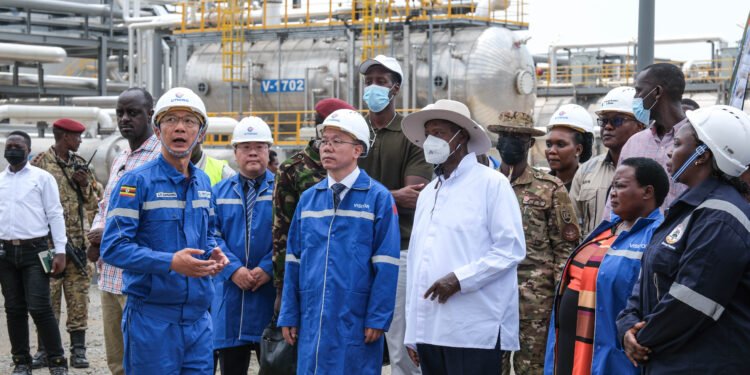
President Yoweri Museveni announced the name on September 2 at the Kingfisher Development Area in Kikuube District, marking a shift from years of oilfield construction and pipeline development towards the commercial phase of one of East Africa’s biggest energy projects.
The significance goes beyond branding. International crude oils are traded as recognisable grades defined by origin and physical characteristics. A distinct identity allows refiners, traders, shippers and market analysts to assess the crude, compare its quality with competing grades and gradually establish a trading and pricing history around it.


‘Pearl’ draws on Uganda’s longstanding ‘Pearl of Africa’ identity, popularised by Winston Churchill, while ‘Sweet’ refers to the crude’s relatively low sulphur content.
EACOP, the company building the export pipeline, describes Uganda’s crude as medium-to-heavy and waxy, with a pour point of about 40°C. That characteristic means it must be heated to remain fluid during transportation.
The specification is commercially important. Refiners buy different crude grades according to sulphur content, density, processing requirements, likely product yields and price.
The Uganda National Oil Company (UNOC) said Pearl Sweet broadly compares with other waxy, sweet African blends, including Chad’s Doba crude and the Nile and Dar grades associated with Sudan and South Sudan, Reuters reported.
Following the naming, UNOC says the next phase will include outreach to refineries, market intelligence and commercial negotiations with prospective buyers. Those discussions will ultimately help determine where Pearl Sweet is sold and how the grade is valued against competing crudes.
For Uganda, it brings two decades of oil development closer to generating export revenue.
The new blend will combine crude from the Tilenga and Kingfisher developments before entering the East African Crude Oil Pipeline at Kabaale in Hoima District.
Tilenga, operated by TotalEnergies EP Uganda, is designed to produce about 190,000 barrels per day at peak, while CNOOC Uganda’s Kingfisher project is expected to contribute roughly 40,000 barrels per day. Combined production could reach about 230,000 barrels per day.
The 1,443km EACOP will carry the crude from landlocked Uganda to the Chongoleani marine terminal near Tanga on Tanzania’s Indian Ocean coast.
The project said on September 1 that construction had reached 92.7 percent overall completion, bringing the export system closer to commissioning.
The advance follows repeated delays to Uganda’s first-oil timetable as the government, project developers and financiers worked through tax, regulatory, infrastructure and funding arrangements.
Reuters reported that commercial production is now expected by the end of 2026, an outlook also reflected in the IMF’s latest assessment of Uganda.
Museveni said Uganda had deliberately pursued a strategy intended to retain more value from petroleum resources at home, including refining and greater domestic participation.
‘What you sow is what you reap,’ he told the ceremony, arguing that the finite resource should generate benefits extending to future generations.
UNOC said Tilenga, Kingfisher and EACOP represent an investment programme of about $15bn, with more than $12bn already invested across the developments.
The state oil company holds a 15 percent participating interest on behalf of the government in the two upstream projects and, through its pipeline subsidiary, a 15 percent interest in EACOP.
The commercial transition comes as Kampala pursues a wider hydrocarbons strategy. Uganda and Tanzania are also pursuing plans for a wider Tanga energy hub, potentially expanding the coastal city’s role beyond crude exports into storage, refining and regional energy logistics.
The IMF said in July that the start of oil production should strengthen Uganda’s fiscal and external balances over the medium term. It also cautioned that future petroleum revenues should be directed towards growth and social development while protecting intergenerational equity.
Uganda’s approach to first oil remains controversial.
EACOP has faced sustained opposition from environmental and human-rights campaigners over its climate impact, land acquisition and effects on communities along the route.
In July, four Ugandan farmers launched proceedings in London’s High Court against EACOP Ltd, the UK-registered company behind the pipeline.
As Africa Briefing reported on the EACOP court challenge, the claim could become an important test of the reach of UK courts over major overseas infrastructure developments.
Reuters reported that the farmers are seeking to invoke Ugandan constitutional, environmental and climate laws in their case against the company.
Supporters of the project have pushed back. The African Energy Chamber has criticised the UK proceedings, arguing that decisions over Uganda’s energy development should remain primarily with African institutions.
EACOP and its shareholders maintain that environmental and social safeguards have been incorporated into the project.
The launch of Pearl Sweet does not mean Ugandan crude is already flowing onto tankers. But it gives the oil a market-facing identity at the point when production facilities and the export pipeline are nearing completion.
UNOC chief executive Proscovia Nabbanja said the name gives the crude ‘a clear identity, a defined quality and a name the market can recognise’.
‘The Pearl speaks to Uganda. The Sweet tells refiners something important about the crude itself,’ she said.
For Uganda, that distinction matters. After years in which its petroleum story was dominated by discoveries, negotiations, financing battles and construction, the next phase will be judged by barrels produced, customers secured, prices achieved and how much of the resulting wealth reaches the wider economy.