The United Kingdom has announced a fresh package of sanctions targeting Israeli settlements in the occupied West Bank, including a ban on imports of goods produced in the settlements.
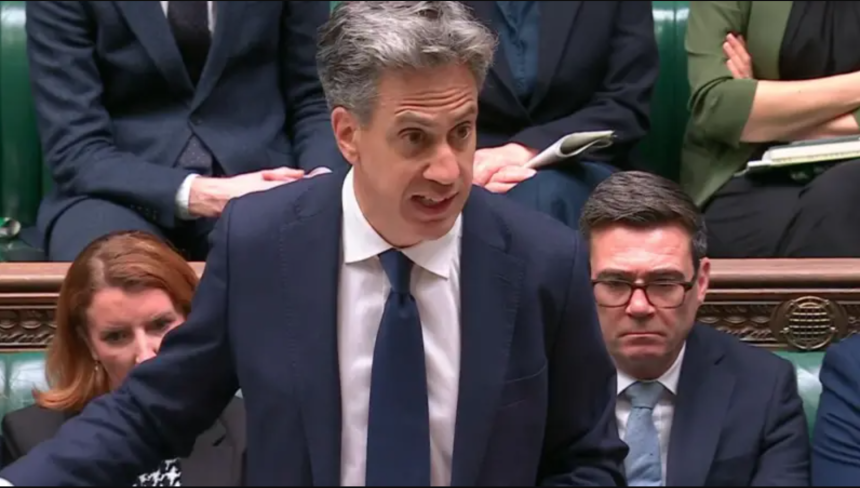
Foreign Secretary Ed Miliband announced the measures in the House of Commons on Tuesday, saying the British government would establish a “comprehensive sanction regime” against illegal Israeli settlements and those facilitating their expansion.
Miliband also accused Israeli settlers of carrying out what he described as “ethnic cleansing” in parts of the West Bank, alleging that Palestinians were being driven from their land by settler violence.


He told MPs that the Israeli government had too often “turned a blind eye” to the actions of what he called “settler terrorists”.
The British foreign secretary said the government’s official position was that Israel’s occupation of the West Bank was unlawful, citing Israel’s entrenchment of control, its intention to extend permanent sovereignty and its expansion of settlements.
Under the new measures, the UK will ban the import of goods from Israeli settlements in the West Bank and prohibit the advertising of illegal settlements in Britain.
Miliband said the sanctions would also target companies and individuals providing services, including construction and finance, that contribute to settlement expansion.
“You will face the full force of UK sanctions,” he told those facilitating the expansion of the settlements.
The government is also sanctioning another group of “extremist settlers” accused of supporting or inciting violence against Palestinian communities.
Miliband said Britain would further extend its existing global human rights sanctions regime to allow faster action aimed at deterring settlement expansion, including efforts to prevent the development of the proposed E1 settlement east of Jerusalem.
He stressed that the measures were directed at the settlements and settlement expansion rather than Israel itself, and rejected any suggestion that the policy amounted to a general boycott of Israel.
“I wholeheartedly oppose the boycott divestment sanctions, or BDS campaign,” Miliband said.
UK links sanctions to two-state solution
The announcement comes amid growing concern in Britain over Israel’s plans to develop about 1,200 new homes in the E1 area of the occupied West Bank.
The proposed development has drawn international condemnation because of its strategic location between East Jerusalem and the settlement of Maale Adumim. Critics argue that construction there could effectively divide the West Bank and make the establishment of a viable Palestinian state more difficult.
Miliband said the British government could no longer simply condemn developments it regarded as undermining the two-state solution without taking action.
He described Tuesday’s announcement as the beginning of a “new approach” in which Britain would not only speak out against injustice and suffering but also act.
The foreign secretary also announced that Britain would refuse new licence applications for arms and other exports that “materially contribute to the occupation”.
He said the policy would remain in place for as long as the occupation continues, describing it as creating a “double lock” on arms sales.
The UK has already suspended more than 30 arms licences used by the Israeli Defence Forces in Gaza, according to Miliband.
Israel and US warn of consequences
The measures have already triggered strong criticism from Israeli officials.
Israeli President Isaac Herzog described the British move as a “grave miscalculation”, arguing that sanctions would harm Palestinians and urging foreign governments to pursue dialogue instead.
Israel’s Foreign Minister Gideon Saar had earlier warned that if Britain acted against Israel, Israel would respond against Britain.
US Ambassador to Israel Mike Huckabee has also warned that Washington could react to the British measures, saying British companies could face restrictions in some US states.
The British government, however, insists that its relationship with Israel remains important and that its measures are intended to preserve the possibility of a two-state solution.