

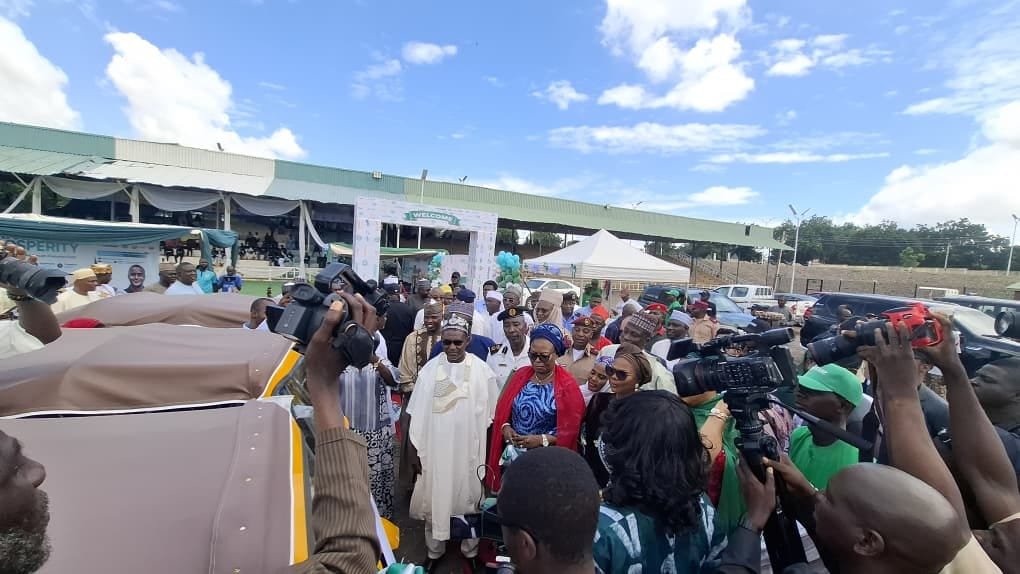
The Nigerian Consumer Credit Corporation (CREDICORP) has extended its nationwide rollout of 10,000 credit-backed, locally assembled vehicles to Yola, Adamawa State, advancing its drive to put productive assets within reach of working Nigerians through affordable consumer credit.
The rollout, held at the Mahmud Ribadu Square in Yola, marks CREDICORP’s arrival in the Northeast—a significant milestone in the Corporation’s expanding national mobility programme, taking credit-backed vehicle ownership deeper into communities across every region of Nigeria.
Having advanced through South-South, North-Central, and South-West—including Port-Harcout, FCT, Ijebu-Ode, Akure Lagos, and Ile-Ife—the rollout now arrives in Adamawa, with Borno to follow, before the programme moves into the South-East as CREDICORP progressively delivers the national programme across the country.

In a historic first, the Yola activation marks CREDICORP’s inaugural deployment of Compressed Natural Gas (CNG)-powered three-wheelers—a deliberate step that aligns the Corporation’s consumer credit mandate with the Federal Government’s energy transition agenda and its commitment to cleaner, more sustainable livelihoods for Nigerian workers. By financing CNG-powered vehicles, CREDICORP is ensuring that the transition to cleaner energy is not a burden on working Nigerians but an opportunity made accessible through responsible consumer credit.
The mobility rollout is part of CREDICORP’s broader effort to make consumer credit an everyday tool for Nigerians to own useful and productive assets, improve their livelihoods, and live better lives today. Across its programmes, more than 301,000 Nigerians nationwide have now accessed CREDICORP-supported consumer credit spanning mobility, digital devices, home improvement, life essentials, and other productive assets.
The vehicle rollout is being delivered under CREDICORP’s S.C.A.L.E. initiative—Securing Consumer Access for Local Enterprises—which connects the purchasing power created by consumer credit
with Nigerian production and enterprise. By financing locally assembled vehicles and other Nigerian-made goods, CREDICORP seeks to achieve two objectives at once: improving the lives and earning capacity of consumers while creating sustained demand for local manufacturers, assemblers, and businesses.
Speaking about the rollout, Engr. Uzoma Nwagba, Managing Director/CEO of CREDICORP, said the Yola activation represents a defining chapter in CREDICORP’s national mission. “What Nigerians are seeing in Yola today is one stop in a much bigger journey. We are taking consumer credit across every region of this country and putting productive assets into the hands of hardworking people who can use them to earn, grow, and live better now.”
“The CNG vehicles being deployed today carry a dual significance. They represent both our commitment to reaching Nigerians in every part of the country and our belief that the energy transition must be financed in a way that works for ordinary people. When a Nigerian can acquire a clean-energy vehicle today and pay responsibly over time, we have not only financed an asset — we have expanded that person’s economic possibilities while building demand for something produced here in Nigeria. Multiply that across thousands of people, communities, and industries, and consumer credit becomes a powerful engine for better lives and national economic growth.”
CREDICORP works through licensed financial institutions and an expanding ecosystem of manufacturers, vendors, and community partners to deliver its programmes. For the Yola rollout, Subcity Global served as the vendor and aggregator partner, mobilising beneficiaries and coordinating the deployment, while credit administration support was provided by Letshego Microfinance Bank and Accion Microfinance Bank. DAG Bajaj supplied the locally assembled CNG three-wheelers.
Through S.C.A.L.E. and its wider consumer credit programmes, CREDICORP continues to build a national marketplace in which responsible credit gives Nigerians the purchasing power to own more, earn more, and live better now—while that purchasing power increasingly supports Nigerian industry and jobs.




