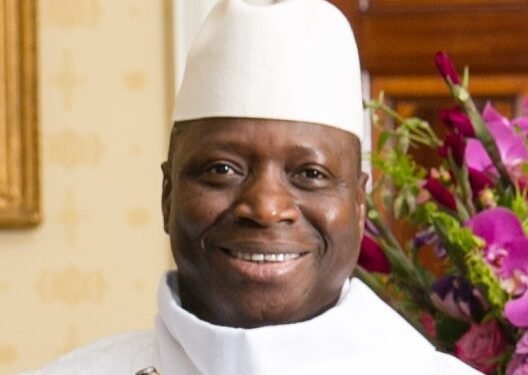
The United States is returning more than $2.5m recovered from the sale of a Maryland mansion linked to former Gambian President Yahya Jammeh, with the proceeds earmarked for eligible victims of his former regime.
The transfer gives The Gambia’s long-running transitional justice process a significant financial boost, turning an overseas asset recovery case into money that must be directed towards people recognised as victims under the country’s reparations law.
The US Department of Justice said it was returning $2,507,911.73 in net proceeds from the forfeiture and sale of a mansion in Potomac, Maryland.
US authorities said Jammeh and his wife, Zineb Jammeh, used criminal proceeds and misappropriated Gambian public funds to acquire the property for their personal use.
The Justice Department said its civil forfeiture complaint alleged that Jammeh obtained millions of dollars through the embezzlement of public funds and the solicitation of bribes from businesses seeking monopoly rights in parts of the Gambian economy.
The property was subsequently forfeited and sold by US authorities.
The department said cooperation from Gambian officials helped make the successful forfeiture possible.
Funds reserved for victims
Crucially, the $2.5m is not being returned for unrestricted government spending.
Under the agreement between Washington and Banjul, The Gambia must use the proceeds to compensate eligible victims of the Jammeh regime as defined under the country’s Victims Reparations Act of 2023.
The Justice Department said the legislation was established to benefit people harmed by Jammeh’s corruption and abuse of office.
The arrangement gives the asset recovery process a direct connection to reparations, ensuring that money recovered abroad is channelled towards people affected by the former government rather than simply disappearing into the state’s general finances.
It also comes amid continuing scrutiny over the handling of assets linked to Jammeh.
Africa Briefing has previously reported on questions surrounding the sale and management of Jammeh-era assets, after President Adama Barrow acknowledged concerns over parts of the disposal process.
Reparations drive gathers momentum
Jammeh ruled The Gambia from July 1994 until January 2017.
The country’s Truth, Reconciliation and Reparations Commission later investigated human rights violations committed during that period, hearing testimony from more than 390 witnesses between 2019 and 2021.
At the swearing-in of Reparations Commission members in April 2025, Barrow said the TRRC had concluded that grave human rights violations and crimes occurred during the former regime.
He also pledged annual government funding for the Reparations Fund and support for efforts to mobilise further financial and technical resources, according to an official statement from the Gambian presidency.
The latest US transfer adds an international asset-recovery component to those efforts.
The Gambia has meanwhile pursued a broader accountability programme alongside reparations. Africa Briefing has documented the country’s transitional justice process and moves towards a Special Tribunal for crimes committed during the Jammeh era.
For victims, the next question will be how efficiently and transparently the recovered money is converted into actual reparations.
The US agreement provides a clear restriction on how the proceeds should be used, while The Gambia’s Reparations Commission now provides the institutional framework through which eligible victims can be compensated.
The return of the Potomac mansion proceeds also demonstrates how assets recovered outside Africa can form part of a wider transitional justice process rather than ending with forfeiture alone.
For The Gambia, that means millions linked to the former regime are finally being redirected towards those its reparations system was created to support.