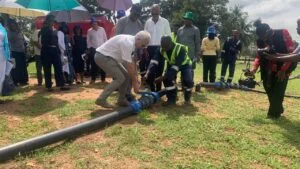
The International Institute of Tropical Agriculture (IITA), Ibadan, has inaugurated irrigation systems and research farm equipment to develop and deliver improved varieties more quickly and on a larger scale.
The News Agency of Nigeria (NAN) reports that the project, funded by the Crops to End Hunger initiative (CtEH), was launched at the institute’s headquarters in Ibadan on Thursday.


IITA Director-General (DG), Dr Simeon Ehui, said the project would strengthen the institute’s capacity to better serve Nigeria’s farmers and Africa in general.
The infrastructure, Ehui said, has improved IITA farm research, further enhancing its ability to conduct more efficient breeding trials, sustain year-round research, and respond better to climate variability.
“In practical terms, this means that we will be able to develop and deliver improved varieties to farmers faster and at a greater scale.
“For us at IITA, this is not just about new equipment. It’s about building a more resilient, productive, and sustainable system for Africa.
“These facilities will serve as platforms for innovation, training and partnership with the national resource systems and other stakeholders across the region,” he said.
The DG, while appreciating IITA staff for their hard work and dedication, commended the German Government and other partners for making the project a reality.
NAN reports that other equipment inaugurated, aside from the irrigation system, includes new tractors equipped with GPS systems, planters, manure spreaders and combine harvesters.
The Chairman, IITA Board of Trustees, Dr Roel Merckx, noting that mechanisation was a challenge in Africa, said the mechanised irrigation facilities would, however, ease the challenge of water access.
Merckx explained that the irrigation would also help researchers focus more on breeding additional crop varieties.
Mr Alick Mulenga, IITA Head of Farm Management and Breeding Operations, said the mechanised equipment would enable them to be more efficient in executing their operations.
“Currently, everything we do in terms of planting, spraying the weeds, and harvesting is done manually.
“We are very inefficient because it takes time, while the window for us to plant and maintain the crop is very short.
“So, having this equipment is going to help us execute the operations quicker, more efficiently and reliably,” he said.
Mulenga said that the irrigation system would now allow them to plant more than one crop per season, different from when they had to rely on rainfall.
He said that the infrastructure would have a positive impact on breeders, the general public and smallholder farmers in Nigeria and across Africa.
Also, Mr Richard Ofei, IITA Project Management Officer for Root, Tuber, and Banana, said the facilities would reduce human input, thus enhancing profits.