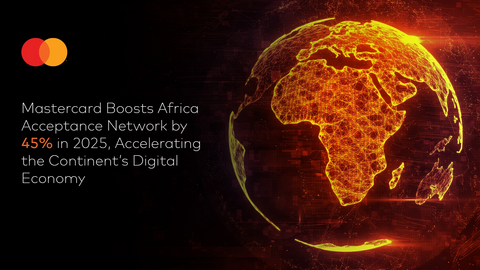
Mastercard has significantly expanded its payment acceptance network across Africa in 2025, reinforcing the continent’s accelerating shift towards digital payments and formal financial services.
The company said its acceptance footprint has grown by 45 percent this year, enabling millions more consumers and businesses to make and receive digital payments. The expansion reflects rising demand for cashless transactions as smartphone penetration, e-commerce activity and mobile connectivity continue to improve across African markets.


In a statement distributed by AFP, Mastercard said the growth underscores Africa’s increasing role in the global digital economy, particularly as governments and businesses seek more efficient, transparent and inclusive payment systems.
Local investment underpins growth
Mastercard attributed the rapid expansion to deeper investment in local operations and closer collaboration with African partners. Over the past two years, the company has opened new offices in Ghana, Uganda and Mauritius, while increasing its workforce across the continent by around 20 percent. Further market entries are planned for 2026.
The company said its expanding local presence has strengthened partnerships with banks, fintech firms, mobile network operators and public institutions, allowing it to develop payment solutions better suited to local regulatory and commercial environments.
‘Africa is one of the most dynamic regions globally for digital innovation,’ Mastercard said, noting that proximity to customers has been critical to scaling acceptance infrastructure beyond major urban centres.
Small businesses at the heart of the strategy
Small and medium-sized enterprises sit at the centre of Mastercard’s Africa growth plans. SMEs account for the majority of employment on the continent but often operate outside formal financial systems, limiting their access to credit and growth opportunities.
Mastercard’s expanded acceptance network includes tap-on-phone technology, QR-based payments, e-commerce gateways and virtual card solutions. These tools allow even micro-merchants and informal traders to accept digital payments without expensive point-of-sale hardware.
In Nigeria, partnerships with local banks have helped roll out QR-on-card solutions now used by more than 1.8 million SMEs and gig-economy workers. In Morocco, Mastercard collaborated with local partners to launch the country’s first digital marketplace, benefiting an estimated 2.3 million artisans.
The company said improved access to digital payments enables small businesses to build transaction histories, manage cash flow more effectively and access financial products previously out of reach.
Extending inclusion beyond cities
Beyond urban markets, Mastercard is also targeting rural and underserved communities through its Community Pass platform. The initiative uses digital identity and payment tools to connect individuals, including smallholder farmers, to essential services such as healthcare, agricultural inputs and financial services.
Mastercard aims to register 15 million Community Pass users across Africa over the next five years, positioning the platform as a bridge between informal economies and the formal financial system.
The company is also a member of the Mobilising Access to the Digital Economy Alliance, a multi-stakeholder initiative seeking to expand digital access to 100 million people and businesses across Africa by 2034.
Momentum expected to continue
Mastercard described 2025 as a pivotal year for its African operations, with the expansion of payment acceptance reflecting both consumer demand and improving digital infrastructure.
As cash use continues to decline in several markets, the company expects emerging technologies such as artificial intelligence, tokenisation and agent-based commerce to shape the next phase of Africa’s digital payments landscape.
For policymakers and businesses, wider payment acceptance is increasingly viewed as a foundation for broader economic participation, transparency and sustainable growth.