

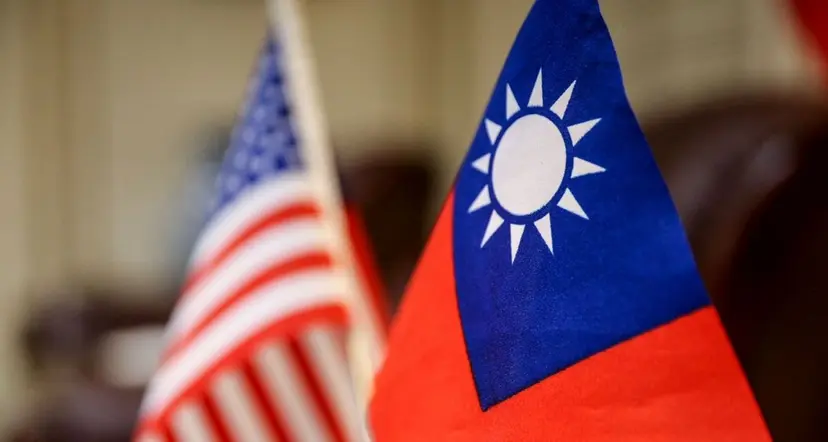
The United States and Taiwan have finalised a bilateral trade agreement that lowers tariffs on Taiwanese goods in return for major investments by the island nation’s semiconductor and technology companies in the US semiconductor sector.
The USD 250 billion deal is “a historic trade deal that will drive a massive reshoring of America’s semiconductor sector,” said the US Department of Commerce in a statement, adding that it would establish an “economic partnership” to create several “world-class” US-based industrial parks in order to help build up domestic production.

Trump had initially set a tariff of 32 per cent on Taiwanese goods, but later changed it to 20 per cent. The new agreement slashes the tariff rate to 15 per cent, the same as levied on other US trading partners in the Asia-Pacific region such as Japan and South Korea.
During an interview, US Commerce Secretary Howard Lutnick said the objective was to bring 40 per cent of Taiwan’s entire chip supply chain and production to the United States. “If Taipei had in any capacity denied manufacturing in the US, the tariffs would likely be nearly 100 per cent,” he said, adding, “We’re going to bring it all over so we become self-sufficient in the capacity of building semiconductors”.
Duties on sectors like automobile parts, lumber and timber will be capped at 15 per cent, while generic pharmaceutical products and certain natural resources will see zero duties, the commerce department added.
Taiwanese Vice Premier Cheng Li-chiun said the “unique” tariff deal will be signed after it is approved by Taiwan’s parliament.
“Producing chips in the US does not mean moving the industry out, since our tech industry is already an international one,” she said.
Semiconductors are a crucial component in the automobile, defence and artificial intelligence sectors, and were invented in the US. They remain one of the US’ major export sectors worldwide.
However, a significant portion of cutting-edge technology chips is mostly manufactured in Taiwan.
“Look, they need to keep our president happy, right? Because our president is the key to protecting their country,” Lutnick said in the interview.
The deal is likely to draw a strong response from Beijing, which considers Taiwan to be a part of its territory and criticises Washington for its undue influence over the self-governing island.
Taiwan, on the other hand, views Washington as a strong ally in countering China.




