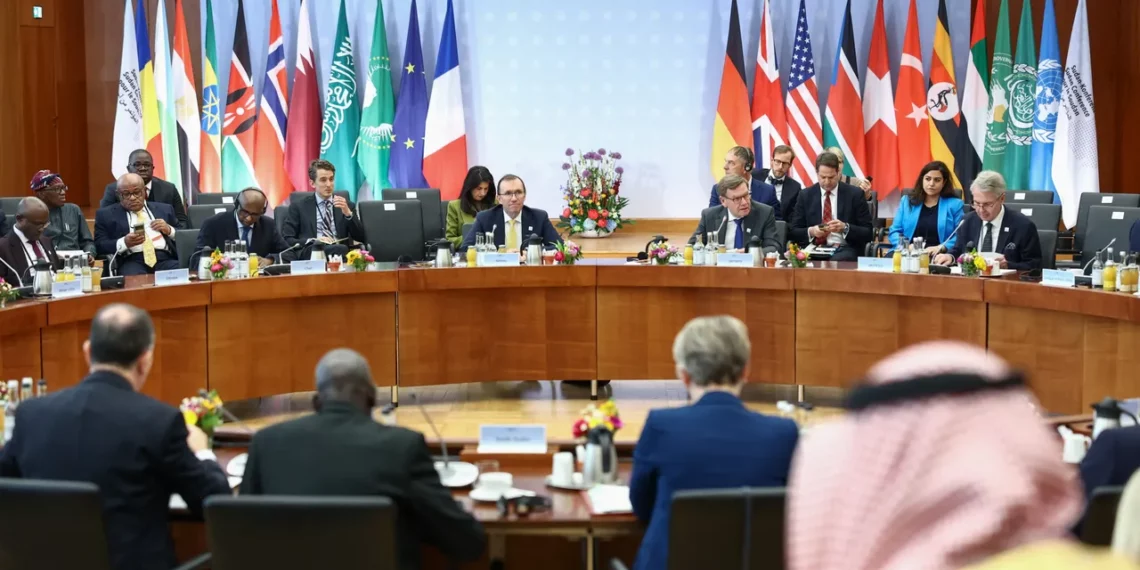
Sudan has condemned a Germany-hosted conference on its ongoing war as a ‘colonial’ intervention, accusing Western countries of attempting to impose solutions without consulting Khartoum, in a sharp escalation of diplomatic tensions over international efforts to end the conflict.
The Berlin conference aims to mobilise humanitarian funding and revive stalled peace efforts in Sudan’s war, but Khartoum argues that excluding the government undermines its legitimacy and risks derailing any meaningful resolution.
In a statement, Sudan’s Foreign Ministry criticised the organisers for excluding the government from consultations, describing the move as a ‘colonial tutelage approach’ through which Western powers seek to dictate outcomes in sovereign states — echoing rhetoric seen in recent criticism by Sudan’s leadership of colonial-era influence on African conflicts.


The ministry said convening the conference without coordination with Khartoum reflected a ‘disregard for the visions presented by the Sudanese state and its official institutions’, warning that such actions risk undermining the credibility of international mediation.
Officials also rejected what they described as an attempt to bypass the government under the pretext of neutrality, arguing that any process excluding state authorities could deepen divisions rather than resolve the crisis.
Sudan further warned that ‘equating the government and its national army with a criminal militia’ would erode the foundations of regional and international security.
Berlin talks aim to address war crisis
The Berlin conference opened on Wednesday with participation from international partners and Sudanese civilian actors, focusing on both humanitarian relief and political pathways to end the conflict.
Organisers are seeking to raise significant funding to support millions affected by the war, while also exploring options for a ceasefire and a broader political settlement between the Sudanese Armed Forces and the paramilitary Rapid Support Forces (RSF).
However, the absence of formal representation from the Sudanese government has cast a shadow over the talks, highlighting the deep divisions that continue to hinder coordinated peace efforts.
The meeting builds on earlier international and regional attempts to address the crisis, including initiatives discussed during African Union engagements on conflict resolution, though progress has remained limited.
Sudan warns of sovereignty breach
Khartoum warned that allowing foreign governments and organisations to deliberate on Sudan’s internal affairs without its participation sets a ‘dangerous precedent in international relations’.
The Foreign Ministry also criticised the representation of Sudan at the conference, objecting to what it called the inclusion of ‘limited and small groups’ as substitutes for national institutions.
Despite its objections, Sudan reiterated that it remains open to ‘serious and fair peace initiatives’, provided they involve consultation with the government and respect the country’s sovereignty and territorial integrity.
The stance reflects a broader pattern of resistance to external mediation seen in recent months, including tensions highlighted in Sudanese opposition to foreign-led peacekeeping proposals.
Conflict with RSF continues to escalate
Sudan has been gripped by conflict since April 2023, when fighting erupted between the army and the RSF over plans to integrate paramilitary forces into the national military structure.
The war has since evolved into a protracted and devastating crisis, killing tens of thousands and displacing around 13 million people, according to international agencies, while pushing large parts of the country towards famine.
Humanitarian conditions continue to deteriorate, with millions facing acute hunger and basic state institutions under severe strain.
Previous diplomatic initiatives have struggled to gain traction, with competing approaches from international actors complicating efforts to secure a ceasefire or unified political process.
Western governments have increasingly stepped up diplomatic engagement as the conflict threatens broader regional stability, particularly in the Horn of Africa and along key Red Sea trade routes.
Analysts warn that fragmented international approaches — including parallel diplomatic tracks that exclude key actors — risk prolonging the war rather than resolving it.
As the Berlin conference unfolds, its outcomes — and Sudan’s rejection of its legitimacy — are likely to shape the next phase of international engagement around the conflict.
For now, Khartoum’s position is clear: any pathway to peace must begin, in its view, with recognition of state authority — not its exclusion.