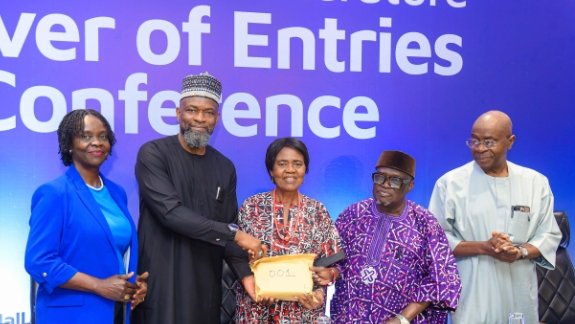
Nigeria LNG Limited (NLNG) has officially launched the adjudication process for the 2026 edition of the Nigeria Prize for Literature with the handover of 224 entries, marking the beginning of what organisers describe as a rigorous and highly anticipated literary exercise.
This year’s competition, valued at $100,000, focuses on poetry—one of the most demanding literary genres—bringing renewed attention to precision, depth, and artistic discipline in writing.

Speaking at the handover ceremony on April 20, 2026, General Manager, External Relations and Sustainable Development at NLNG, Dr. Sophia Horsfall, described the moment as “the beginning of a process that requires attention, patience, and sound judgement—one that will run its course and ultimately determine the outcome of this year’s Prize.”
Highlighting the unique demands of poetry, Horsfall noted: “Poetry, on its own, requires a particular kind of attention—one that values precision, depth, and the ability to express complex ideas in few words and with clarity. In many cases, a single line defines the entire piece.”
She disclosed that the 2026 cycle attracted 224 entries, reflecting sustained engagement from writers and the enduring relevance of the Prize. Drawing a comparison with the previous poetry cycle, she referenced Romeo Oriogun’s Nomad, the 2022 winning collection, which she said “has continued to hold its place within contemporary Nigerian literature” and remains “a useful reference for the standard this Prize represents.”
Reaffirming NLNG’s commitment, Horsfall stated that the organisation’s role goes beyond sponsorship. “We have provided the platform, but the credibility of the Prize rests on the integrity of its process and the quality of the works it attracts,” she said.
She added that over the years, the Prize has played a broader cultural role: “It has contributed to the growth of reading culture, encouraged discipline in writing, and sustained a space where Nigerian literature can continue to develop with confidence.”
According to her, the Prize also serves as a national cultural moment. “Annually, the Nigeria Prize for Literature ignites a spirited conversation that extends far beyond the bounds of the literary community… it sparks anticipation, debate, critical reflection, and cultural engagement,” she said, while acknowledging the media’s role in amplifying these conversations.
Formally receiving the entries, Chairman of the Advisory Board, Professor Akachi Adimora-Ezeigbo, described the handover as “an important transition in the life of the Prize,” marking the point where responsibility shifts fully to the Board and the panel of judges.
“The Nigeria Prize for Literature… has earned its standing by recognising only excellence,” she said. “Every entry will be subjected to careful, independent scrutiny, and at the end of the process, only one work will emerge.”
She emphasised the thoroughness of the adjudication process: “We read thoroughly and independently. Where necessary, we interrogate the works, raise questions, and assess them against a standard that has been carefully built, refined, and sustained over time.”
Adimora-Ezeigbo also reassured stakeholders of the integrity of the process, noting that it remains “thorough, unbiased, and strictly merit-based,” a consistency she said has sustained the Prize’s credibility over the years.
Speaking on the genre in focus, she stressed that poetry is often underestimated. “There is very little room to hide. One cannot rely on length or excessive explanation. Every line must be precise; every word must justify its presence. It is here that many works fall short,” she said.
Referencing the last poetry cycle, she described Nomad by Romeo Oriogun as “a layered, introspective journey” and “a strong reference point for the genre,” encouraging renewed engagement with the work.
Beyond the prize money, she highlighted the long-term significance of the award: “While the Prize money understandably attracts initial attention, what follows is far more significant. The sustained relevance of the work, the conversations it stimulates, and the influence it exerts over time are the true measures of the Prize’s impact.”
In her closing remarks, Manager, Corporate Communication and Public Affairs at NLNG, Anne-Marie Palmer-Ikuku, reaffirmed the organisation’s commitment to sustaining the Prize as a credible and respected platform.
“There are very few platforms in Nigeria that have consistently shaped a field the way this Prize has shaped literature,” she said. “Its standing rests on years of steady work, careful judgement, and a shared commitment to doing things the right way.”
She commended the Advisory Board for its role in maintaining the Prize’s integrity: “Your role remains fundamental to the strength of this Prize. Its credibility rests on your ability to make difficult decisions with fairness.”
Palmer-Ikuku also acknowledged the courage of participating writers and the role of the media in extending the Prize’s impact. “Through your work, conversations on the Prize continue, and these works find their place in the public domain,” she noted.
Looking ahead, she said: “In the months ahead, what happens next will require critical attention, unbiased judgment, and publicity by the media. In the end, it will produce an outcome that reflects the standard this Prize has come to represent.”
The adjudication process will proceed with the selection of a longlist, followed by a shortlist of three finalists, before culminating in the announcement of the winner in October 2026.