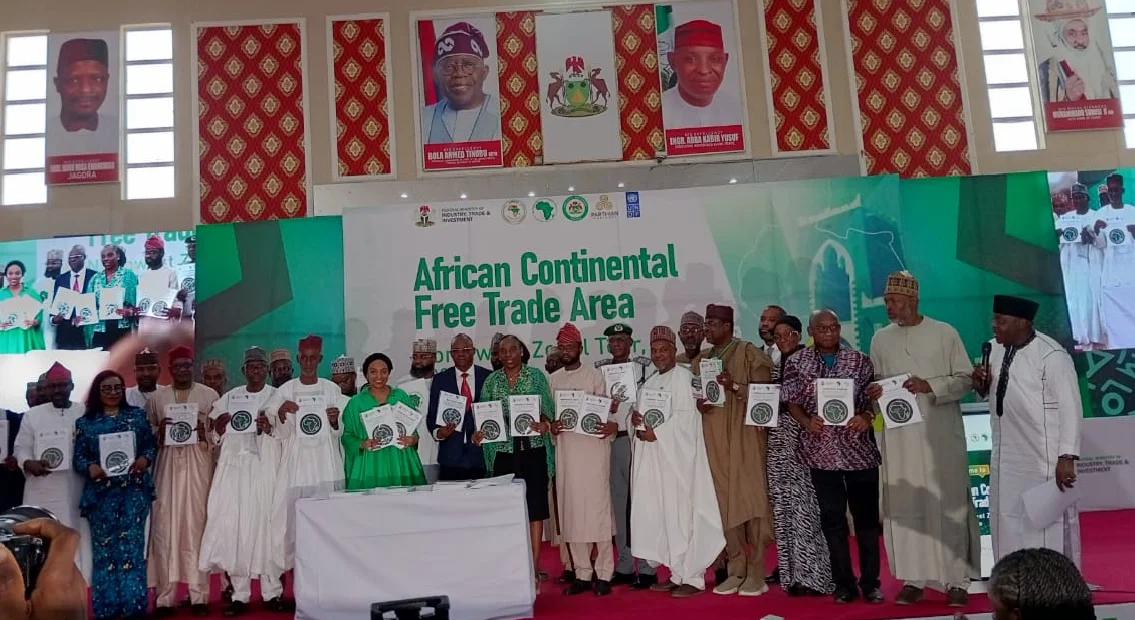
The Federal Government has unveiled simplified books and toolkits designed to enhance Nigeria’s participation in the African Continental Free Trade Area (AfCFTA), ease trade and boost non-oil exports.
The books were produced in English, Arabic and Hausa Languages to promote inclusivity and prepare Nigerian businesses for continental trade opportunities.
Dr Jumoke Oduwale, Minister of Industry, Trade and Investment, inaugurated the initiative on Monday in Kano, at the North-West Subnational Tour and Public-Private-Press (P3) engagement on AfCFTA implementation.


She said the toolkits are designed to simplify trade rules, including rules of origin, customs procedures, standards compliance and market entry requirements, especially for Small and Medium Enterprises (SMEs).
Oduwale said the initiative aligned with the Renewed Hope Agenda of President Bola Tinubu, aimed at ensuring that Nigerians prosper at all levels.
She said the initiative seeks to make trade practical, simple, actionable, and close gaps making export procedures cumbersome for businesses.
The minister said regulatory agencies would be in Kano to provide services, including business registration, product certification and issuance of certificates of origin for exporters.
Oduwale announced plans for live export simulations and hands-on training sessions for businesses, adding that the federal government had introduced, “One Local Government, One Export Product initiative,” to promote production at the grassroots.
“We want every local government to identify at least one product they can export to Africa. We are making the process easy and immediate,” she said.
She said Nigeria has recorded major gains under AfCFTA, including the inauguration of an air cargo corridor that reduced freight costs by about 75 per cent across selected African routes.
According to Oduwale, Nigerian products such as food items, textiles and processed goods are gaining strong demand across African markets.
Gov. Abba Kabir-Yusuf, described Kano as Africa’s historic commercial hub and a natural gateway for continental trade.
Represented by Umar Ibrahim, Secretary to the State Government, Kabir-Yusuf
said Kano was utilising opportunities being offered by AfCFTA through industrialisation, logistics expansion and SME development.
He stressed that AFCFTA must work for the growth of traders, processors, youths, ICT hubs and industries.
Dr Chris Isokpunwa, Permanent Secretary, Federal Ministry of Industry, Trade and Investment, said the engagement marked a shift from policy awareness to practical implementation of AfCFTA at the grassroots.
He said the tools would help businesses to better understand trade procedures and move from interest to actual exports.
Also, Khalil Halilu, Vice Chairman, National Agency for Science and Engineering Infrastructure (NASENI), reiterated commitment to support manufacturers to improve product quality and scale up production for African markets.
On her part, Nonye Ayeni, Executive Director, Nigerian Export Promotion Council (NEPC), said Nigeria recorded $6.1 billion in non-oil exports in 2025.
She said AfCFTA remained a major opportunity for Nigeria to expand its export base and strengthen its position in continental trade.
Mrs Patience Okala, National Coordinator, Nigeria AfCFTA Coordination Office, said the books were produced in multiple languages to ensure inclusivity.
She highlighted that Nigeria had made progress in digital trade protocols, tariff concessions and cross-border trade facilitation.
themomentng reports that the engagement features technical sessions, regulatory clinics and export simulations.