

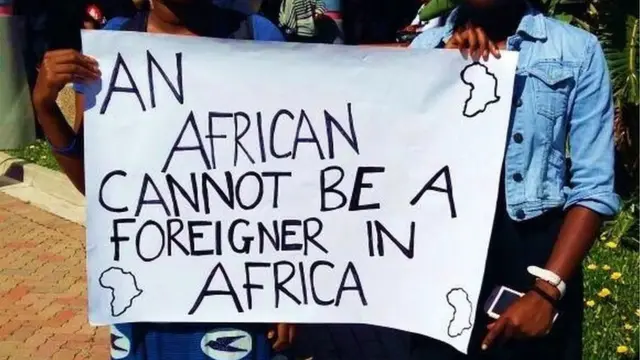
The Ghana government has formally requested the African Union to place xenophobic attacks against African nationals in South Africa on the agenda of the bloc’s upcoming mid-year coordination meeting in Egypt.
Africa Briefing reviewed the diplomatic communication sent by Ghana’s Foreign Ministry to the African Union Commission ahead of the Eighth Mid-Year Coordination Meeting of the African Union scheduled to take place from June 24 to June 27 in El Alamein, Egypt.
In the letter dated May 6, 2026, Ghana’s Foreign Affairs Minister Samuel Okudzeto Ablakwa described the recurring attacks as a matter of ‘urgent continental interest’ requiring collective African action.


In the document, Ghana said it remained ‘deeply concerned’ by repeated xenophobic incidents in South Africa, which it said had led to deaths, destruction of investments and growing insecurity for African nationals living in the country.
The government said the persistence of attacks against fellow Africans was especially troubling given the continent’s historic solidarity with South Africa during the anti-apartheid struggle.
‘This development is especially concerning when viewed in the light of the longstanding solidarity demonstrated by African states in support of the struggle against apartheid and South Africa’s subsequent democratic transformation,’ the letter stated.
While acknowledging South Africa’s sovereignty and responsibility for protecting all persons within its borders, Ghana argued that attacks targeting African migrants undermined core African Union principles, including continental unity, pan-Africanism and regional integration.
South African governments over the years have repeatedly condemned xenophobic violence and pledged stronger law enforcement responses during outbreaks of unrest.
The concerns come amid mounting warnings from rights groups and international observers over rising anti-immigrant sentiment in the country. UN experts recently warned that South Africa risked sliding towards renewed large-scale xenophobic violence.
Accra urged the African Union to adopt a series of measures during the June deliberations.
Among the proposals outlined in the letter were:
- the formal inclusion of xenophobic violence on the summit agenda;
- stronger AU monitoring mechanisms to ensure member states uphold obligations under the African Charter on Human and Peoples’ Rights;
- the establishment of a fact finding mission into the root causes of xenophobic violence in South Africa; and
- dialogue and reconciliation initiatives aimed at promoting tolerance and continental unity.
The Ghanaian government also argued that xenophobic violence contradicted the objectives of the African Continental Free Trade Area, which seeks to reduce barriers and promote the free movement of Africans across the continent.
Officials warned that continued attacks could weaken confidence in Africa’s integration agenda and damage economic cooperation among member states. Analysts say recurring xenophobic violence also risks undermining broader efforts to deepen continental mobility, labour integration and cross-border commerce under the AfCFTA framework, which currently includes 54 African countries.
The letter invoked the legacy of Ghana’s founding president Kwame Nkrumah, stressing that Africa’s future depended on collective dignity, prosperity and mutual respect.
‘The full potential and emancipation of Africa can only be achieved when Africa unites,’ the government wrote, echoing Nkrumah’s pan-African ideals.
It added that no African should be ‘dehumanised on African soil’.
The diplomatic move reflects growing concern that recurring xenophobic violence could undermine Africa’s integration agenda and weaken confidence in Pan-African solidarity.
The AU has previously condemned xenophobic violence on the continent, but Ghana’s latest intervention signals growing pressure for a more coordinated continental response as African leaders pursue deeper political and economic integration under the AfCFTA framework.




