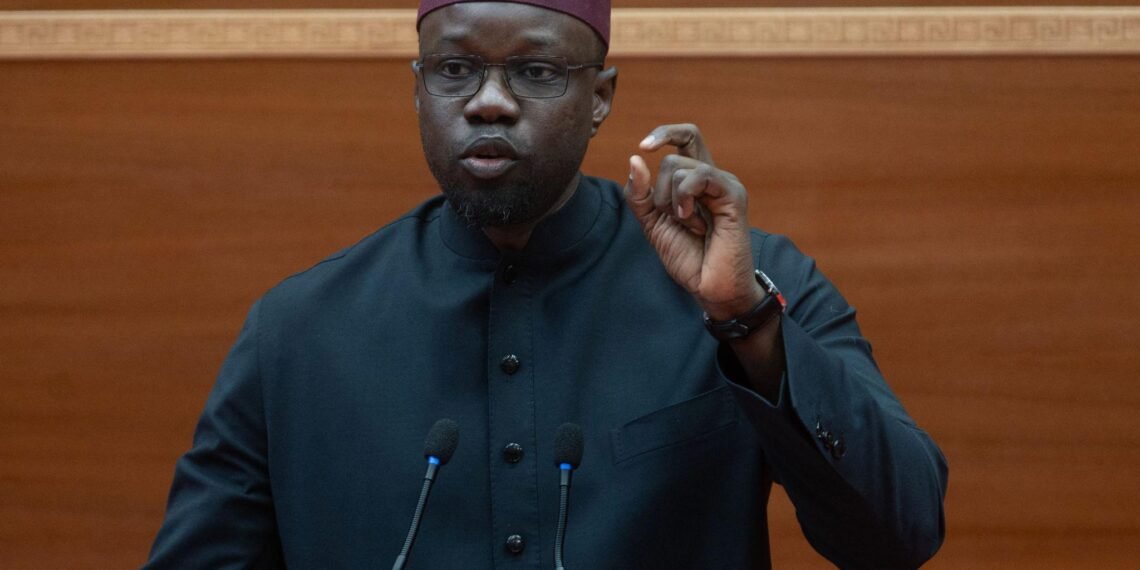
Senegal’s political tensions intensified on Tuesday after former Prime Minister Ousmane Sonko was elected Speaker of parliament just days after being dismissed by President Bassirou Diomaye Faye, deepening a growing split inside Senegal’s ruling leadership.
Sonko’s appointment places Senegal’s two most influential figures at the head of rival institutions, with analysts warning the development could reshape governance dynamics in a country long viewed as a democratic anchor in West Africa.
The development marks the most serious rupture yet inside the ruling Pastef movement, which swept to power in 2024 on promises of reform, sovereignty and economic change.


According to Reuters, parliament’s previous Speaker resigned on Sunday to clear the way for Sonko’s election. Pastef currently holds a commanding majority in the National Assembly.
President Faye moved quickly to stabilise his administration following Sonko’s dismissal last week by appointing economist Ahmadou Al Aminou Lo as Senegal’s new prime minister.
Alliance collapse spills into parliament
The crisis marks a dramatic deterioration in relations between Faye and Sonko, once regarded as inseparable allies.
Many supporters view Sonko as the ideological force behind Pastef and the chief strategist behind Faye’s rise to power during the 2024 presidential election.
Faye’s victory followed Sonko’s exclusion from the race because of a defamation conviction, a legal setback that transformed the then little-known Faye into the opposition movement’s presidential candidate.
At the time, Faye’s rise from prison to the presidency was widely seen as a continuation of Sonko’s anti-establishment movement.
However, tensions between the two men have steadily widened in recent months, particularly over Senegal’s economic direction and handling of mounting debt pressures.
Disagreements over how to address billions in previously undisclosed debt had become a major source of friction between the pair, intensifying leadership tensions over debt negotiations.
Sonko openly criticised the government’s management of state finances and publicly challenged decisions taken by Faye’s administration, exposing divisions that had previously remained largely behind closed doors.
His dismissal last week confirmed what many observers in Dakar had increasingly suspected — that the ruling alliance had fractured at the highest level.
Speaker role gives Sonko new leverage
Sonko’s new position as Speaker significantly strengthens his influence despite his removal from government.
Under Senegal’s political system, the Speaker of parliament occupies one of the country’s most powerful constitutional offices and can influence legislative priorities, parliamentary debate and political alliances.
Control of parliament also gives Sonko influence over legislation, committee structures and the pace of government reforms.
With Pastef controlling parliament, analysts say Sonko could complicate Faye’s ability to secure legislative backing for sensitive reforms and economic measures.
Some observers also warn that the arrangement risks creating rival power centres inside government, with the presidency and parliament increasingly operating at odds.
The situation is further complicated by constitutional restrictions preventing the president from dissolving parliament before November this year, limiting Faye’s political room for manoeuvre.
Some opposition lawmakers have meanwhile criticised the speed of the parliamentary transition and questioned its legitimacy following Sonko’s rapid reinstatement to parliament before his election as Speaker.
Debt pressures add to uncertainty
The political rupture comes at a delicate moment for Senegal’s economy.
The country has been grappling with debt concerns, budget strains and growing demands for economic reform following the transition from former President Macky Sall’s administration.
Senegal’s $1.8bn IMF programme crisis deepened after authorities uncovered billions in previously unreported liabilities, increasing pressure on the government to restore investor confidence and restart stalled negotiations with international lenders.
The crisis comes as several West African states face mounting political and economic pressure following years of coups, debt stress and democratic unrest across the region.
International investors and regional observers are closely monitoring developments in Dakar, particularly given Senegal’s reputation for institutional stability within West Africa.
Any prolonged confrontation between the presidency and parliament could complicate policy implementation and undermine confidence in the government’s reform agenda.
Sonko remains one of the country’s most influential political figures despite legal battles and repeated attempts to sideline him politically.
As an opposition leader, he built a reputation for aggressively challenging Sall’s government and mobilising large numbers of younger voters demanding political and economic change.
Observers note that the same confrontational style now appears to be shaping his relationship with Faye.