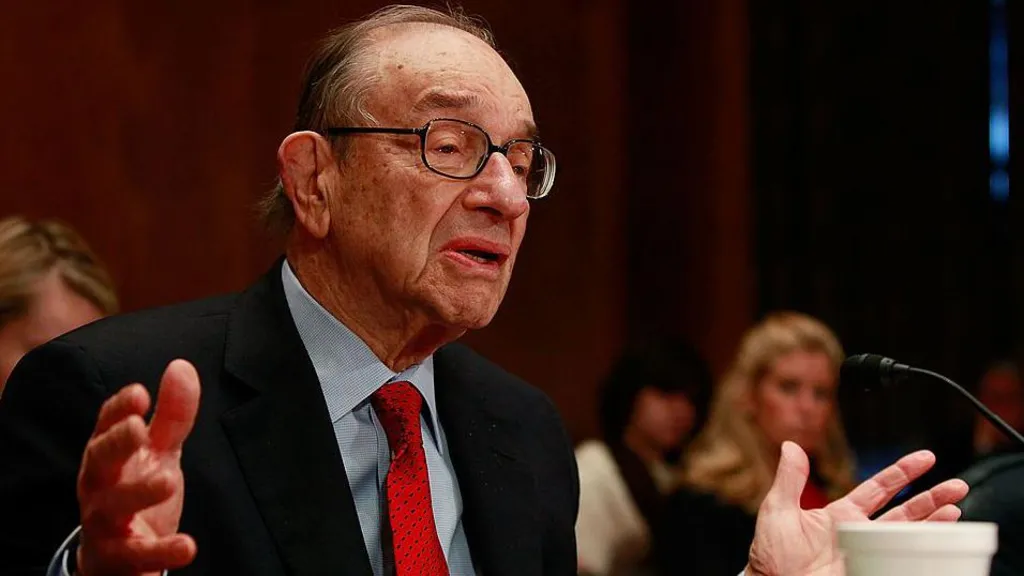
Former US Federal Reserve chair Alan Greenspan has died aged 100, his wife has said.
NBC News correspondent Andrea Mitchell said in a statement reported by her employer that her husband had died from complications of Parkinson’s Disease.
Mitchell’s statement said Greenspan was “a giant of a man who helped shape the US economy for decades under presidents of both parties, but was always honest in acknowledging his mistakes”.


For nearly 20 years, Alan Greenspan was charged with safeguarding the US economy and keeping the dollar sound.
As chairman of the Federal Reserve from 1987-2006, a post described as the second most important after the presidency, he presided over the longest sustained period of US economic growth in a generation.
Described as the “God in the machine” of American finance, Greenspan declined all requests for interviews during his time at the Fed.
But the media and the money markets hung on his few public statements, and a sign in his office said simply, “the buck starts here”.
But critics argue that an over-reliance on easy credit fuelled the dot-com bubble of the late 1990s and caused the sub-prime mortgage crisis of 2008.
 Bettmann via Getty Images
Alan Greenspan was born in New York City on 6 March 1926. His mother, who worked in a furniture store, brought him up single-handed.
Far from being a budding economist, the young Greenspan was a talented musician, who studied the clarinet at New York’s renowned Julliard School of Music.
He played in a band with Stan Getz, the legendary jazz saxophonist, before touring the country with the Henry Jerome Band. This peripatetic lifestyle gave him a valuable practical insight into the workings of US business.
And while his fellow musicians spent their evenings smoking marijuana, Alan Greenspan busied himself by swotting up on economics and doing the band’s accounts.
At the age of 19, he enrolled as an economics student at New York University, where he became an apostle of the free market, and eventually found employment as an economic consultant and, later, as a member of the board at JP Morgan.
Curbing inflation
In 1952, Greenspan met the right-wing novelist and social philosopher Ayn Rand, whose views were to have a profound influence on him.
She called him “the undertaker” because of his liking for dark, sombre suits.
But the young economist came to support her belief that society functions most efficiently when people actively pursue their own self-interests, to the exclusion of the interests of society as a whole.
In an article he wrote in 1966, he declared “the welfare state” as “nothing more than a mechanism by which governments confiscate the wealth of the productive members of a society”.
 The Chronicle Collection via Getty Images
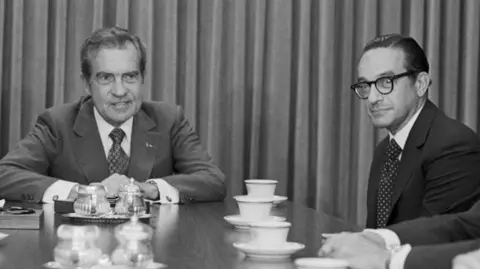
Having successfully predicted the Eisenhower recession, Greenspan advised Richard Nixon during his successful presidential election campaign in 1968.
He went on to become head of the Council of Economic Advisers.
Greenspan later wrote that he found the president to be “sadly paranoid, misanthropic and cynical”, but the economist’s success at curbing inflation impressed Nixon’s successors.
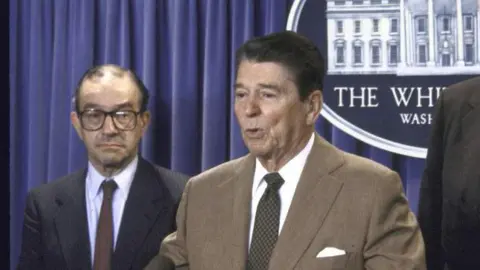
Gerald Ford asked Greenspan to continue at the Council of Economic Advisers and – in the early 1980s – Ronald Reagan chose him to lead an inquiry into the reform of the America’s state pension system.
In August 1987, Reagan promoted him to chairman of the US Federal Reserve, and – for the next two decades – he became one of the most powerful men in the world.
Golden era
He was thrown in at the deep end.
His astute handling of the October 1987 stock market crash, which saw more than 30% wiped off share prices, earned Greenspan many plaudits.
His statement of confidence in the underlying economy calmed frayed nerves, and his facilitation of cheap credit helped keep the banks afloat.
It was an approach used again and again, whenever the markets had a crisis. Later dubbed “quantitative easing”, such upheavals included the 1980s savings and loan crisis, the first Gulf War, the Mexican peso crisis and – shortly after he had retired – the global credit crisis in 2008.
Greenspan was renominated as chairman of the Federal Reserve by George H.W. Bush, although the president later complained that a sluggish economic recovery had put paid to his chances of re-election.
Surprisingly, Bill Clinton – a Democratic Party president – also asked the driest of monetarists to stay on in post. But his decision was rewarded as, under Greenspan’s direction, there followed a golden era of growth in the late 1990s.
Greenspan later praised Clinton in his memoir for the president’s “consistent, disciplined focus on long-term economic growth” – while complaining that some Republican administrations simply lost control of public spending.
 Archive Photos via Getty Images
Away from work, the rather grey-looking banker was a skilled and enthusiastic tennis player.
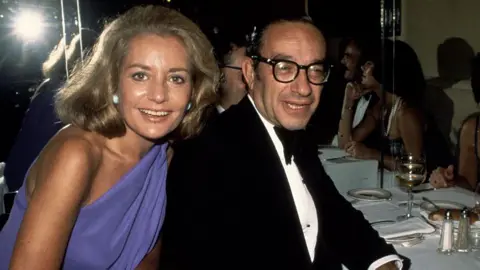
An early marriage to a Canadian artist lasted less than a year, and Greenspan dated TV star Barbara Walters, before marrying NBC reporter Andrea Mitchell in 1997.
The same year, the spectacular fall of the South East Asian “tiger economies” tested him again.
By cutting US interest rates, he indicated his belief that the situation would recover and, in doing so, aided the world economy.
Bubbles and crashes
Much the same happened when many dot-com companies, overpriced by investors, failed to live up to their hype and folded in March 2020.
The market, said Greenspan, had exhibited “irrational exuberance”.
The Federal Reserve raised interest rates and then cut them rapidly after consumers vastly reduced their expenditure.
But Greenspan was blamed for the low interest rate culture that had allowed the dot-com bubble to grow in the first place.
The Nobel laureate Paul Krugman was one critic.
“He didn’t raise interest rates to curb the market’s enthusiasm,” Krugman complained, “he waited until the bubble burst… then tried to clean up the mess afterwards.”
 AFP via Getty Images
After the 9/11 attacks on America, he slashed interest rates to help prop up the US economy and urged George W. Bush to remove Saddam Hussein, in case the Iraqi dictator caused chaos on the global energy markets.
In 2006, Greenspan stood down as chairman of the Federal Reserve after an unprecedented five terms in office.
A year later came a downturn in the US housing market that the Federal Reserve had failed to predict. The sub-prime mortgage crisis went on to bring down banks and trigger the worst global economic downturn since the Great Depression.
Critics said Greenspan’s policy of low interest rates after 9/11 had fuelled a sharp rise in house prices and over-enthusiastic selling of mortgages by banks.
It was also said that his aversion to the regulation of banks – and their practice of using complicated financial instruments like derivatives to insure their lending – made the problem worse.
 Getty Images
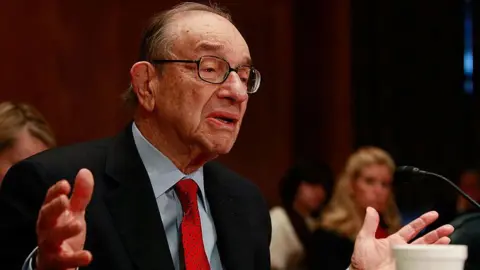
In October 2008, Greenspan admitted that he had put too much faith in the free-market and had given insufficient attention to the dangers of sub-prime lending.
He said he’d believed that the financial industry could be relied upon to “self-regulate” because it would always be in its best interests to do so.
In testimony to Congress, the former Federal Reserve chairman confessed that the banks had proved his free-market, anti-regulation views wrong.
“I have found a flaw. I don’t know how significant or permanent it is. But I have been very distressed by that fact.”
Alan Greenspan will be remembered as the man who – more than anyone else – shaped the modern US economy.
For twenty years, a series of presidents and many ordinary Americans viewed him as a financial guru, and a talisman against bad times.
 Getty Images
In the course of his extraordinary career, he was awarded the Presidential Medal of Freedom in Washington and an honorary knighthood by Queen Elizabeth II.
He remained a sought after economic adviser and media pundit into his late 90s.
He was no fan of President Trump’s first administration, describing his populist approach as a “shout of pain” that would do little to raise living standards.
He also criticised Britain’s decision to leave the European Union, calling Brexit the “worst outcome”.
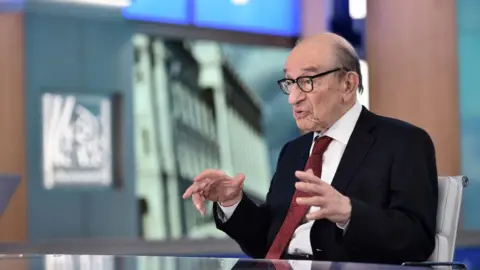
Fast approaching the age of 100, he popped up on television warning that the Biden administration was raising interest rates too fast in 2023.
He celebrated his centenary in March 2026.
With his air of Olympian detachment, Greenspan will be remembered for his long stewardship of the US economy, during which GDP contracted only once.
Although, for his critics, his reputation was dented by his philosophical antipathy to regulation, and two great market crashes.