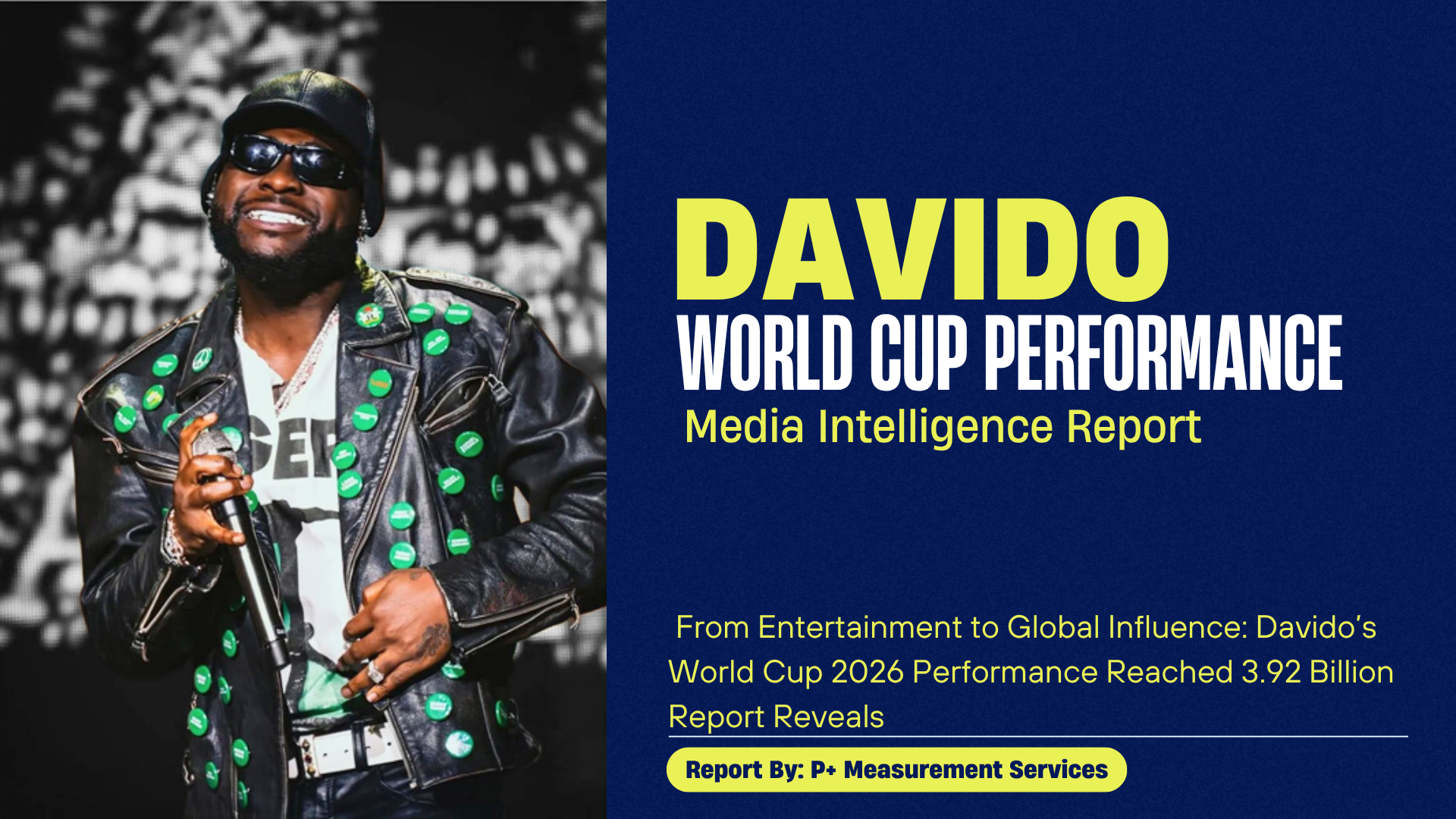
What began as a performance on one of the world’s biggest stages has evolved into a global communications phenomenon that demonstrates the growing power of African storytelling, purpose-driven advocacy and reputation-led influence.
A newly released Media Intelligence Report by P+ Measurement Services reveals that Nigerian music icon Davido’s participation during the FIFA World Cup 2026 generated extraordinary levels of global media attention, audience engagement and positive sentiment, transforming a cultural performance into a worldwide conversation about unity, hope, justice and African influence.
The report analysed media coverage, public conversations and stakeholder engagement generated between June 10 and June 20, 2026 across print, online, broadcast and social media platforms worldwide. Beyond measuring visibility, the analysis examined the broader reputation implications of the campaign and its impact across traditional media ecosystems, digital communities and emerging AI-powered discovery environments.

According to the report, Davido generated approximately 1.48 million media mentions globally within the ten-day reporting period, reaching an estimated audience of 3.92 billion people and producing 6.78 billion impressions across media channels. Social conversations exceeded 432,700 discussions while total engagements surpassed 54.3 million interactions, highlighting one of the most impactful African entertainment-led communication moments recorded on the global stage in recent years.
The report found that public response to the performance was overwhelmingly favourable. Positive sentiment accounted for 89 percent of all measured conversations, while neutral conversations represented only 2 percent. Negative and strongly negative narratives combined accounted for less than 1 percent of total discussions, indicating widespread approval not only of the performance itself but also of the underlying message embedded within the campaign.
At the centre of the conversation was Davido’s “Bring Them Home” message, which drew international attention to the plight of abducted schoolchildren and teachers from Oyo State. Rather than positioning the performance solely as entertainment, the campaign successfully integrated advocacy into one of the world’s largest cultural and sporting platforms.
The report suggests that this strategic combination of entertainment, social purpose and national storytelling significantly contributed to the scale and quality of media attention generated globally. In an era where audiences increasingly reward authenticity and meaningful narratives, the campaign demonstrated how celebrity influence can be leveraged to drive conversations that extend beyond music and popular culture.
One of the most significant findings of the report is the geographic diversity of the audience reached. While Nigeria remained a major contributor to conversations surrounding the performance, the United States emerged as the largest international market by reach, accounting for approximately 16 percent of global visibility. Nigeria contributed 15 percent, followed by the United Kingdom, Canada, Ghana, South Africa, France, Brazil, Germany and India.
The presence of conversations across 156 countries underscores the increasingly global nature of African cultural influence. It also reinforces the growing capacity of African creatives to shape narratives that resonate across continents and cultural boundaries.
For Nigeria, the findings provide further evidence that entertainment continues to function as one of the country’s most powerful soft power assets. While governments often invest heavily in national branding campaigns, the report indicates that cultural exports such as music, film and creative storytelling remain among the most effective vehicles for shaping international perception and projecting national influence.
The analysis further reveals that social media served as the primary engine of visibility throughout the reporting period. Social platforms generated approximately 1.32 million mentions, representing more than 89 percent of total conversations recorded. X, formerly Twitter, accounted for the largest share of discussions, followed by Instagram, TikTok, Facebook and YouTube.
The dominance of social media highlights a broader shift in the communications landscape. Traditional media continues to play an important role in validating narratives and extending credibility, but public conversations increasingly originate and gain momentum through digital communities. For brands, institutions and public figures, this reinforces the importance of integrating earned media, influencer engagement and community-driven storytelling within communication strategies.
Online media also recorded significant performance, generating approximately 268,000 mentions and reaching an estimated audience of 1.65 billion people. Coverage was amplified by leading international and regional media organizations including BBC News, CNN, Reuters, Al Jazeera, The Guardian and several influential African news platforms.
Broadcast media contributed an additional 11,500 mentions with a reach exceeding 452 million people, while print media generated more than 35,000 mentions and reached over 512 million audiences globally.
The report notes that the strength of this performance lies not merely in media volume but in media diversity. Visibility was achieved across multiple platforms, audience segments and geographic regions simultaneously, creating a highly resilient communication ecosystem capable of sustaining attention long after the initial event.
Analysis of audience demographics revealed particularly strong engagement among younger and economically active audiences. Individuals between the ages of 18 and 34 accounted for nearly 58 percent of all measured social media engagement, reflecting the growing influence of youth-driven digital communities in shaping modern reputation outcomes.
From a communications and public relations perspective, the report identifies the campaign as a compelling case study in strategic narrative management. Traditionally, major sporting events have been viewed primarily as sponsorship and visibility opportunities. However, the Davido World Cup performance illustrates how organizations and personalities can use globally relevant moments to introduce social causes, build emotional connection and drive stakeholder engagement simultaneously.
For communications professionals, the findings reinforce the principle that visibility alone does not create influence. Influence emerges when visibility is supported by relevance, purpose and audience resonance. The campaign’s success demonstrates the effectiveness of aligning advocacy messages with cultural moments capable of generating significant public attention.
For the entertainment industry, the report highlights the increasing importance of purpose-driven storytelling. Audiences are becoming more responsive to artists and creators who leverage their platforms to address societal issues while maintaining authenticity. The performance illustrates how entertainment brands can generate both cultural impact and reputation value when social purpose is integrated into communication efforts.
For government institutions and policymakers, the findings offer important lessons regarding nation branding. The report suggests that Africa’s creative industries continue to represent one of the continent’s strongest tools for shaping international perception. As countries compete for tourism, investment and global relevance, cultural ambassadors such as musicians, filmmakers and creators are increasingly becoming key contributors to national reputation.
The report also presents significant implications for the public relations industry itself. As measurement frameworks evolve beyond traditional metrics such as impressions and advertising value equivalency, communications professionals are being challenged to evaluate influence through more sophisticated indicators including sentiment quality, audience engagement, narrative ownership, stakeholder resonance and AI discoverability.
One of the report’s most forward-looking findings concerns performance within AI-powered information environments. An assessment of leading generative search and AI discovery platforms found exceptionally strong visibility for the campaign across ChatGPT, Perplexity AI, Claude AI and Microsoft Copilot.
Visibility scores ranged from 89 to 92 percent across the evaluated platforms, indicating strong representation of campaign narratives within AI-generated responses and emerging search environments. Associated themes consistently included global impact, unity, humanitarian advocacy, African culture and Davido’s performance.
This development is particularly significant because reputation management is entering a new era where discoverability within AI systems increasingly influences public understanding. As users rely more on generative AI platforms to access information, organizations must ensure that their narratives are not only visible in traditional media but also accurately represented within AI-powered search and discovery ecosystems.
The report concludes that Davido’s World Cup 2026 performance represents far more than a successful entertainment event. It stands as a powerful example of how African talent can shape global conversations, amplify important social issues and create measurable influence across interconnected media environments.
More importantly, it demonstrates that purpose-driven storytelling, when combined with cultural relevance and strategic communications, can transform a single performance into a global reputation asset.
For PR practitioners, communication strategists, policymakers, marketers and brand leaders, the campaign offers valuable lessons on the future of influence. In a media environment increasingly driven by attention scarcity, algorithmic discovery and AI-generated information, success will belong to those who can create narratives that are not only seen but remembered, shared, trusted and discovered.
As Africa continues to strengthen its voice on the global stage, the findings reinforce a growing reality: the continent is no longer merely participating in global conversations. It is increasingly helping to shape them.
As part of its ongoing commitment to advancing evidence-based communications practice, P+ Measurement Services continues to make industry intelligence, measurement frameworks and media insights available to communications professionals, helping organizations move beyond assumptions and make informed decisions based on data, reputation intelligence and stakeholder understanding. With more than a decade at the forefront of media intelligence and communications measurement in Nigeria, the firm remains committed to strengthening the practice of public relations through research, accountability and meaningful evaluation.