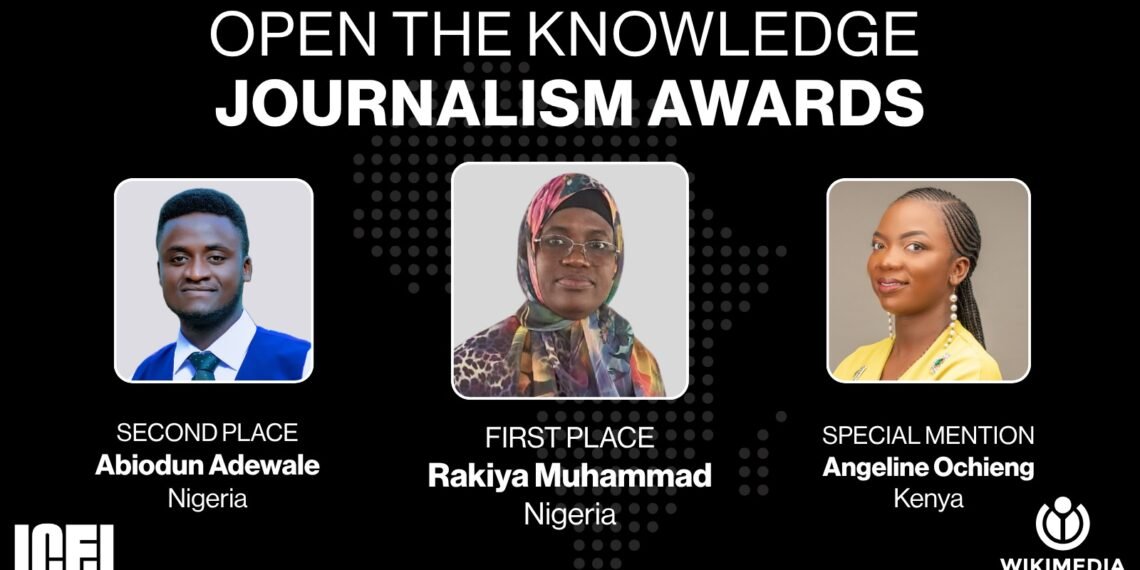
Three African journalists have been honoured at the 2026 Open the Knowledge Journalism Awards, an initiative by the International Center for Journalists (ICFJ) and the Wikimedia Foundation that recognises reporting helping to improve public knowledge about Africa.
The awards celebrate journalists whose work provides reliable, evidence-based reporting that can be used by Wikipedia’s volunteer editors to improve coverage of the continent. This year’s winning stories focused on migration, women’s empowerment, youth sport and maternal health.
Organisers said the initiative highlights the increasingly important relationship between quality journalism and freely accessible public knowledge, particularly at a time when Africa remains underrepresented on many global information platforms.

Earlier this year, journalists from across Africa were invited to submit published work exploring issues affecting women, youth, arts, culture, heritage and sport. The competition attracted 320 submissions from journalists representing 40 African countries.
Nigerian journalist takes top honour
The first-place award went to Nigerian freelance journalist Rakiya Muhammad for her article, West Africa’s Borderless Women: Inside the Yoruba Sisterhood Linking Nigeria and Côte d’Ivoire.
Published by RM Times, the story documents the decades-long migration of women from Ejigbo in south-west Nigeria to Cote d’Ivoire, where they have become influential traders in Abidjan while strengthening economic and cultural ties between the two countries.
Muhammad’s reporting found that remittances from migrants in Cote d’Ivoire account for as much as 80 percent of funding flowing into Ejigbo.
Speaking after receiving the award, Muhammad said the recognition had strengthened her commitment to telling stories that place African women at the centre of development narratives.
‘Receiving this honour renews my passion for telling stories that place African women at the heart of the narrative as active agents of development, leadership and social change,’ she said.
‘The recognition rekindles my commitment to documenting positive stories about Africa with authenticity and depth, while shedding light on the gendered dimensions often overlooked in broader discussions.’
Stories on cricket and maternal health also recognised
Second place was awarded to Abiodun Adewale, sports reporter at The Punch, for Breaking boundaries: How Nigeria’s U-19 women are rewriting cricket history. The article follows Nigeria’s Junior Female Yellow Greens during their preparations for and participation in the 2025 International Youth Cricket World Cup. The judges praised the story for highlighting a sport that receives relatively limited media attention in Nigeria while showcasing the achievements of young female athletes.
A special mention was presented to Angeline Ochieng of Kenya’s Nation Media Group for her feature The converts: How reformed midwives are ending maternal deaths.
Her reporting explores how former traditional birth attendants in rural Kenya have abandoned unsafe delivery practices to encourage expectant mothers to seek skilled care in hospitals, contributing to lower maternal mortality and fewer childbirth complications.
Strengthening reliable public knowledge
ICFJ President Sharon Moshavi said the awards demonstrate the close relationship between journalism and Wikipedia.
‘Journalism and Wikipedia need each other,’ she said.
‘Wikipedia’s volunteer editors rely on independent reporting to build a more complete knowledge resource, and journalists benefit from the global and multilingual reach that Wikipedia provides. These awards recognise that relationship and the African journalists who are making our digital information ecosystems stronger.’
The Wikimedia Foundation’s Chief Communications Officer, Anusha Alikhan, said African journalists play an essential role in ensuring the world’s largest online encyclopaedia reflects a wider range of perspectives.
‘Wikipedia is the largest encyclopaedia ever assembled, but it is far from complete,’ she said.
‘Having stories written by Africans about the issues they care about is vital to ensuring the encyclopaedia is representative of many experiences and perspectives.’
Closing Africa’s information gap
Olaniyan Ishola Oulushola, President of Wikimedia Nigeria and a member of this year’s awards selection committee, said the quality of submissions demonstrated the value of African journalism in addressing long-standing knowledge gaps.
‘The quality and relevance of the articles received and selected in this year’s awards is commendable,’ he said.
‘From documenting the history of women cross-border traders in West Africa to the achievements of female cricketers, each of these articles brings us a step closer to closing the knowledge gaps we are working on every day.’
Wikipedia celebrated its 25th anniversary in January 2026 and now hosts more than 65 million articles in over 300 languages, created by nearly 250,000 volunteer editors worldwide.
Despite that scale, Africa remains significantly underrepresented. According to the organisers, only 3.7 percent of articles on the English-language version of Wikipedia focus on Africa, underlining the continued need for high-quality journalism that can serve as reliable source material for expanding knowledge about the continent.
The 2026 award winners were selected by a panel comprising African academics, civil society leaders, Wikimedia volunteers and representatives from both the Wikimedia Foundation and ICFJ.