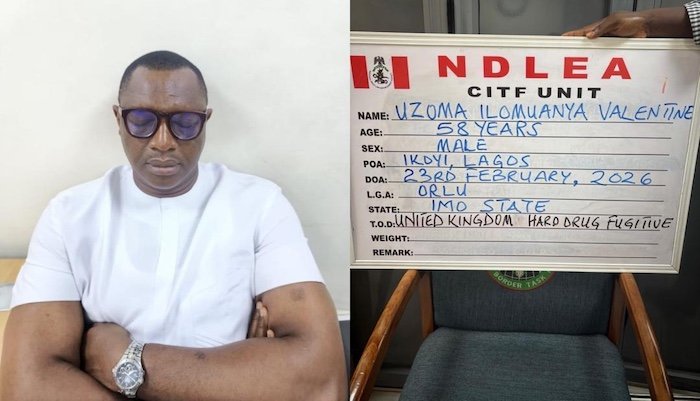
Justice Ayokunle Faji of a Federal High Court, Lagos, has ordered the extradition of convicted drug offender, Uzoma Valentine Ilomuanya, also known as Val, Valentine Ilomuanya and Henry Ilomuanya, to the United Kingdom to serve a 66-month prison sentence imposed on him by a British court for drug-related offences.
In a judgment delivered on July 6, 2026, Justice Faji granted an application filed by the Attorney-General of the Federation (AGF) seeking Ilomuanya’s surrender under the Extradition Act, holding that all the statutory requirements for extradition had been satisfied.
The application, filed on March 6, 2026, was brought pursuant to the Extradition Act following a formal request by the United Kingdom for the return of Ilomuanya, who had been tried, convicted and sentenced by the Isleworth Crown Court after absconding while on bail.


The judge held that the Attorney-General established a prima facie case by presenting the necessary extradition documents, including a duly authenticated certificate of conviction, a warrant of arrest issued by the UK authorities, and diplomatic requests seeking the respondent’s surrender.
Justice Faji relied on the Supreme Court’s decision in Attorney-General of the Federation v. Princewill Ugonna Anuebunwa (2022), which sets out the conditions that must be fulfilled before a Nigerian court can order the surrender of a fugitive to another country.
He found that the UK request complied with the provisions of the Extradition Act and that the offences for which Ilomuanya was convicted were extraditable offences.
The court rejected Ilomuanya’s argument that the extradition request was defective because it was not personally signed by the Attorney-General of the Federation.
Justice Faji held that under Section 4 of the Law Officers Act, the Attorney-General could delegate the signing of official documents to officers in the Federal Ministry of Justice.
He further ruled that the presence of the seal of a law officer in the Attorney-General’s chambers on the court processes substantially complied with the law, adding that technical objections relating to signatures, seals and the failure to tick the signatory’s name could not invalidate the proceedings.
The judge also dismissed the respondent’s challenge to the authenticity of the UK conviction documents.
According to him, the certificate of conviction and other supporting documents bore original signatures and had been authenticated before a District Judge in the United Kingdom, thereby enjoying a presumption of authenticity.
He held that original public documents from a foreign jurisdiction do not require certification before being admitted in evidence where there is no proof challenging their validity.
Justice Faji equally rejected the argument that the extradition request was not made by the proper authorities.
He held that letters issued by officials of the UK Central Authority and the British High Commission in Nigeria constituted sufficient diplomatic requests under the Extradition Act.
According to the judge, principles of international comity require Nigerian courts to accord due recognition to official communications issued by competent foreign authorities in extradition matters.
On the respondent’s contention that there were pending criminal proceedings against him in Nigeria, Justice Faji held that the objection lacked merit.
He found that the earlier criminal charge pending against Ilomuanya in Nigeria had been discontinued by the prosecution before the extradition application was filed.
The judge ruled that the Notice of Discontinuance, filed on February 24, 2026, effectively terminated those proceedings, meaning there was no pending criminal charge capable of preventing his surrender under Sections 3(5) and 3(6) of the Extradition Act.
Justice Faji also dismissed the respondent’s argument that the 13-year period between his conviction in the United Kingdom and the extradition request made the proceedings oppressive.
He observed that Ilomuanya had absconded while on bail, left the United Kingdom without informing the trial court and was subsequently tried in absentia.
The judge held that a fugitive who deliberately evades justice cannot rely on the passage of time created by his own conduct to resist extradition.
“I do not however, see anything inordinate in sending a convict back to the place of conviction even if after 13 years as in this case,” Justice Faji held.
“What it means is that a duly convicted person who jumped bail must not be allowed to escape the long arms of the law.”
The court likewise rejected Ilomuanya’s claim that he was too ill to travel because he was receiving traditional medical treatment in Imo State and could not endure flights lasting more than two hours.
Justice Faji held that no credible medical evidence was produced to support the claim.
He noted that there was no report from any orthodox medical practitioner, no meaningful description of the alleged ailment and no particulars identifying the traditional medical practitioner purportedly treating the respondent.
The judge further observed that Ilomuanya failed to explain how he was able to travel from the United Kingdom to Nigeria if he was medically incapable of enduring long flights.
He stated that the medical defence appeared to have been advanced solely to frustrate the execution of the sentence imposed by the UK court.
Justice Faji stressed that Nigeria is under an obligation to honour its international treaty commitments on extradition and mutual legal assistance.
“The treaty obligations of Nigeria ought to be complied with and observed by all organs involved in law and order,” the judge held.
Finding merit in the Attorney-General’s application, Justice Faji granted the request and ordered the surrender of Ilomuanya to the United Kingdom to serve the sentence imposed on him by the British court.