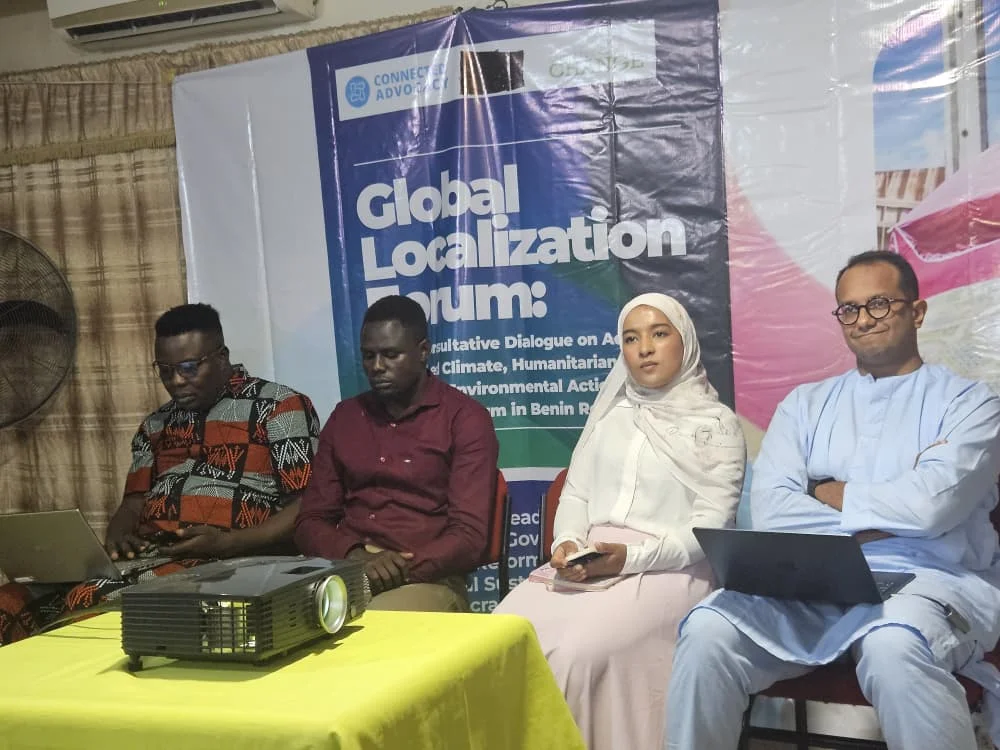
Governments, civil society organizations, and development partners adopted the Cotonou Declaration to advance locally led climate action, humanitarian response, environmental sustainability, and energy access across Africa during a consultative forum in Benin.
The communiqué on Thursday said the declaration was adopted at the Global Localization Forum held in Cotonou, Republic of Benin.
Tagged “Global Localization Forum: Africa Consultative Dialogue on Advancing Locally Led Climate, Humanitarian, Energy Access and Environmental Action,” the forum convened diverse stakeholders to strengthen community-driven development initiatives across the continent.

The forum was organised by Connected Advocacy alongside the Charter4Change Advocacy Working Group and Climate and Environment Working Group, bringing together institutions committed to advancing localisation and sustainable development.
Participants included government representatives, youth groups, indigenous communities, humanitarian organisations, academics, women-led organisations, faith-based institutions, private sector partners and grassroots movements from across Africa and beyond.
They reaffirmed commitment to placing communities at the centre of decision-making, financing, implementation, monitoring, and accountability, recognising local actors as critical drivers of sustainable and inclusive development.
Participants identified climate change, biodiversity loss, environmental degradation, conflict, displacement, food insecurity and energy poverty as interconnected challenges requiring coordinated, community-driven responses and stronger institutional support systems.
They emphasised that lasting solutions required empowering local communities, indigenous peoples, women and young people to lead interventions affecting their lives, livelihoods, resilience and long-term sustainable development.
The declaration called for increased direct financing to local organisations and community institutions, while advocating greater participation of women, youths, indigenous peoples and marginalised groups in governance.
Participants urged increased investment in community-led climate adaptation and resilience initiatives, while calling for expanded access to renewable energy and equitable energy systems across African countries.
The declaration further advocated stronger partnerships among governments, development partners, civil society organizations, academia, and the private sector to advance localization, accountability, and sustainable development goals.
It also called for policies promoting local ownership, transparency and accountability, while recommending mandatory capacity building for local actors across multiple sectors and development programmes.
Participants pledged to strengthen collaboration, encourage innovation, promote knowledge sharing and establish accountability mechanisms to ensure effective implementation of commitments contained in the declaration.
The forum endorsed an implementation framework comprising an Annual Africa Localisation Dialogue, alongside mechanisms designed to support learning, monitoring, collaboration and sustained stakeholder engagement.
Other mechanisms include a Continental Community of Practice, a Policy Monitoring and Accountability Mechanism and a Knowledge and Learning Platform to strengthen localisation efforts continent-wide.
Organisers described the declaration as a milestone in redefining relationships between global institutions and local communities, promoting equitable partnerships and greater community ownership of development processes.
“Localisation is not simply about shifting resources. It is about shifting power, strengthening trust and recognising communities as architects of their own development and resilience,” the forum secretariat said.
Earlier, Prince Israel Orekha, who delivered the welcome address, said the forum’s major outcome would be a joint communiqué and policy recommendations for stakeholders.
According to Orekha, the recommendations are designed to accelerate progress on Africa’s localisation agenda and strengthen community participation in development planning and implementation processes.
Dr Limam Boussif, President of the Youth Pioneer Organisation, Morocco, delivered a presentation focusing on localization, financing, and resource mobilisation strategies for sustainable development.
Onzima Dankan, acting executive director of the South Sudanese Refugees Association, Uganda, discussed barriers to direct funding for local actors and challenges affecting community organisations.
He also examined innovative financing mechanisms, donor commitments and accountability frameworks aimed at strengthening support systems and improving access to development resources locally.
Salma El Ferini, Head of Qualification, Cultural, Artistic and Sports Affairs, Youth Pioneer Organisation, Morocco, highlighted experiences and lessons from frontline communities.
She also spoke on youth and women’s leadership in climate and humanitarian action while emphasizing the importance of indigenous knowledge systems in development.
Juliet Eyokia, Refugee Engagement and Policy Influencing Coordinator at Woord en Daad, Uganda, moderated the dialogue, while Chineye Patrick-Biose co-moderated discussions throughout the forum.
Prof. Richard Adjaye of the Education Centre, Ghana, emphasised the importance of capacity development for local actors, while advocating stronger institutional support mechanisms.
Rokhaya Sane of USOFRAL, Senegal, highlighted practical approaches to innovative networking and collaboration aimed at strengthening localisation efforts across African communities and institutions.
Other contributors included Bakary Makalo of United Youth for Sustainable Development, The Gambia; Esther Atar, and Oluwayomi Oyebanji, who discussed private sector participation.
The organisers thanked partners, speakers, volunteers, development organisations and participating institutions for supporting the forum and contributing to discussions on localisation and sustainable development.
They urged governments and development partners to translate the declaration into concrete actions that would advance equitable, inclusive and community-led development across Africa for future generations.