

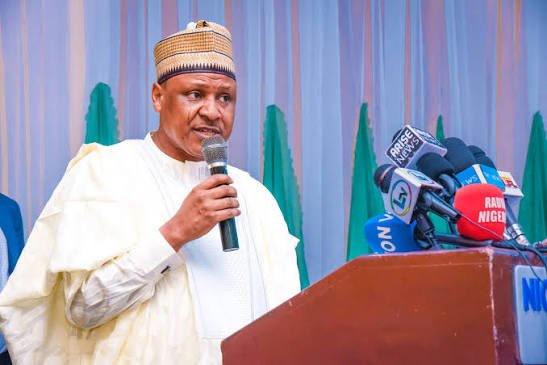
The federal government on Monday launched the “Hire from Nigeria” campaign to market and showcase the country’s skilled talents to the global market.
The Minister of Information and National Orientation, Mohammed Idris, at a news conference on the official launch of the campaign in Abuja, said that the initiative would create job opportunities.
Idris said that the initiative would also create business opportunities without requiring Nigerians to cross international borders.


He described the initiative as an important step toward positioning Nigeria’s skilled talents and human assets at the centre of the country’s economic engagement with the global community.
He said the federal government would leverage the campaign to communicate directly with employers, investors and businesses around the world about the quality and availability of Nigerian talent.
According to him, the campaign will affirm that Nigeria is open for business and has talented people ready to compete, collaborate and contribute meaningfully to the global marketplace.
Idris said the initiative would also communicate directly with young Nigerians and remind them that opportunities in the modern economy were no longer restricted by geographical boundaries.
He noted that young Nigerians would not necessarily have to leave the country to participate in the global economy, provided they had the necessary skills, infrastructure, professional standards and access to international markets.
“With the right skills, infrastructure, professional standards, and access to markets, Nigerians can live and work and earn here at home, while providing valuable services to clients and employers worldwide,” he said.
The minister explained that such an arrangement would enable Nigeria to benefit from foreign exchange inflows, tax revenues and an expanded skills and knowledge base.
He said the “Hire from Nigeria” campaign represented a practical expression of President Bola Tinubu’s Renewed Hope Agenda, particularly with focus on job creation, economic diversification, skills development, global integration and youth empowerment.
Idris said under the President’s vision and leadership, the federal government had unveiled a strategy to make Nigeria a major hub for talent and services exports.
He said the strategy had an ambition of creating one million export-linked jobs over a five-year period.
The minister said the task before the government and its partners was to transform the ambition into concrete opportunities for Nigerians, adding that the “Hire from Nigeria” campaign would be at the vanguard of the effort.
He, however, stressed that achieving the objective would require close cooperation between government and the private sector, training institutions and employers, technology companies and young professionals.
The minister also emphasised the importance of strengthening Nigeria’s connection with international markets to ensure that local talents could access employment and business opportunities globally.
Idris said the future of the Nigerian economy would increasingly be driven by the talent, creativity, skills and productivity of the country’s people.
He described the message behind the campaign as simple, saying Nigeria was ready to compete on the global stage and Nigerian talent was ready to work.
“The world should look to Nigeria,” he said, stressing the readiness of the country’s workforce to participate in the global economy.
Idris commended the Minister of Industry, Trade and Investment, Dr Jumoke Oduwole, the Minister of Education, Dr Tunji Alausa, and other partners for their contributions toward making the campaign a success.
On his part, Alausa said the initiative was designed to market Nigeria’s workforce to the world and connect skilled Nigerians with employment opportunities available internationally.
He explained that the campaign had three major dimensions comprising the demand side, supply side and partnership side.
According to him, the demand for skilled workers already exists across the world, particularly in technology-related fields, while government and its partners are working to ensure that Nigerian youths are equipped to take advantage of those opportunities.
Alausa cited 2025 UNESCO data indicating that about 2.3 million vacancies were available globally across seven technology-related job areas.
He said software development and development methodologies accounted for almost 250,000 vacancies globally, while cybersecurity had about 170,000 vacancies.
The minister added that IT automation had about 16,000 vacancies, artificial intelligence and machine learning had approximately 72,000 vacancies, while natural language processing had about 14,000 vacancies.
He further identified cloud computing as another area with about 17,000 vacancies globally, stressing that the figures demonstrated the enormous opportunities available to skilled Nigerians.
Alausa said the government’s objective was to scale up the skills of Nigerian youths so they could remain in the country while securing jobs and serving clients across the world.
He said the government was already working on the supply side through initiatives such as the Digital Technology Academy and the 3 Million Technical Talent programme.
According to him, 35,000 Nigerians would be trained over a six-month period under the Digital Technology Academy, with the government providing funding for international certification.
He said the beneficiaries would obtain certifications through platforms and institutions including Coursera, AWS, Microsoft and Huawei, among other international certification bodies.
Alausa said the government had purchased the necessary licences for the training and certification programmes as part of efforts to produce a globally competitive workforce.
He noted that Nigeria was already experiencing shortages of skilled workers in some areas, including fintech, even as many young Nigerians remained unemployed in spite of possessing university degrees.
The minister said the campaign would therefore focus on making Nigerian youths industry-relevant, globally competitive and capable of securing and retaining jobs in the international labour market.
He said the initiative would open opportunities for citizens to acquire relevant skills, obtain certifications and apply for jobs available across the world while remaining in Nigeria.
Also speaking, Oduwole said discussions about Nigeria’s exports had for decades focused largely on physical products such as crude oil, agricultural produce, solid minerals and manufactured goods.
She noted, however, that the global economy had changed significantly, with knowledge, skills, creativity and professional services now capable of crossing borders without the movement of physical goods.
Oduwole described “Hire from Nigeria” as a model of public-private collaboration involving the Federal Ministry of Industry, Trade and Investment, the Federal Ministry of Education, the National Talent Export Programme, the Bank of Industry’s iDICE programme and domestic and international private-sector players.
She said the initiative was designed to position Nigeria as a preferred global source of skilled talent and digitally delivered services, thereby expanding opportunities for Nigerian youths and strengthening the country’s participation in the global services economy.




