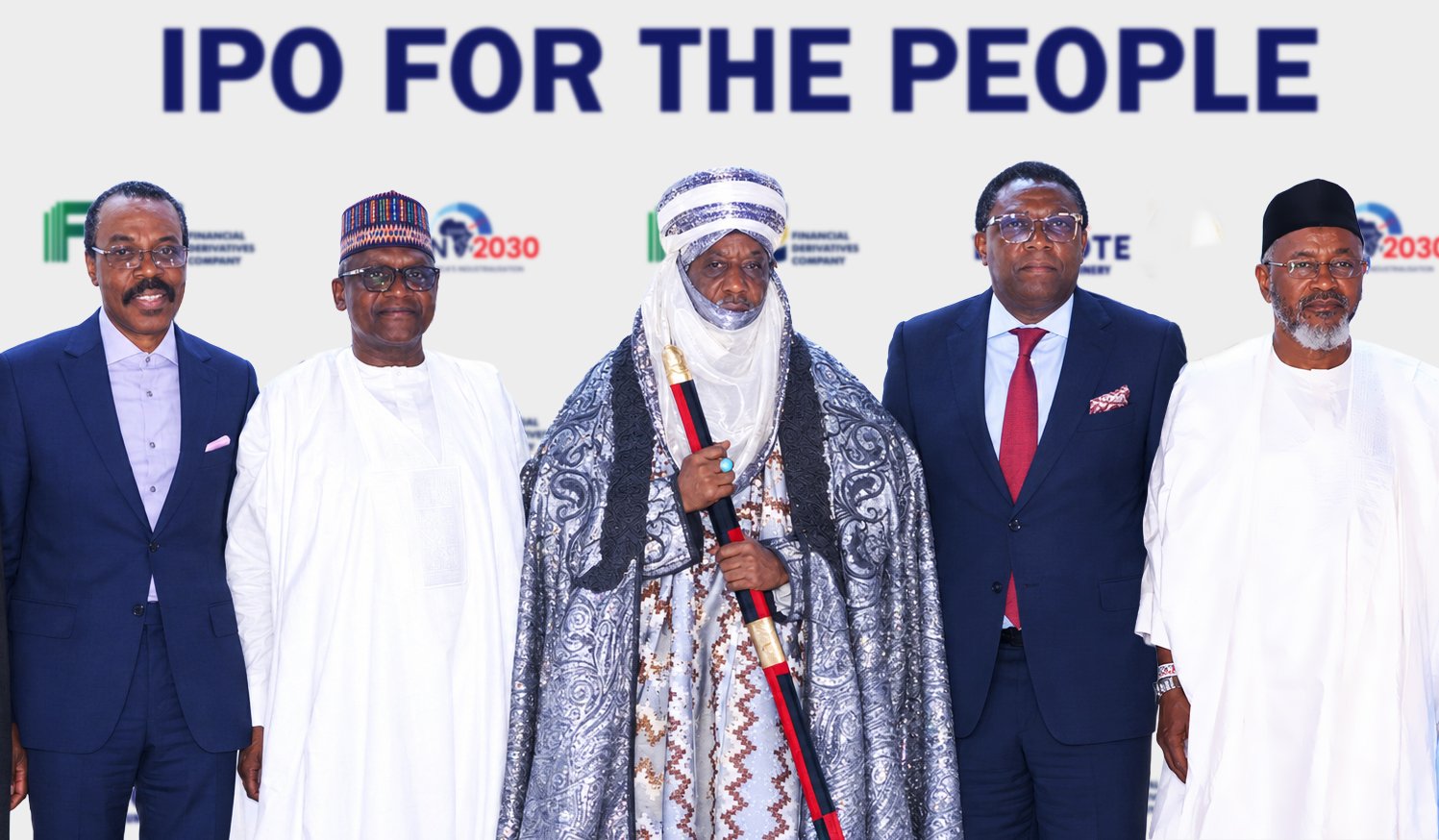
The Emir of Kano, His Royal Highness Khalifa Muhammadu Sanusi II, has urged individuals, entrepreneurs and businesses across Kano State to take advantage of the Dangote Petroleum Refinery and Petrochemicals Limited Initial Public Offering (IPO), describing equity ownership as a powerful vehicle for long-term wealth creation and economic empowerment.
Speaking at the Dangote Refinery “People’s IPO” sensitisation roadshow in Kano, the revered monarch said Kano’s rich history of commerce, enterprise and investment positioned its people to benefit significantly from participation in the capital market.
Sanusi noted that he had closely followed the evolution of the Dangote Group from its formative years and described the refinery as the culmination of a long-standing vision to produce in Nigeria the products required to serve its vast population.

Reflecting on his early career as a Credit Risk Management Officer at United Bank for Africa (UBA) in the late 1990s, he recalled engaging with Aliko Dangote at a time when the company was transitioning from trading and importation into large-scale manufacturing.
According to the Emir, what many initially viewed as an unusual strategy of using short-term financing to pursue long-term industrial investment was, in reality, evidence of Dangote’s determination to build productive capacity and reduce Nigeria’s dependence on imports.
He explained that the industrial vision was based on a simple but compelling economic principle: producing locally the goods Nigerians consume daily rather than importing them from overseas.
“Somebody needs to produce the petrol for your cars, somebody needs to produce the cement for your houses, somebody needs to produce the food that you eat. We are importing these things from Asia, Europe and America. Our strategy is to produce those things here,” he recalled.
The Emir described the Dangote Refinery as a landmark project capable of transforming Nigeria’s economic structure, particularly its long-standing dependence on imported petroleum products despite being one of Africa’s leading crude oil producers.
Drawing from his experience as a former Governor of the Central Bank of Nigeria, Sanusi noted that fuel imports had historically exerted substantial pressure on the country’s foreign exchange reserves, as Nigeria earned foreign exchange from crude oil exports only to spend a significant portion importing refined products.
“What Aliko has done is disrupt that model,” he said, noting that domestic refining would not only reduce import dependence but also position Nigeria as an exporter of refined petroleum products.
He pointed to the refinery’s growing international relevance, citing reports of European airlines purchasing aviation fuel from the facility during disruptions linked to the Strait of Hormuz crisis, a development he said demonstrated the refinery’s capacity to serve global energy markets.
Addressing concerns about market dominance, the Emir argued that the solution was not criticism but increased investment in productive industries.
“There is no monopoly if a monopoly is not protected by law. Anybody who wants to build a refinery, anybody who wants to raise $22 billion, invest and go through what Aliko went through is welcome to do so,” he stated.
Sanusi further encouraged Nigerians to channel investments towards productive ventures capable of generating jobs, value and economic growth rather than focusing primarily on speculative activities or overseas assets.
He described the Dangote Refinery IPO as a unique opportunity for Nigerians to become part owners of one of Africa’s most significant industrial projects.
“It is the shareholders who own it. It is the shareholders who take the returns. It is the shareholders who own the profits,” he said.
While encouraging participation, the Emir advised prospective investors to invest responsibly and maintain a long-term perspective, cautioning against committing funds required for essential family obligations.
Calling on Kano residents to seize the opportunity, he declared: