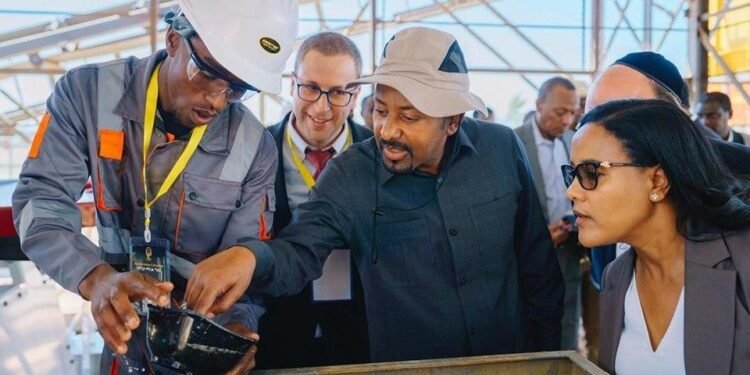
Ethiopia has opened a national precious-metals refinery outside Addis Ababa, giving it the capacity to process more than 600 tonnes of gold, silver and other precious metals a year. The government hopes to keep more of the work, jobs and income that come after gold is mined.
But the bigger ambition reaches beyond Ethiopia. With domestic gold output well below the refinery’s stated capacity, Addis Ababa is counting on business from neighbouring countries. That will mean convincing miners and traders that processing their gold in Ethiopia is worth changing established routes to market.
Prime Minister Abiy Ahmed inaugurated the National Precious Metals Refinery at the Bole Lemi Special Economic Zone on October 10, according to the Ethiopian News Agency.


The facility was developed by Ethiopian Investment Holdings and international partner Sam Precious Metals, according to reporting on the joint venture. Abiy said the Ethiopian side holds 51 percent of the project, leaving 49 percent with its international partner.
The refinery is intended to assess purity, process precious metals and produce bullion for export. Abiy believes it can also support jewellery businesses and create skilled jobs. Those benefits, however, will depend on how much work the plant actually attracts.
The scale of the project becomes clearer beside Ethiopia’s own mining figures. Mines Minister Habtamu Tegegne said the country produced 44 tonnes of gold in the 2025/26 fiscal year, earning $5.65bn from the metal, according to official figures reported in August.
That 44-tonne output is not directly comparable with the refinery’s 600-tonne-plus capacity, which covers several precious metals. Nevertheless, the figures show why regional business matters to the government’s plans.
Ethiopia’s Government Communication Service says the plant is intended to take gold from East African and other African markets for refining, testing and sale. The announcements reviewed do not establish how much metal it is already processing or identify confirmed regional supply contracts.
Across Africa, governments are trying to keep more mineral processing closer to the mines. In September, Burkina Faso inaugurated a refinery with an initial capacity of 164 tonnes of gold a year. Guinea has moved to prohibit exports of unrefined gold as it backs domestic processing.
The attraction is easy to understand. Refining can bring fees, specialist skills and supporting businesses into producing economies. But it does not make the underlying gold vastly more valuable simply by changing where it is processed. Costs, reliability and access to buyers still matter.
For Ethiopia, that includes meeting the quality and responsible-sourcing expectations of international bullion markets. The London Bullion Market Association’s Good Delivery standards illustrate how demanding that process can be. The inauguration itself is not evidence of such accreditation.
The October launch also settles an earlier question. In July, Africa Briefing reported that Ethiopia’s proposed June refinery opening had passed without official confirmation. The government has now confirmed the inauguration, the site’s location and its stated processing capacity.
What comes next will be less visible than the opening ceremony. Ethiopia will need dependable supplies, competitive charges and buyers who trust the finished bullion. It has built a refinery with room to serve a much wider market. Now it needs that market to turn up.