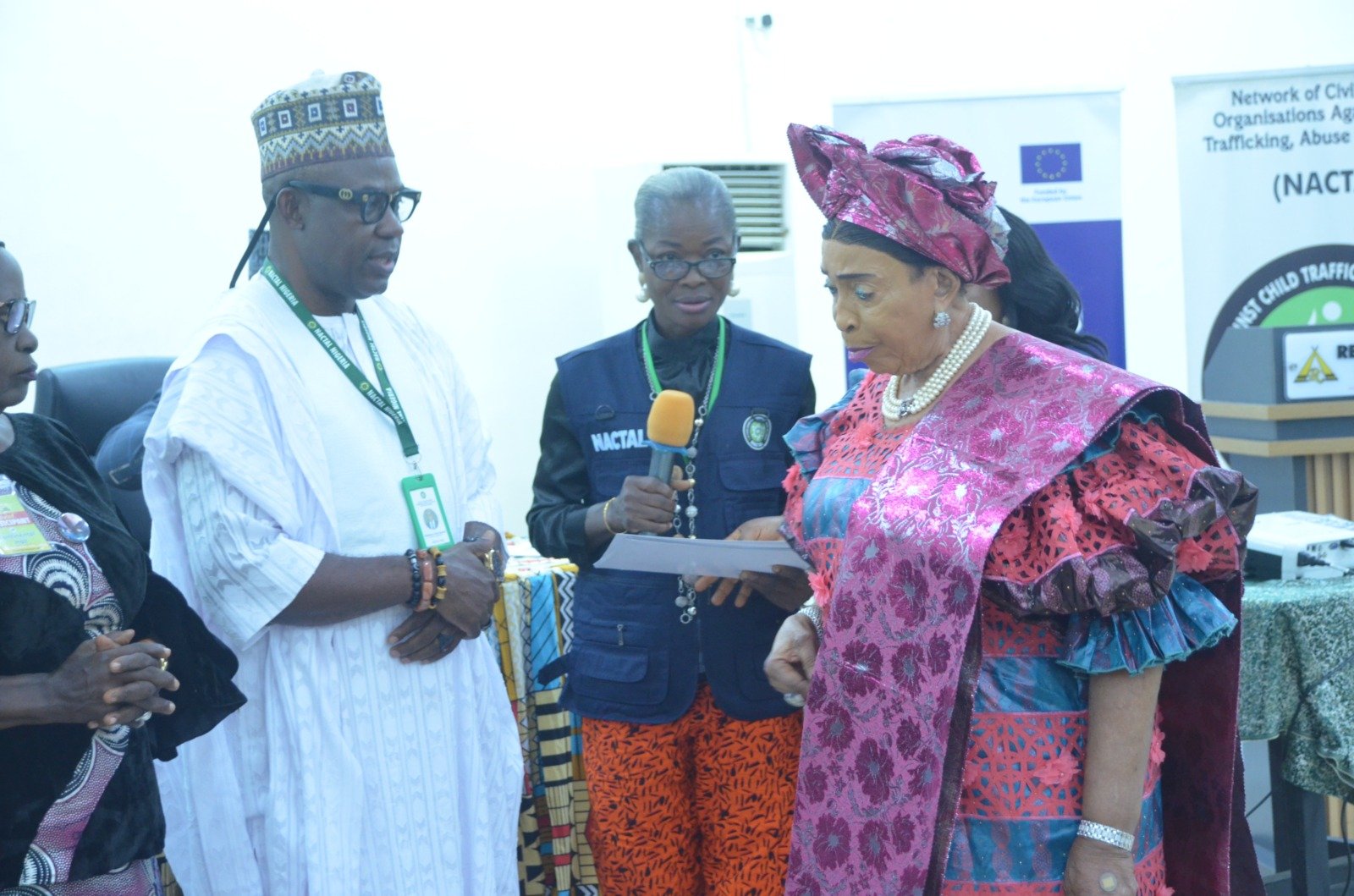
Osita Osemene, a survivor of irregular migration through Libya, was inaugurated as the fourth national president of the Network Against Child Trafficking, Abuse and Labour (NACTAL), pledging to strengthen the organization’s fight against human trafficking, child abuse, and exploitation.
At the inauguration in Abuja, Amina Titilayo Atiku-Abubakar, chairman of NACTAL’s board, presented Osemene with his certificate of leadership and urged him to build on the achievements of his predecessor, Abdulganiyu Abubakar.


She said Osemene’s experience as a survivor could give him a deeper understanding of the challenges faced by victims and strengthen his commitment to protecting vulnerable people.
Atiku-Abubakar commended the outgoing president for his dedication and inclusive leadership, urging Osemene to maintain strong relationships with the network’s partners and work closely with his team. She also called for a smooth transition, emphasising the need for the outgoing leadership to introduce his successor to key stakeholders to ensure continuity.
NACTAL’s development partners and other stakeholders reaffirmed their commitment to supporting the incoming administration.
Javier Leon, deputy team leader at FIAP, urged civil society organisations (CSOs) not to relent, despite the limited public recognition and media attention their work often receives, because human trafficking statistics represent real people, families and communities whose lives have been devastated by exploitation.
He commended the organisations for listening to victims, providing shelter and other interventions, and defending survivors who might otherwise lack support.
Ambassador Catherine Udida, director of the Migrant Affairs Department at the National Commission for Refugees, Migrants, and Internally Displaced Persons (NCFRMI), expressed confidence in the new administration.
She also condemned the reported treatment of Nigerians by Ghanaian authorities before their recent repatriation to Nigeria, urging NACTAL’s new leadership to support efforts to secure justice for those affected.
Amarachi Chike-Jerry, project manager at the International Centre for Migration Policy Development (ICMPD), reaffirmed the organisation’s partnership with NACTAL and encouraged the incoming leadership to seek technical assistance and other support when necessary.
Agatha Kolawale, project director at the International Labour Organization (ILO), also pledged continued support, reflecting on her association with NACTAL from its inception.
The outgoing president, Abubakar, congratulated Osemene and urged him to approach the office with boldness. He expressed confidence in his successor, citing his experience as a survivor and his longstanding involvement in civil society work.
Five-point agenda
In his inaugural address, Osemene pledged to build a stronger, more inclusive, transparent and sustainable NACTAL, with a focus on combating human trafficking, child abuse, exploitation and unsafe migration.
Under what he described as his Consolidation and Scale Agenda, he outlined five priorities: capacity building and economic empowerment for member organisations; transparency and inclusion; institutional sustainability; counter-trafficking and accountability; and evidence-based programming and regional leadership.
He said his administration would strengthen member organisations through training, mentorship, technical assistance and improved access to funding, with particular attention to emerging and survivor-led organisations.
To promote accountability, Osemene pledged to introduce quarterly activity reports from member organisations, state coordinators and zonal coordinators. He also announced plans to convene an annual human trafficking conference to review interventions and assess progress across the country.
Working with NACTAL’s National Executive Council, the National Agency for the Prohibition of Trafficking in Persons (NAPTIP), and other stakeholders, he said the network would promote more reliable human trafficking data to improve coordination, advocacy, programme planning and policy decisions.
Survivors at the centre
Osemene said survivors would be central to NACTAL’s interventions, stressing that they should be recognised not merely as beneficiaries but as rights-holders and active participants in decisions affecting their lives.
He pledged to advocate access to safe shelter, psychosocial support, healthcare, legal assistance, education, skills development and sustainable livelihoods. He also promised to strengthen survivor-led organisations and expand their role in shaping interventions.
The new president further pledged to promote the inclusion of persons with disabilities in NACTAL’s programmes, leadership processes and advocacy, including through accessible communication and support services.
He disclosed that he had begun an organisational capacity assessment of survivor-led organisations before assuming office. The findings, he said, would guide future capacity-building programmes and the provision of technical support.
Osemene called on government institutions, development partners and the private sector to deepen their collaboration with NACTAL, pledging to lead with integrity, transparency, fairness and accountability.
He said the success of his administration would depend on unity among members, stronger partnerships and measurable results, with the ultimate aim of expanding NACTAL’s impact across Nigeria and West Africa.