With exactly 50 days to go before Nigerians return to the ballot, the Independent National Electoral Commission (INEC) is about to face its first real examination ahead of the 2027 general elections.
On Saturday, November 28, from 8:30 a.m. to 2:30 p.m., the Commission will roll out its Bimodal Voter Accreditation System (BVAS) and electronic results upload technology across 17,676 selected polling units nationwide.

It is a mock exercise. But no one in INEC is treating it as a rehearsal without consequences.
Two polling units in each of the country’s 8,838 registration areas will be tested, giving the Commission a nationwide snapshot of how its machines, its network, its personnel and its procedures will hold up when it matters most — on January 16, 2027, for the presidential and National Assembly elections, and on February 6 for governorship and State Houses of Assembly elections.
The question hanging over Saturday is simple and brutal: Has INEC learnt from 2023?
The mock accreditation is unfolding in the shadow of the last general elections, when BVAS largely worked for accreditation but the failure to upload presidential results to the INEC Result Viewing Portal (IReV) in real time became the defining controversy of the polls.
That failure, and the allegations that followed it, still shape how millions of Nigerians view the Commission.
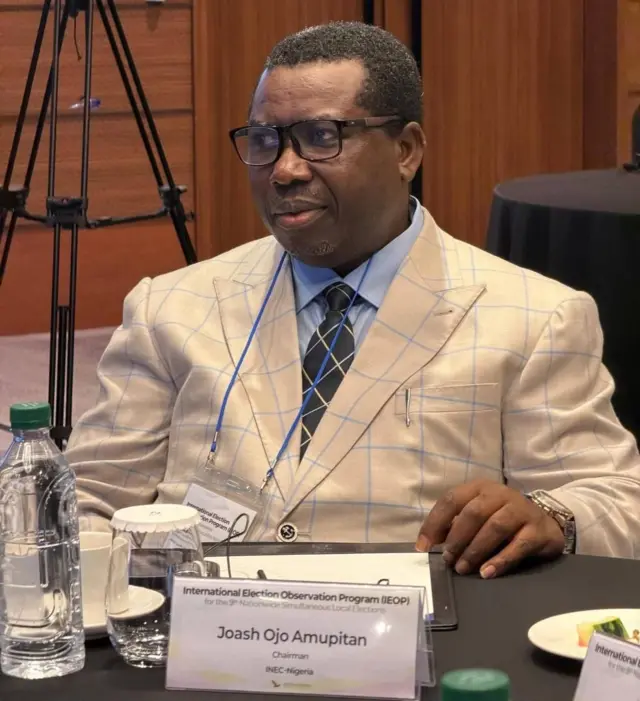
INEC Chairman, Joash Amupitan, has described Saturday’s exercise as a critical part of preparations. His Director of Voter Education and Publicity, Victoria Meci, was even blunter about why it cannot wait.
“We don’t want to wait till the elections before we test the ruggedness, readiness and functionality of the system,” she said on Channels Television’s Sunrise Daily.
The Commission says it has lowered the accreditation threshold to 850 voters per BVAS device, with extra machines for polling units with larger populations. It will also test electronic upload to IReV, though Meci conceded that transmission will still depend on network availability—the same vulnerability that haunted 2023.
INEC says it has also introduced additional technical safeguards to block inaccurate results and figures reflecting over-voting from being uploaded to IReV.
Saturday will show whether those safeguards work in the field, not just on paper.
—A 100-Million-Voter Election—
The scale of what INEC is preparing for is staggering.
The Commission now says it is managing a verified national register of more than 100 million voters, after cleaning over 1.6 million invalid, duplicated and deceased records from a previous register of about 103 million.
Amupitan disclosed the figures on Wednesday at a meeting with Resident Electoral Commissioners from the 36 states and the Federal Capital Territory. The clean-up, he said, followed the use of an Automated Biometric Identification System and a statutory claims-and-objections audit.
Three phases of Continuous Voter Registration (CVR) since 2025 attracted more than 11 million registrations, with over 10.77 million new registrants retained.
During claims and objections, the Commission received about 311,000 complaints, of which about 232,000 were found genuine and addressed.
“By the time we are putting the verified and cleaned-up register together, the national voters’ register is reduced from 103 million to 100 million,” Amupitan said.
The register also captures 232,658 persons with disabilities, who will require accessible polling arrangements and assistive materials.
Before the clean-up, Lagos led with 7,488,633 registered voters, followed by Kano with 6,570,276 and Kaduna with 4,662,640. The rest of the top 10 were Katsina (3,876,051), Rivers (3,736,434), Oyo (3,588,111), Delta (3,525,988), Benue (3,057,225), Ogun (3,037,981) and Bauchi (3,012,547).
Nigeria now has 176,846 polling units across 8,809 wards. INEC expects to deploy more than 1.41 million ad hoc personnel, and says it has deployed 57,000 newly procured BVAS devices nationwide.
That is the machine INEC must make work on election day. Saturday is its dress rehearsal.
—Trust Is The Real Ballot—
Beyond machines, INEC is fighting a credibility battle.
A former Resident Electoral Commissioner, Mike Igini, captured the mood on Channels Television’s Politics Today, arguing that the 2023 transmission failure did lasting damage.
“Now, in 2023, what worked and what broke public confidence? The BVAS worked. But what broke confidence, which has created a liability and a cloud of distrust that the current leadership is suffering, was the fact that there were three elections, same day; only one could not be transmitted, which was the presidential,” Igini said.
“That was what evaporated public trust and confidence. Even people like us, who put out our integrity to explain to people, to give a clarion call to the Nigerian people, up till date I don’t have a clear explanation of what constituted that glitch.”
The numbers back him up.
A September 2026 survey by Yiaga Africa found that only 34 per cent of respondents were confident INEC would conduct credible elections, down from 45 per cent in previous surveys.
Yet 84 per cent said they were likely or very likely to vote — a sign that Nigerians have not given up on elections, even if they doubt the umpire.
But 61 per cent said fear of electoral violence could discourage them from participating, and only 49 per cent said they trusted BVAS and IReV.
That trust gap is what Saturday is really about.
—The Human Problem: People Are Afraid To Work For INEC—
Technology is only half the problem. The other half is people.
INEC recently disclosed that political violence is discouraging prospective ad hoc staff, particularly members of the National Youth Service Corps, from applying for election duties.
Its Director of Voter Education and Publicity, Victoria Eta-Mesi, said the Commission had not received enough applications to begin training, forcing a two-week extension of the recruitment deadline to December 3, 2026.
“We didn’t have the numbers that we require to train for the election,” she said.
The Commission has identified insecurity, logistics and results management as its major priorities, while also acknowledging that it is still awaiting the outstanding portion of its 2027 election budget.
—Why Saturday Matters—
The 2023 presidential contest remains the reference point for 2027. President Bola Tinubu of the APC polled 8,794,726 votes to defeat former Vice President Atiku Abubakar, then of the PDP, who scored 6,984,520. Peter Obi, then of the Labour Party, finished third with 6,101,533 votes, while Rabiu Kwankwaso, then of the NNPP, got 1,496,687 votes.
All four remain central figures in the calculations for 2027, raising the stakes for a process that must be seen to be free, fair, and transparent.
Saturday’s mock accreditation will not decide the election. But it will offer the clearest indication yet of whether INEC can translate procurement, planning and promises into a process that works for voters, officials and observers.
In the end, 2027 will not be judged by how many BVAS devices INEC bought, or how many polling units it mapped, or how clean its register looks on paper.
It will be judged by a simpler test: Can eligible Nigerians vote freely, have their votes accurately recorded, and see the results transparently accounted for?
Saturday is INEC’s chance to prove it has learnt from the past. The bigger test comes when the nation votes.